





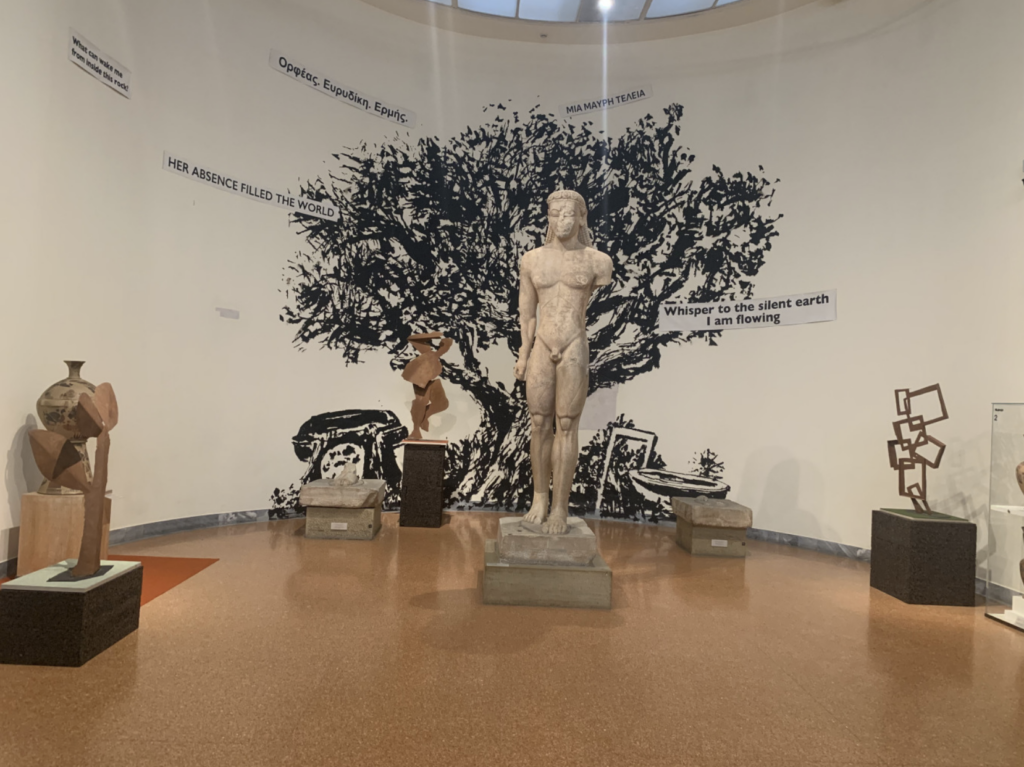
The artist’s contemporary works engage in a dialogue with antiquities from the National Archaeological Museum’s collections, offering a distinctive retelling of the legendary myth of Orpheus’s descent into the Underworld to bring Eurydice back.
“The National Archaeological Museum, the world’s most important repository of ancient Greek art, provides an ideal setting in which to revisit the journey of the myth of Orpheus, from its earliest representations to the most recent. Ancient and contemporary creations meet and engage in dialogue, offering a panorama of art spanning millennia. They demonstrate the enduring appeal of this ancient myth and its wider connotations in the present day,” Minister of Culture Lina Mendoni said.
She stressed that the exhibition was not an isolated event, as William Kentridge is also directing the production opening this year’s artistic season at the Greek National Opera: Monteverdi’s Orfeo, which premieres tonight. She also announced that a large-scale solo exhibition by the artist, entitled The Great Yes, the Great No, would follow in June at the National Museum of Contemporary Art.
“Our cultural institutions are working together, continually creating new synergies. In doing so, they express and demonstrate our policy priority: the continuous interaction between, and mutual enrichment of, our unique cultural heritage and contemporary artistic creation. This exhibition adds another important piece to the multifaceted contribution of the National Archaeological Museum, while attracting a diverse audience of curious and inquisitive visitors,” the minister emphasised.
For his part, William Kentridge expressed his deep satisfaction at having his work presented in Athens.
“The exhibition at the National Archaeological Museum is an extraordinary privilege for me. As an artist, I work in Johannesburg, and I have been working on the ancient Greek myth of Orpheus and Eurydice through Monteverdi’s opera. Being able to bring this myth from Johannesburg to this setting is something extraordinary,” he said.
He continued: “At the same time, having the exhibits I created — the drawings, projections and wall paintings — alongside some of the most wonderful works of art in the Western canon — the vases and sculptures — is a unique opportunity for me. There is no other city where this could happen. And, of course, as we know, Greek myths, Greek philosophy, tragedies, comedies and so much more have been deep in our souls ever since we learnt about them as children. So being able to engage in this dialogue with them, in the heart of modern Athens, is a privilege I deeply appreciate.”
He also noted that the exhibition had been made possible by the generosity of the Minister of Culture, who had been willing to imagine that contemporary works could coexist with antiquities in this particular museum.
“There would be many ministers of culture who would say, ‘No contemporary work in the heart of classical Athens.’ I am therefore deeply grateful to the minister because, through her approach, she provided the support needed for this undertaking,” he said.
At the heart of the exhibition, Kentridge develops a series of visual, material and conceptual groupings that move between stone and paper, excavation and drawing, stillness and movement, and survival and disappearance.
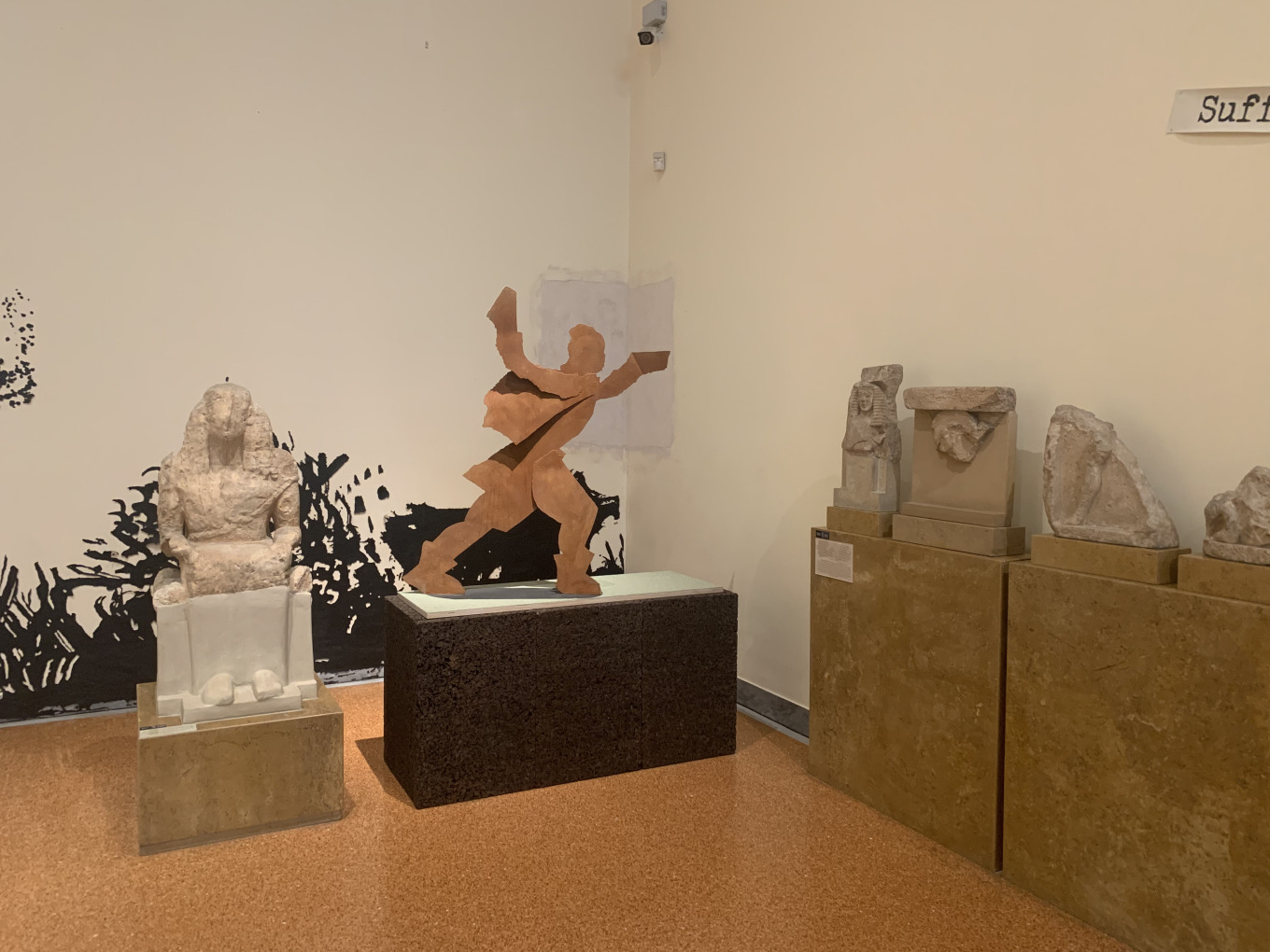
Among the works on display are steel figures painted rust-red from his 2026 work Frieze (13 rusted figures). These form hybrid silhouettes in which human figures merge with trees, clothing and tools, including megaphones and backpacks. The work continues the depiction of a procession and explores its associations with migration, displacement and collective history.
Paper silhouettes of trees also feature, drawing on Rainer Maria Rilke’s interpretation of the myth and linking Eurydice’s transformation to stone, soil and excavation.
The exhibition’s centrepiece is a diorama that employs a nineteenth-century theatrical optical technique known as “Pepper’s ghost”, introducing reflected moving images into a physical model. The projected figures appear within the constructed space as fleeting presences, bringing drawing, performance, cinema and theatrical illusion together in a single work.
The diorama creates a passage between visibility and disappearance, echoing Orpheus’s journey. The contemporary works engage directly with remarkable antiquities from the National Archaeological Museum’s collections, as well as selected loans, which explore connections with music, love and the passage from life to death.
These include a Corinthian red-figure calyx krater dating from around 400–375 BC, depicting Orpheus playing the lyre; an ivory lyre and surviving fragments from the tholos tomb at Menidi, dating from the fourteenth to thirteenth centuries BC; and a white kylix by the Pistoxenos Painter, dating from around 470 BC, depicting a Thracian woman attacking Orpheus. The latter is on loan from the Acropolis Museum.
Ask me anything
Explore related questions




