





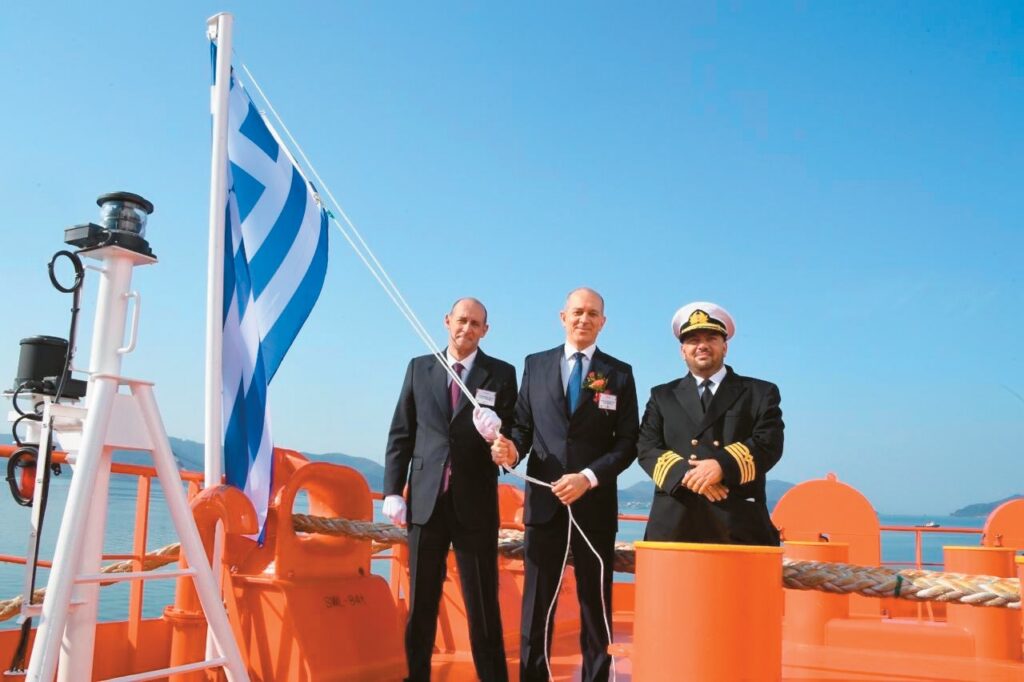
Approximately 6,500 Greek-controlled vessels sail the world’s oceans, but only 500 of them fly the Greek flag. The figures, cited by representatives of Greek shipowners at the recent Capital Link conference in Athens, illustrate one of the biggest contradictions in Greek shipping: while Greek shipowners are leading players in the global market, the national shipping register accounts for only a limited share of their fleet.
At the same time, powerful shipping families continue to choose the blue-and-white flag for their newly built vessels. From April to early October, at least seven newly built tankers belonging to the Angelicoussis, Tsakos and Angelopoulos groups were added to the Greek shipping register.
These deliveries highlight the confidence that these particular shipowners place in the Greek flag. At the same time, however, they bring back into focus the warning issued by Mr. Panos Laskaridis about the registry’s dependence on a limited number of major shipping families. The Greek flag has powerful supporters, but it cannot rely exclusively on them. The question is whether Greece can turn this longstanding support into a broader movement to bring vessels back under the national flag.
Maria Angelicoussis, head of the shipping group bearing her name, has clearly expressed her support for the Greek flag. Speaking last June, she said: “I am very proud of my decision to have the overwhelming majority of our ships flying the Greek flag.”
More than 85% of the group’s vessels fly the Greek flag. This choice is particularly significant given the group’s size and international operations, with a strong presence in tankers, bulk carriers and LNG carriers. Ms. Angelicoussis’s support is not limited to statements. It is backed by new shipbuilding projects and investments in modern vessels.
Maran Tankers took delivery this summer of the Suezmax tankers Maran Menelaus and Maran Myrsini, each with a capacity of 155,500 dwt, while the Maran Melina, also 155,500 dwt, was added at the end of September. All three newly built vessels fly the Greek flag, confirming that the choice of the national registry is a consistent part of the group’s strategy.
Nikos Tsakos
Dr. Nikos Tsakos, founder and chief executive of Tsakos Energy Navigation (TEN), is also among the supporters of the Greek flag.
“There can be no major Greek shipping industry without a strong Greek flag, for national and geopolitical reasons,” he said in June.
The Greek shipowner has linked the presence of the blue-and-white flag on merchant vessels to Greece’s international standing and the preservation of its maritime tradition. This summer, TEN took delivery of the newly built shuttle tanker Anfield DP, with a capacity of approximately 154,000 dwt, which was entered in the Greek shipping register. At the same time, Mr. Tsakos announced that two more VLCCs under construction, Euroleague 26 and NY Knicks 26, would fly the Greek flag.
Dr. Tsakos made a particularly significant commitment regarding the future of the Greek flag during the 16th Annual Capital Link Operational Excellence in Shipping Forum in Athens.
While receiving the Capital Link Maritime Sustainability Award, which was presented to the Tsakos Group and the “Maria Tsakos” Foundation in recognition of their longstanding contribution to maritime education and support for seafarers, the Greek shipowner set an ambitious goal: to create the conditions that would enable all the group’s vessels to fly the Greek flag.
Addressing young students pursuing maritime education, he said: “What we would like to be able to do is train enough of you so that we can have the Greek flag on all our ships. This is a commitment I want to make.”
Mr. Tsakos made clear that strengthening the Greek shipping register is not primarily a financial issue, but a strategic choice of particular geopolitical importance.
“It is not a matter of economics. I believe that, in today’s geopolitical environment, it is of strategic importance for the 5,500 Greek ships to be able to fly the Greek flag,” he stressed.
At the same time, he acknowledged that achieving this goal requires more Greek seafarers, a substantial upgrade in training and new, unconventional ideas. He pointed out that modern ships are becoming increasingly technologically advanced, meaning that young officers need broader knowledge and skills beyond traditional seamanship.
His intervention carries particular weight because it links the future growth of the Greek shipping register to the development of a new generation of Greek seafarers. This is not an announcement that all the group’s vessels already fly the Greek flag, but a specific commitment to creating the conditions that would make this possible.
Anna Angelicoussis
Anna Angelicoussis is also contributing to the strengthening of the Greek flag through Pantheon Tankers Management.
On July 31, the company took delivery of the newly built Suezmax tanker Sea Topaz, with a capacity of 156,832 dwt, followed in early October by the Sea Quartz, with a capacity of approximately 157,000 dwt.
The second vessel was registered in Piraeus, with the process of raising the Greek flag completed through Greek maritime services in South Korea. This case highlights the importance of an effective presence by Greek authorities in Asia’s major shipbuilding centers.
The Angelopoulos family
Similarly, Arcadia Shipmanagement, whose interests are held by the Angelopoulos family, took delivery this summer of the newly built Suezmax tanker Aegean Miracle from HD Hyundai Samho shipyard.
With this addition, the company’s fleet numbers 17 Suezmax vessels, all of which fly the Greek flag. This reflects a consistent registration policy that is not limited to individual deliveries but characterizes the company’s overall operations.
Haris Vafeias
The issue of the Greek flag was at the center of the 16th Annual Capital Link Conference.
Mr. Haris Vafeias described it as a disgrace that, out of approximately 6,500 Greek-owned vessels, only 500 fly the Greek flag. He focused on the requirements for staffing these ships with Greek seafarers, which he considers an obstacle to attracting more vessels to the national register. He also stressed the need for young people to learn about the importance of shipping to the Greek economy while still at school.
Petros Pappas
Mr. Petros Pappas approached the issue from the perspective of administrative efficiency.
He argued that the Greek shipping register should operate around the clock, seven days a week, as competing international registries do. His point concerned the need to provide immediate service to shipping companies that manage vessels across different time zones and require continuous support.
Aristides Pittas
The contribution of Mr. Aristides Pittas was also of particular interest.
The Greek shipowner highlighted the strong position of Greek-owned shipping internationally, particularly in the European tanker and dry bulk carrier fleets.
His remarks added a crucial dimension to the discussion about the Greek flag: Greece has enormous commercial power at sea, but this strength is not reflected proportionately in its national shipping register.
The issue is not simply how many ships Greek shipowners control, but also what proportion of this activity is institutionally connected to Greece through the flag they fly.
Greek-owned shipping includes vessels controlled by Greek interests, regardless of the registry under which they are registered. By contrast, vessels flying the Greek flag fall under the jurisdiction of the Greek state as their flag state.
This distinction explains why Greece can dominate international ship ownership while facing significant challenges in expanding its national shipping register.
Antonis Kanellakis
Mr. Antonis Kanellakis presented a different perspective. He is the son of Anna Angelicoussis and, together with his brother Fragiskos, has taken over the reins of the group as part of the next generation.
He said that approximately 35 vessels belonging to the group fly the Greek flag and expressed satisfaction with its cooperation with the Ministry of Maritime Affairs and the Hellenic Coast Guard.
This positive assessment carries particular weight because it comes from a representative of companies with a substantial presence in the Greek shipping register.
At the same time, he acknowledged the shortage of Greek officers and argued that better pay and working conditions could help attract young people to the maritime profession.
Behind the discussion about the competitiveness of the Greek shipping register lies the availability of Greek seafarers. The staffing requirements of a large and continuously expanding fleet are difficult to meet with the available Greek workforce.
Strengthening the Merchant Marine Academies, upgrading their facilities, increasing opportunities for practical sea training and improving working conditions are all essential prerequisites.
The issue, however, is not limited to staffing ships. Greek officers have traditionally been an important source of personnel for shipping company offices, bringing ashore the experience they acquire at sea.
At the same time, the Greek shipping register must compete with flags such as those of Liberia, the Marshall Islands, Panama, Malta and Cyprus.
The speed of procedures, digitalization, availability of services and flexibility in staffing are decisive factors in shipowners’ decisions.
The seven recent deliveries of newly built vessels under the Greek flag this year demonstrate that the Greek shipping register remains an option for major shipping groups. They are not, however, enough to change the overall picture.
Greece’s major challenge is to create the conditions that will make the blue-and-white flag a competitive choice for more Greek shipowners, turning a greater share of their global maritime power into strength for the national shipping register.
Ask me anything
Explore related questions




