





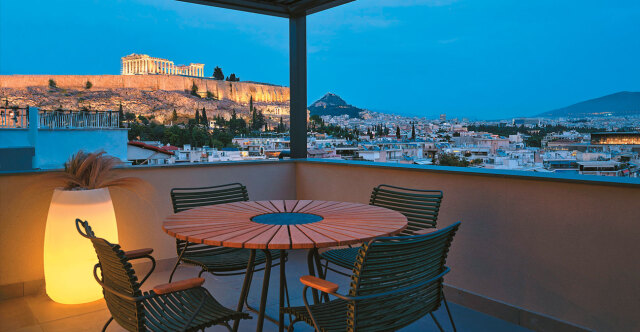
Greece is no longer the bargain property market created by the economic crisis. It has evolved into a destination for wealthy buyers and international investment funds, with the Athens Riviera, the Cyclades, and the Ionian Islands competing for a share of the Mediterranean luxury housing market. Foreign buyers are not simply looking for holiday homes with sea views. They are purchasing primary residences, investment properties, entire buildings, and luxury villas, combining tax advantages, expected returns, and quality of life.
The figures reflect both the market’s momentum and its differing rates of growth. According to Bank of Greece data, foreign investment in real estate reached €1.03 billion in the first half of 2026, creating the conditions for the figure to exceed €2 billion for the year as a whole. Interest in luxury housing is even stronger.
Greece Sotheby’s International Realty estimates that the total indicative value of properties for which purchase inquiries were submitted reached €6.11 billion in the six-month period. This represents a 35% increase compared with €4.51 billion in the corresponding period last year and is 19% above the five-year average. The figure does not represent completed sales, but rather expressed interest.
According to the company’s historical data, approximately 12% of inquiries lead to a property viewing, 11% of viewings result in a preliminary agreement, and 78% of preliminary agreements lead to a completed transaction. Ultimately, approximately 1% of the total value of inquiries is converted into sales. The median value of each inquiry increased from €2.3 million to €2.95 million, a rise of 28%. This indicates that interest is shifting toward more expensive homes, while part of the smaller-scale investment market is retreating.
Investment
The way properties are used varies according to the buyer’s budget and purpose. In the mid-market segment, investment considerations prevail. According to estimates by E-Real Estates, only 18% of foreign buyers intend to live in the property they purchase. Among Golden Visa holders, the figure falls to 6%, while 94% proceed to rent out their properties, primarily on a long-term basis.
In the luxury housing market, British buyers relocating their tax residence often seek primary homes on the Athens Riviera. Americans and Greek Americans combine personal use with investment returns, while many members of the Greek diaspora buy with a view to retirement or returning to Greece. On the islands, villas are often used by their owners for limited periods of the year and offered on the luxury rental market during the remaining months. In central Athens, property development is more heavily focused on hotels, serviced apartments, and residences for business executives.
In the luxury market, Greeks remain the largest group of interested buyers, accounting for 18.8% of inquiries. They are followed closely by the British, at 17.4%, and Americans, at 14.5%. Together, the three nationalities account for 50.7% of demand. The largest change has been recorded among British buyers, with the value of their interest increasing by 60%. A decisive factor has been the abolition of the UK’s non-dom tax regime in April 2025, which prompted wealthy UK residents to seek a new tax domicile.
Greece has its own tax regime for new tax residents, offering a flat annual tax payment of €100,000 on foreign-sourced income, subject to specific conditions and for a period of up to 15 years. The scheme, combined with political stability and living conditions, enhances the country’s appeal. Buyers associated with the non-dom regime accounted for 29% of the value of Sotheby’s network transactions in 2025. Of the relevant transactions during the 2024–2026 period, 53% involved British buyers and 12% American buyers.
The United States remains an important source of demand, despite its share declining from the five-year average of 21.8% to 14.5%. The value of inquiries from American buyers increased by 16%. In the broader housing market, according to property-search platform Spitogatos, Americans rank first among foreign buyers expressing interest in Greek real estate, with an average search price of €358,220. Particularly high growth rates have been recorded in inquiries from Spain, up 470%; South Africa, up 264%; the Netherlands, up 199%; and Belgium, up 101%, although these increases are based on smaller starting figures.
Demand in Central Athens
The composition of buyers in the capital’s historic center is different, with investment-oriented property development playing a more dominant role. According to estimates by the nationwide E-Real Estates network, presented by its president, Themistoklis Bakas, Israelis account for 18%–22% of foreign demand. They are followed by Turks, at 16%–20%; Chinese buyers, at 14%–18%; and investors from Lebanon and Arab countries, at 8%–12%. Israelis are particularly interested in entire buildings, Turks are seeking a European base and protection for their capital, while Chinese buyers—who played a leading role in purchases of small apartments through the Golden Visa program between 2017 and 2023—are now showing greater selectivity.
The market has also changed in terms of the types of investments being made. Instead of mass purchases of small apartments for short-term rentals, interest is growing in standalone buildings, small luxury hotels, furnished serviced apartments, and high-specification residences. Plaka and Thiseio attract buyers seeking expensive homes, Koukaki and the Psyrri area attract tourism-related investments, while properties with potential for capital appreciation are being sought in Kerameikos.
Interest from wealthy foreign buyers, including Lebanese investors, is also being recorded in Kolonaki and Mets. Budgets start at €180,000–€350,000 for small investors, reach €800,000 for mid-range buyers, and rise to €1 million–€5 million for property development companies. Larger institutional investors are considering investments ranging from €5 million to more than €50 million.
The most important emerging hub for luxury housing is the Athens Riviera. The development of Ellinikon, the “Apollo Hills” complex, and the redevelopment projects along the coastal front are creating a market with the characteristics of an international destination. Across the 44 active luxury property listings examined by Sotheby’s, the median asking price stands at €10,213 per square meter. Residences in branded developments currently under construction are being offered at even higher prices.
Buyers on the Athens Riviera are not necessarily looking for holiday homes. They often seek permanent or long-term residence, with access to the airport, international schools, services, and modern infrastructure. This is a different profile from that of buyers of island villas, who primarily choose a location and lifestyle.
Mykonos tops the list of asking prices, with a median of €10,938 per square meter and individual listings reaching €24,688. It is followed by the Athens Riviera and central Athens, at €9,489.
In the Ionian Islands, Lefkada reaches €9,130 per square meter, surpassing Paros, at €9,028. Corfu has a larger stock of luxury properties, with 70 active listings, a median price of €8,716, and some properties reaching €26,820 per square meter. In the northern suburbs of Athens, the median price stands at €5,273.
Across the more than 400 luxury listings examined, the median price is €8,333 per square meter, with the most expensive properties approaching €40,000.
The largest share of demand is concentrated at the top end of the market. Properties worth more than €5 million accounted for 70% of the total value of inquiries in the first half of the year, representing an annual increase of 45%. By contrast, demand for properties priced below €2 million increased by 18%.
Strong demand, however, does not mean that every expensive property sells easily. For completed sales in the sample, the median time from publication of a listing to an agreement was 238 days. Some 41% of transactions were completed within six months, a further 20% within one year, while the remaining 39% took longer.
Pricing has proved decisive. In a sample of 25 properties whose asking prices changed between 2025 and 2026, 72% of the adjustments were reductions, with a median decrease of approximately 8%.
Buyers carefully assess location, construction quality, energy efficiency, legal status, and renovation costs. They prefer move-in-ready homes, often fully furnished and equipped, with no additional work or outstanding issues.
Taxation is not Greece’s only advantage. Despite rising prices, the country remains competitive compared with other Mediterranean markets. According to Savills data for 2023, the average price of luxury housing in Athens was €10,800 per square meter, compared with €12,800 in Lisbon, €13,400 in Rome, and €14,600 in Milan.
The country’s improved credit standing also plays an important role, with investment-grade status and declining public debt strengthening the confidence of international capital.
Geopolitical… Brakes
The Golden Visa remains an additional incentive, but its influence is smaller than in the past. With the new thresholds set at €800,000 in high-demand areas and €400,000 elsewhere in the country, purchases have shifted toward more expensive properties.
New applications in the first half of 2026 fell by 44%, to 2,551 from 4,553 a year earlier. At the same time, of the transactions totaling €600 million carried out by Greece Sotheby’s since 2020, only 3.7% were linked to the Golden Visa program.
Other factors influencing buyers’ decisions include climate, security, international air connections, and the possibility of residing in a European Union country. For buyers from the Middle East and Turkey, Greece can also serve as a destination for geographical diversification and asset protection.
The performance of the market in the second half of the year will depend on the completion of major residential projects, the international economic environment, interest rates, and sellers’ ability to adjust prices to actual demand.
The geopolitical turmoil in March caused a temporary slowdown, but inquiries recovered from the end of that month. From April 10 onward, their number was 47% higher year-on-year, while their value was up 71%, according to Sotheby’s.
At the same time, the Bank of Greece had recorded a 23.9% decline in foreign direct investment in real estate during the first nine months of 2025, to €1.47 billion. The contrast shows that the market is not growing uniformly: demand for expensive properties is strengthening, while the smaller-scale investment market is facing greater pressure.
The conclusion is that Greece has secured a more established position on the international luxury housing map. The next challenge is not simply how many interested buyers the country can attract, but how many of those expressions of interest will turn into actual investments, at prices the market can sustain.
Ask me anything
Explore related questions




