





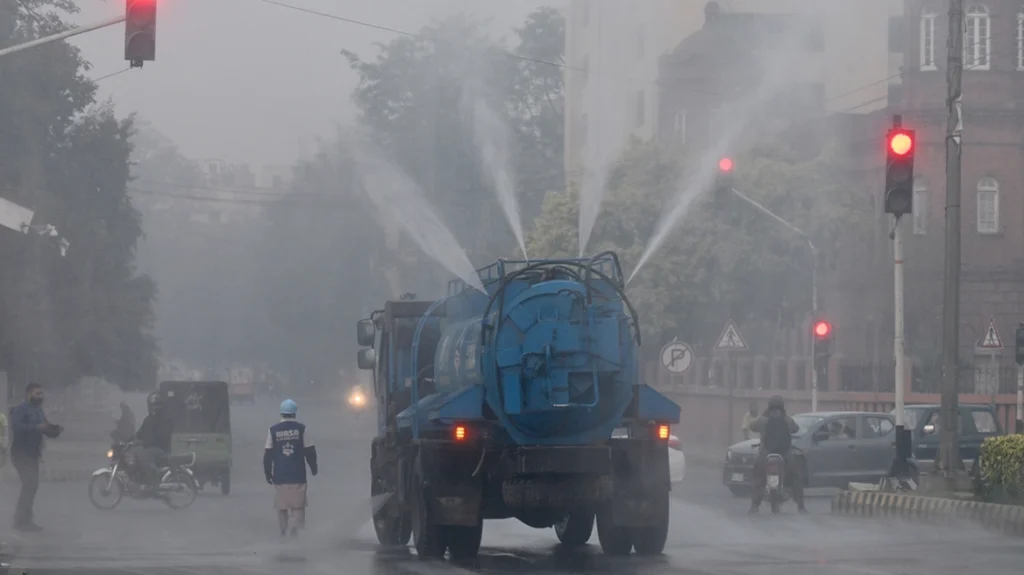
Air quality deteriorated rapidly today in parts of northern India and neighbouring Pakistan as the early-winter smog set in, making Lahore the world’s most polluted city and forcing authorities in New Delhi to impose restrictions to combat the toxic haze hanging over the capital.
Air pollution becomes a very serious problem in this region at this time of year, when cold, dense air traps emissions from vehicles, construction sites and the burning of agricultural waste, pushing pollution levels among the highest in the world and exposing residents to serious respiratory health risks.
Fireworks during the Hindu festival of Diwali, which falls on November 8 this year, make pollution in India even worse.
Early this morning, the Air Quality Index (AQI) in Lahore stood at 447, according to IQAir, a Swiss organisation that operates the world’s largest real-time air quality monitoring platform, based on the concentration of pollutants.
An AQI reading of up to 50 is considered good, with little or no health risk.
The concentration of PM2.5 particles in Lahore was 60 times higher than the annual exposure limit set by the World Health Organization.
What are PM2.5 particles?
The term PM2.5 refers to airborne particles with a diameter of 2.5 micrometres or less. They can penetrate deep into the lungs, posing a risk of fatal diseases and heart problems.
According to authorities, the sharp drop in temperature and light winds have affected air quality in Lahore.
The Pakistani government has stepped up action against brick kilns that violate environmental regulations, while continuing to urge farmers not to burn crop residue after harvesting.
In Delhi, the Air Quality Index (AQI) was lower, at 215, according to IQAir. India’s Central Pollution Control Board described air quality in the capital as “very poor,” with the AQI reaching a high of 332.
The readings from the Swiss and Indian organisations differ because they use different AQI scales and methodologies to calculate and classify air pollution levels.
On Monday, Delhi’s graded pollution-control measures came into force. These include restrictions on polluting vehicles, construction activities and the use of coal or firewood in restaurants, as well as an expansion of public transport services.
With the Diwali festival, which takes place over the weekend, expected to worsen pollution further, India’s Supreme Court has allowed the use of low-pollution fireworks for just three hours on both Saturday and Sunday.
Ask me anything
Explore related questions




