





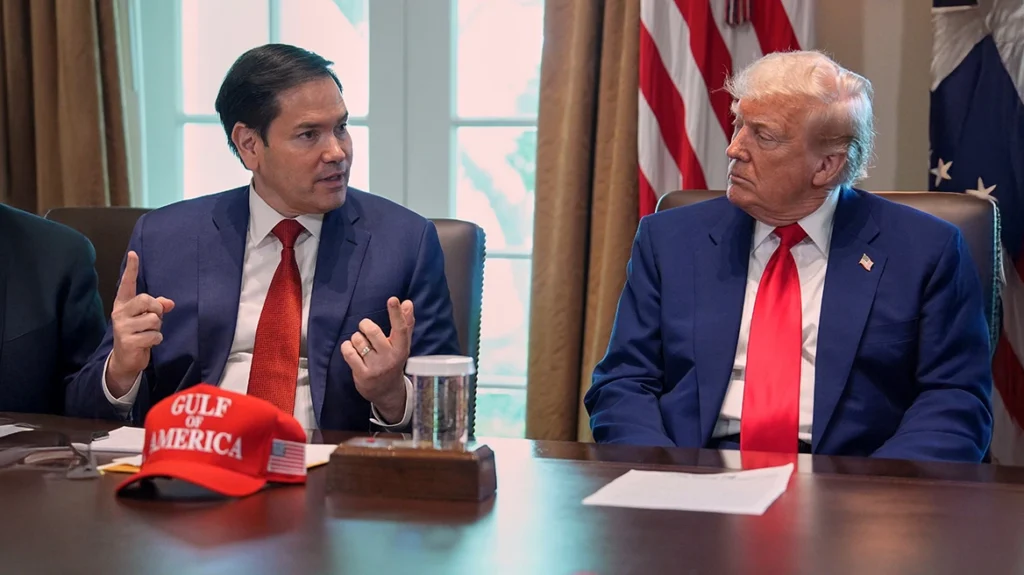
The involvement of US Secretary of State Marco Rubio in an espionage case that has caused turmoil at Nvidia has been revealed by The New York Times.
According to the newspaper, Rubio oversaw the drafting last spring of a top-secret memorandum informing senior members of the Trump administration that Jensen Huang, the chief executive of the technology giant, had a close relationship with a woman whom US intelligence agencies regarded as a Chinese spy.
The revelation, based on accounts from several people familiar with the matter, indicates that concerns over Huang’s relationship with Alice Huang had reached the highest levels of government at an early stage, while the Nvidia chief continued to exert significant influence on Donald Trump over artificial intelligence policy issues.
The Classified Memo and Intelligence from Surveillance
According to The Times, the memorandum drafted under Rubio’s supervision was based on classified intelligence gathered through electronic surveillance of Alice Huang.
The Chinese national was a senior executive at a Singapore-based company that purchased Nvidia’s advanced artificial intelligence processors and was under investigation over their possible illegal transfer to China.
US authorities had concluded that the woman, who, despite sharing the same surname, is not related to the Nvidia chief, had a close personal relationship with him and had been recruited to conduct espionage by China’s Ministry of State Security, the country’s main intelligence agency.
Marco Rubio’s involvement in the process of briefing the administration had not previously been known. The fact that the Secretary of State himself oversaw the drafting of the document underlines the seriousness with which senior US government officials viewed the matter.
Trump’s China Visit and Huang’s Initial Exclusion from the Delegation
Rubio’s memorandum was distributed to government officials with high-level security clearance before Donald Trump’s visit to China last May.
Sources for The New York Times, who spoke on condition of anonymity because of the sensitivity of the information, said that Jensen Huang was initially not included on the list of prominent business leaders and technology executives invited to accompany the US president. It remains unclear whether his initial exclusion was connected to the classified memorandum.
At the time, however, several administration officials were expressing concerns about the influence Huang exerted on Trump, particularly regarding the administration’s decision to maintain a relatively limited regulatory framework for artificial intelligence.
When Trump saw reports about the Nvidia chief’s absence from the delegation, he asked him to join the trip, with Huang meeting the presidential aircraft, Air Force One, during a stopover in Alaska.
Indeed, the US president had drafted a social media post in which he said it was his honour to travel with “the great Jensen Huang” and other business leaders to the “great country of China”. In the same post, he said he would ask President Xi Jinping, whom he described as “a highly respected leader”, to “open up” China so that these “brilliant people can work their magic”.
Trump Had Known for About a Year
The New York Times reported last month that Donald Trump had been briefed about the case around a year earlier.
US intelligence agencies possessed information obtained through electronic surveillance of Alice Huang and believed that she was working for Chinese intelligence services.
The surveillance revealed that she had a close relationship with a US citizen. When the relevant officials requested that his identity be disclosed, since the names of US citizens are generally protected in intelligence gathered through the surveillance of foreign nationals, it emerged that he was Nvidia’s chief executive.
Trump chose not to take any action at the time.
According to the report, the US president considers Nvidia’s processors to be of critical importance to US competition with China in the field of artificial intelligence. At the same time, he views the company’s success as a crucial factor in maintaining the momentum of the US stock market.
Admission of the Extramarital Relationship and Trump’s Response
On Sunday, Nvidia announced that it was launching an internal investigation into the matter after Jensen Huang admitted that he had been involved in a romantic relationship with Alice Huang.
The company clarified, however, that it had “no reason to believe that either national security or Nvidia’s confidential information had been compromised”.
In a message to employees, the company’s chief executive apologised for his behaviour. “I cheated on my wife. My actions hurt her and our children. There is no excuse for what I did. I am deeply sorry,” he said.
That same evening, Donald Trump was asked by journalists whether, following Huang’s admission, he regretted not having acted when he was briefed on the intelligence information. “No, I don’t think so,” he replied.
Alice Huang’s Links to the Semiconductor Industry
According to people who know her, Alice Huang speaks English very well and has developed relationships with senior figures in the artificial intelligence processor industry.
Her contacts include Jensen Huang as well as executives at Gigabyte, one of the largest companies assembling supercomputing systems using Nvidia technology.
It has not been established when she first met the Nvidia chief.
In 2024, around the time the two were photographed together with other industry executives at a bar in Taipei, Megaspeed, the company where she worked, began purchasing advanced artificial intelligence microprocessors worth several billion dollars in total.
Nvidia executives have maintained that Huang’s contacts with Alice Huang “were neither unusual nor unexpected”, but formed part of the professional meetings he holds with the company’s customers.
Nvidia has also stressed that customers such as Megaspeed do not have access to confidential business information.
$2 Billion in Purchases and Suspicions of Smuggling into China
Megaspeed, despite effectively maintaining a small office with a limited local presence in Singapore, had purchased Nvidia products worth $2 billion in recent years.
The company builds data centres in South-East Asia that lease their computing power to Alibaba, the Chinese technology giant.
However, US authorities suspect that Megaspeed has helped to illegally transfer advanced Nvidia processors to China, despite US export restrictions on such technologies.
Ask me anything
Explore related questions




