





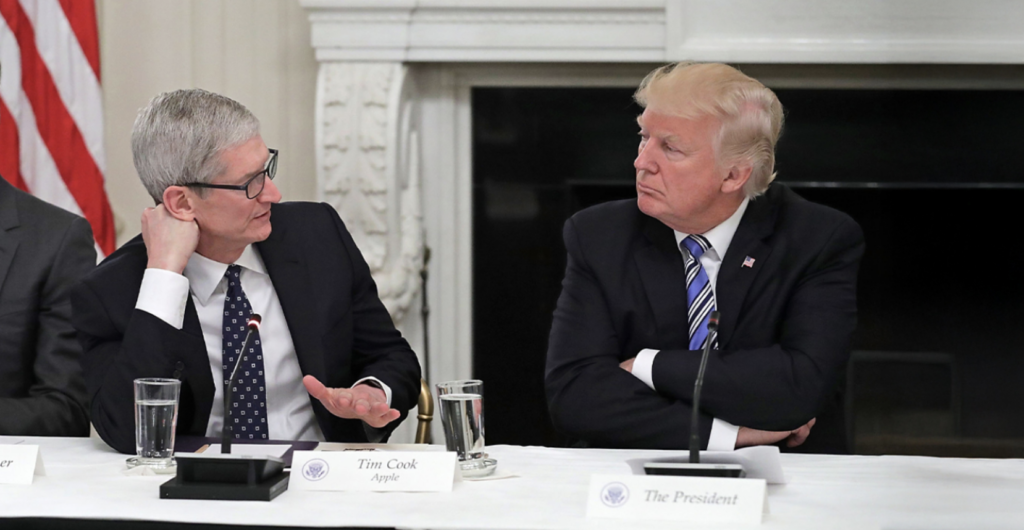
Donald Trump said today that former Apple chief executive Tim Cook should replace Jensen Huang as chief executive of Nvidia.
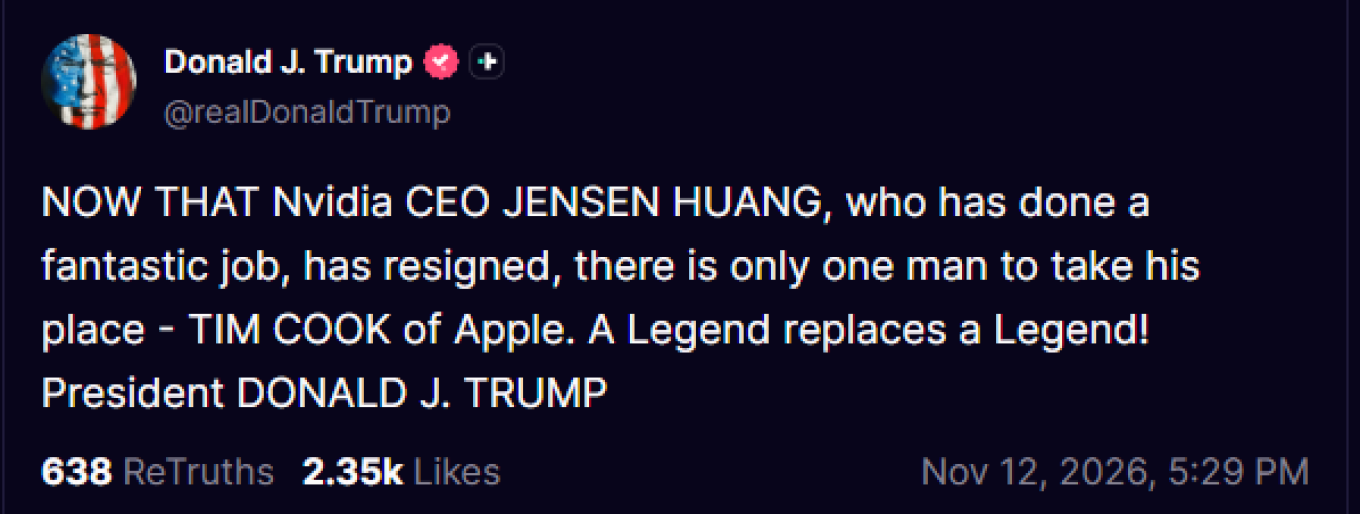
‘Now that Nvidia CEO Jensen Huang, who has done a fantastic job, has resigned, there is only one person who can take his place: Tim Cook of Apple,’ Trump wrote on social media. ‘A legend replacing a legend!’ he added.
Earlier on Thursday, Nvidia announced Jensen Huang’s resignation from his positions as chairman, chief executive and board member, marking the end of the co-founder’s 33-year tenure at the helm of the technology giant.
According to the board’s announcement, Colette Kress will take over as interim chief executive. She currently serves as Nvidia’s executive vice-president and chief financial officer.
Kress will continue in her role as CFO until a permanent successor to Huang is appointed. The board is launching a search for a new chief executive, considering candidates from both inside and outside the company.
As recently as Sunday, Nvidia’s board had expressed confidence in Huang and the company’s leadership team. However, under Nvidia’s articles of association, the chief executive can be removed ‘with or without cause’, provided a majority of board members vote in favour.
Huang’s departure leaves a huge gap in Nvidia’s leadership. The company, which he co-founded and built over more than three decades, has a market capitalisation of approximately $4 trillion. Following his departure, shares in the US semiconductor giant fell by 5.44%, having dropped by as much as 11%.
China may be the biggest loser
While the resignation may offer the technology company a way out of the crisis triggered by Huang, the consequences for China’s artificial intelligence industry are only now beginning to be felt.
According to a Bloomberg analysis, the crisis goes far beyond the scandal surrounding Huang’s alleged extramarital relationships with a woman suspected of spying for China and with a subordinate at the company itself. From now on, Washington will demand answers about how much Huang and his company knew about the use of Nvidia products in China, with developments looking anything but favourable.
According to information presented by The Information, Huang’s relationship with Alice Huang, who is alleged to have links to Chinese intelligence services, helped facilitate Chinese companies’ access to at least $7.5 billion worth of Nvidia chips.
Her company, Megaspeed International, is Nvidia’s largest single buyer of chips in Southeast Asia and has been a source of concern for the relevant authorities for more than a year. Nvidia is also alleged to have intervened in a US investigation into Megaspeed, although both companies have denied acting unlawfully.
The presentation of these events strengthens the case made by those advocating a tougher US policy towards China. From now on, export restrictions are likely to become considerably stricter, even along the approved and legal channels through which Chinese companies have so far been able to access Nvidia equipment.
To some extent, such a development was something Beijing wanted. Chinese officials have made clear their desire to accelerate the shift towards domestic technological alternatives, including through restrictions imposed by the Chinese government itself on the re-entry of approved Nvidia products into the market.
However, technocrats cannot simply decide overnight to create the capacity for mass production of advanced artificial intelligence processors.
The grey market and legal or commercial loopholes have so far limited the impact of a strict exclusion of China from US technology. That dependence remains evident. A recent example is Moonshot, the rising Beijing-based Chinese AI company behind the successful Kimi K3 model. According to reports, Moonshot gained access to large numbers of Nvidia’s most advanced chips during the summer.
At the same time, Huawei Technologies, Nvidia’s main Chinese competitor, acknowledges that it cannot meet domestic demand.
If nothing else, the case offers a lesson in how export restrictions can be implemented in the worst possible way.
Washington imposed sufficiently strict measures to spur Beijing and Huawei into a comprehensive effort to develop domestic technological alternatives, but at the same time left enough ways to circumvent the restrictions, thereby weakening the pressure to accelerate the transition to Chinese solutions.
Following the developments at Nvidia, if this route to accessing US technology is closed, the consequences for China’s industry will be serious, even if the country’s long-term ambitions remain unchanged.
For Chinese AI companies caught at the centre of this confrontation, the threat of further restrictions could hardly come at a worse time.
According to Bloomberg, despite rapid technological progress, many of these companies are still struggling to compete even with one another, let alone find a sustainable path to profitability. The sector has undoubtedly achieved impressive technological breakthroughs, but pressure from all sides is expected to intensify just as businesses are being called upon to prove that they can generate financial returns.
Chips, however, are not the only problem. Beyond being a strong advocate of selling equipment to China, Huang was also one of Silicon Valley’s most prominent defenders of open AI models, in which Chinese companies have invested heavily.
In July, in his first post on X, Huang urged the US technology industry to support open-weight AI models, amid growing fears that the United States could ban the use of Chinese applications.
He had also defended the technique of ‘distillation’ – training an AI model using the outputs generated by another model – describing it as a ‘widely used technique’ and a form of ‘competition’.
The dispute over model distillation has become central to efforts in the US to restrict Chinese open models, with American companies and lawmakers accusing Chinese businesses of appropriating advances in US artificial intelligence technology without permission.
Without one of the industry’s most influential figures publicly defending distillation and open models more broadly, pressure for stricter restrictions is expected to grow.
Such a development would also hurt US start-ups and developers that rely on these Chinese models for affordable, customisable tools, including cybersecurity applications.
In the longer term, it could also lead to an even greater concentration of power among Silicon Valley’s leading AI laboratories.
But, Bloomberg points out, the first and most immediate consequences will be felt by Chinese AI companies, which have just lost their most important supporter.
The scandal linking Nvidia’s former chief with Beijing erupted just weeks before planned US-China talks on artificial intelligence safety and is said to have wiped out the already limited hopes of cooperation in this field.
The Nvidia crisis is expected to deepen mistrust between the two sides and limit each side’s ability to know and understand the other’s actions.
The likely result is an even more uncontrolled and reckless race for technological supremacy. And if all this sounds like a form of Cold War, one need only look at the specific espionage case, which evokes an earlier era.
Until recently, Jensen Huang’s legacy appeared to be the creation of bridges between the world’s two biggest technology powers, in the hope that the AI revolution would not necessarily lead to a world divided into two opposing camps. Now, however, his legacy may instead be associated with how quickly a single individual can destroy those bridges.
In any case, Elon Musk has already said that he would like to hire Jensen Huang, adding that it ‘would be an honour’.
Ask me anything
Explore related questions




