





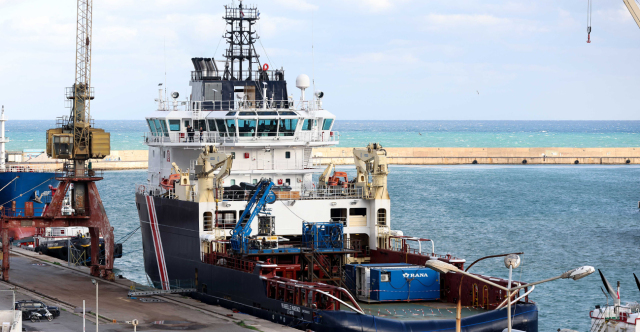
Surveys by the French research vessel Abeille Marengo are proceeding unhindered after it entered international waters on Thursday morning. The vessel is currently southeast of Karpathos, marking the start of survey operations for the Greece-Cyprus electricity interconnection project.
The French research vessel is following the route coordinates outlined in the Greek NAVTEX, under which it will conduct its surveys south of Karpathos before continuing towards Cyprus, into an area covered by the corresponding Cypriot NAVTEX.
However, the Turkish response to the French research vessel was notably restrained, with Ankara making no attempt to escalate tensions with Athens. This was reflected in the reaction of the Turkish frigate CG Gökova, whose crew read out a message over the radio stating that the vessel was “sailing in an area of the Turkish continental shelf and had consent to continue its voyage”.
Specifically, Turkey’s response was even more limited than the verbal challenge, known as “hailing”, for which the Greek authorities had prepared. So far, no other Turkish reaction has been recorded in the area, apart from seven violations of Greek national airspace on Thursday involving two armed Turkish F-16 fighter jets in the northeastern Aegean.
Months of preparation at the Foreign Ministry
Ankara’s decision to refrain from maximalist claims and provocations at sea on Thursday is not unrelated to the months of diplomatic efforts undertaken by the Greek Ministry of Foreign Affairs, with Foreign Minister Giorgos Gerapetritis playing a pivotal role in contacts between Athens, Paris and countries across the southeastern Mediterranean. At the same time, the multilateral approach of Greek foreign policy, reflected both in the EU’s alignment with Greek positions on the illegal Turkey-Libya maritime memorandum and in Greece’s presentation of its positions at UN Security Council level, has created a network of diplomatic relationships allowing for more sophisticated diplomatic manoeuvring.
Meanwhile, the established relationship of cooperation between Athens and Paris has enabled Greece to retain the initiative over the Greece-Cyprus electricity interconnection project, as ultimately demonstrated by Ankara’s handling of Thursday’s developments.
The significance of the absence of authorisation
According to some observers, Ankara’s conduct on Thursday reflects its increasingly limited room for manoeuvre as a result of Greece’s multilateral foreign policy, with Turkey ultimately opting for a restrained response that went no further than the message read out by the crew of its frigate.
Military analysts are paying particular attention to the fact that the Turkish frigate CG Gökova transmitted the message without asking either the French research vessel or the Greek frigate Limnos to leave the area. For these analysts, this is the clearest indication of Turkey’s implicit acknowledgement that it had not authorised the surveys and, by extension, that it does not exercise jurisdiction over the area. Instead, the research operations were allowed to begin as planned.
Ask me anything
Explore related questions




