





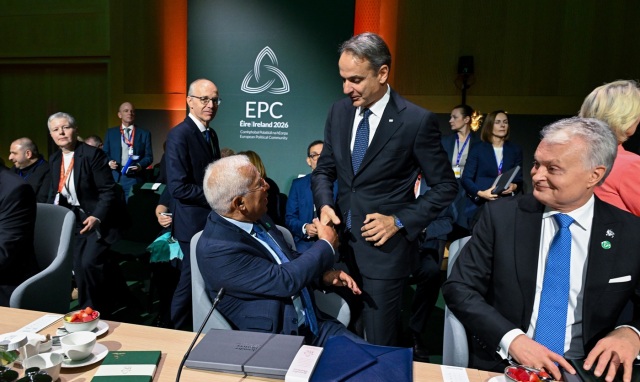
France is once again emerging as a key player in the Greece-Cyprus electricity interconnection project, this time from Dublin. The smiles exchanged by Prime Minister Kyriakos Mitsotakis and Cypriot President Nikos Christodoulides during the family photograph at the summit had an energy dimension, as both leaders expressed satisfaction with the project’s progress.
A separate conversation between Christodoulides and French President Emmanuel Macron reflected the same positive atmosphere, with both sides agreeing that work was proceeding according to schedule.
The discussions on the sidelines of the European Political Community summit took place as the French research vessel Abeille Marengo had entered international waters, marking a new phase in surveys for the electricity cable.
The developments highlight an increasingly familiar diplomatic pattern. At critical stages of the project, Athens, Nicosia and Paris intensify their coordination, with the French president personally involved.
France’s growing involvement
Following Macron’s visit to Athens, French infrastructure investment firm Meridiam joined the project. Its chief executive subsequently revealed publicly that the French president had been calling him daily for updates on progress.
On 7 October, during the MED9 summit in Croatia, Mitsotakis, Christodoulides and Macron discussed restarting the surveys.
A month later, in Dublin, the circumstances have changed. The French vessel is now at sea, and the three countries are focusing on the next stage of the project.
The development has acquired additional significance following Turkey’s first response in international waters southeast of Karpathos.
The Turkish frigate Gökova confined its intervention to a radio message asserting that the area fell within Turkey’s continental shelf and that Ankara’s consent was required, without specifically referring to the issuing of permits.
The Greek frigate Limnos responded that the research vessel was operating on the Greek continental shelf and conducting its activities under a Greek NAVTEX maritime notice.
Athens maintains that the electricity interconnector is a European project, that the necessary authorisations are issued by Greece and Cyprus, and that surveys will continue without recognising any Turkish jurisdiction over the operations.
Energy costs and Europe’s strategic autonomy
Against this backdrop, Mitsotakis has also brought energy costs to the forefront of discussions, linking the need for cheaper electricity to Europe’s competitiveness and security.
In his statements ahead of the summit, the Greek prime minister emphasised the importance of reducing energy dependencies and strengthening Europe’s domestic production of clean energy.
His remarks carry particular weight as surveys continue for the Greece-Cyprus electricity interconnector, which forms part of the EU’s broader strategy to strengthen energy infrastructure and end Cyprus’s electricity isolation.
Mitsotakis also opened a wider discussion on European strategic autonomy, covering areas ranging from critical raw materials to space capabilities and artificial intelligence.
He stressed that reducing dependencies is now a matter not only of economic strength but also of security.
Focus shifts to the 27 EU leaders
Attention now turns to today’s informal European Council summit, where Mitsotakis is expected to thank the other 26 EU leaders for their support in opposing the Turkey-Libya maritime memorandum.
Ukraine will also feature prominently on the agenda.
The Greek prime minister has already made clear that no lasting peace agreement or new European security architecture can be established without Europe participating in the negotiations.
Athens supports the involvement of European institutions, alongside representatives of major European countries, while identifying a ceasefire as the immediate priority, particularly regarding attacks on commercial shipping in the Black Sea.
The 27 EU leaders will also discuss the opportunities and risks associated with artificial intelligence, with particular emphasis on European competitiveness.
Meanwhile, Turkey’s decision not to send a government-level representative to Thursday’s European Political Community summit did not go unnoticed.
Feridun Sinirlioğlu attended the Dublin gathering in his capacity as Secretary General of the Organization for Security and Co-operation in Europe (OSCE), rather than as a representative of Ankara.
His presence in that capacity came at a time when the electricity interconnector and Turkey’s maritime claims are attracting increasing European attention.
Ask me anything
Explore related questions




