





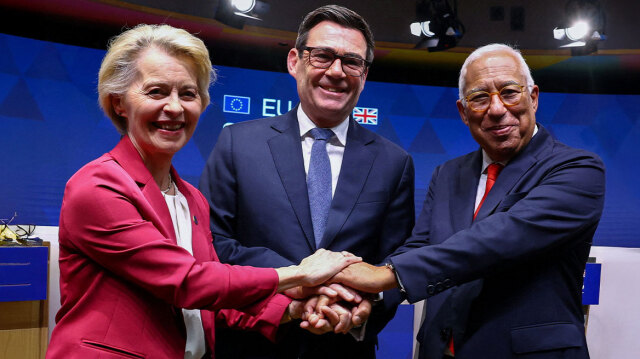
“It is a good day for Britain and a good day for Europe.” These were among the remarks made by British Prime Minister Andy Burnham following the conclusion of negotiations between the European Union and the United Kingdom on three agreements covering trade in food and agricultural products, youth mobility and the linking of carbon markets. As stated in the joint communiqué, the aim is for these agreements to begin being implemented in 2028, once all the necessary legal and technical preparations have been completed.
Andy Burnham also announced that the relevant legislation to implement the agreements reached would be introduced in the British Parliament next week. Emphasising the importance of today’s summit, he noted that, according to estimates by the British Treasury, the agreements signed could increase his country’s GDP by up to 0.5%. This represents £17 billion annually.
Food, emissions and electricity
The sanitary and phytosanitary agreement provides that the movement of animals, plants and products of animal or plant origin will be possible without the certificates or inspections currently required. The benefits will also extend to shipments from Great Britain to Northern Ireland. The implementation date has been set for 1 March 2028.
Carbon emissions – Protecting British exports
The second agreement concerns the cost of carbon dioxide emissions.
Following Brexit, the EU has imposed environmental tariffs on the United Kingdom, as stipulated by the European Union’s Carbon Border Adjustment Mechanism (CBAM) for third countries. These cost the British economy up to £3.8 billion every year.
These tariffs mainly affect the steelmaking and aluminium industries.
The agreement provides that the linking of the emissions trading systems will be completed during 2028, thereby exempting companies currently bearing this cost.
Mobility, Erasmus+ and tuition fees
Regarding the youth mobility programme, it was agreed that 100,000 young people from each side will be allowed to live on the other side for up to three years for work, studies, volunteering or travel.
The aim is for the agreement to be implemented no later than 2028, with the programme’s opportunities available to young people by January 2030.
At the same time, it was agreed that Britain will rejoin Erasmus+ in 2027.
As for university tuition fees, the two sides committed to completing separate negotiations within six months, covering both EU students in Britain and British students in the EU.
The next phase of relations
At the joint press conference held immediately after the agreement was signed, British Prime Minister Andy Burnham stressed, among other things, that, ten years after the Brexit referendum, he wants to explore options informally with Brussels for the long-term relationship ahead of the next summit, which, as he noted, he expects to take place around this time next year.
European Commission President Ursula von der Leyen, for her part, said she was open to a broader discussion.
European Council President António Costa expressed a similar position, saying that the EU seeks the closest possible relationship with Britain, while emphasising pointedly that the four freedoms of the single market are non-negotiable.
Ask me anything
Explore related questions




