





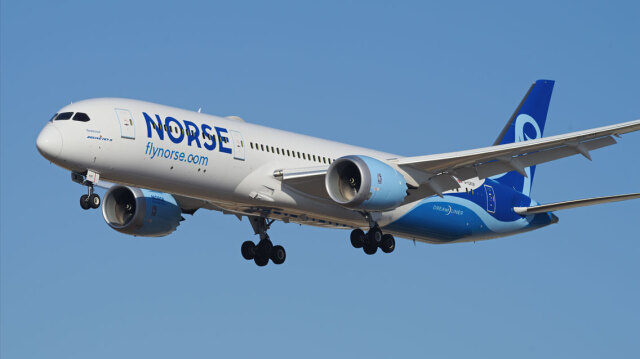
Norse Atlantic Airways has suspended all its flights, warning that it may file for bankruptcy if it fails to secure funding immediately, a day after its shares collapsed on the Oslo Stock Exchange.
Shares in the Norwegian low-cost airline, which specialises in long-haul flights, closed down 85% on Wednesday after management warned of the company’s critical financial position.
“The board of directors continues to explore options to secure short-term funding,” Norse Atlantic said in a statement on Thursday.
“If an urgent short-term funding solution is not secured, the board’s intention is to file for bankruptcy,” the company stressed, clarifying that there could be no assurance that a viable solution would be found.
Despite the suspension of flights, checks by CNBC showed that, as of 9am on Thursday, Oslo time, the airline was still offering tickets for flights on Friday and the following days.
First flight cancellations
The first signs of serious problems emerged with the cancellation of two Pakistan International Airlines (PIA) flights, from London to Islamabad and from Manchester to Lahore, due to an “unforeseen suspension of operational activities”, according to an announcement by Pakistan’s national carrier on X.
Norse Atlantic had been due to operate the flights on Wednesday under a wet-lease agreement, which had been signed only in early October.
Pakistan International Airlines announced that it would now operate the routes using its own Boeing 777 aircraft.
Meanwhile, according to flight-tracking platform Flightradar24, Norse Atlantic flight Z0 783 from London’s Gatwick Airport to Orlando, Florida, was also cancelled on Wednesday.
For the corresponding Thursday flight, the British airport’s website directed passengers to contact the airline for further information.
Race against time to secure liquidity
In an effort to tackle its financial difficulties, Norse Atlantic cut 75 jobs in May as part of a $50 million cost-cutting programme.
This followed a change in the company’s leadership in November 2025, when Eivind Roald succeeded its founder, Bjorn Tore Larsen, as chief executive.
The Norwegian company had already warned on Wednesday that its financial position depended on securing funding to meet its immediate liquidity needs. It also disclosed that it was in talks over a possible acquisition by a strategic investor.
“Norse is also in discussions with selected interested parties regarding short-term funding, although there can be no assurance that these discussions will result in a viable solution,” it had said.
A further blow came with the end of its partnership with IndiGo, India’s largest airline.
In early 2025, IndiGo had signed an agreement with Norse Atlantic to lease six Boeing 787-9 aircraft, enabling it to launch routes to Europe and the UK while awaiting delivery of its own wide-body aircraft.
The agreement expired at the end of October 2026, with the Indian airline citing airspace restrictions, high fuel costs and foreign exchange pressures.
Dramatic contraction of operations
Figures from aviation analytics company Cirium illustrate the extent of the deterioration.
At the peak of its operations in 2024, Norse Atlantic had scheduled 4,822 flights. That number fell to 4,695 in 2025 and just 2,565 in 2026, while the airline had scheduled only 122 flights for November this year.
Norse Atlantic chief executive Eivind Roald told CNBC in May that he was not particularly concerned about access to fuel, pointing out that at the time there were no indications that the crisis would have an immediate impact on the company’s operations.
However, in October, Norse Atlantic announced that it was continuing to operate with reduced capacity due to fuel prices remaining elevated for a prolonged period.
Ask me anything
Explore related questions




