





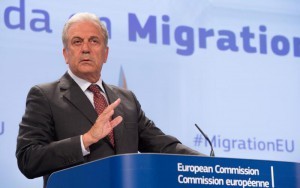
On Friday 9 October, Migration and Home Affairs Commissioner Dimitris Avramopoulos and Luxembourg Minister for Foreign Affairs Jean Asselborn will travel to Italy accompanied by Interior Minister Angelino Alfano for a concrete demonstration of the roll out of the European Union’s comprehensive response to the refugee crisis.
They will meet with the first group of asylum seekers to volunteer for protection in another Member State under the new relocation scheme proposed by the Commission, prior to their departure by plane from Rome’s Ciampino airport, to have their asylum applications processed in Sweden.
Twenty Eritrean asylum seekers came forward to register with the Italian authorities and provided their identification and fingerprints as part of the process. They will then visit the hotspot area operational in Lampedusa.
Migration and Home Affairs Commissioner Avramopoulos said: “This is a historic day for Europe. It is a great expression of European solidarity, both with those in need of protection, and between our own Member States. The Commission wishes to thank the Luxembourgish Presidency for the swift adoption of this scheme, and to thank Sweden for leading the way in the first relocation from the 160,000 asylum seekers from Italy and Greece set to be offered asylum throughout Europe over the next two years. We are sure that the other Member States will soon be ready to play their part. Today we are showing solidarity, but we must also show responsibility. Greece and Italy should now finalise the rollout of the hotspot teams, in order to continue our efforts to strengthen Europe’s borders. I’m looking forward to visiting the functioning hotspot in Lampedusa and seeing the work done to implement the Commission’s proposals.”
Tomorrow’s first flight is the result of intensive preparatory work on the ground by the Italian and Swedish authorities, by Frontex and other EU agencies, by local NGOs, and by the special envoys which the European Commission has deployed. Tireless efforts have ensured that the system is operational, and the necessary registration and processing can be done at each step of the way. Outreach to the Eritrean community has also been an important way to build trust in the system and encourage participation.
Ask me anything
Explore related questions




