





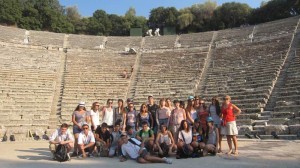
The Onassis Public Benefit Foundation and the S. Onassis Foundation Cultural Center non-profit organization have invited 250 students from Greece and other European countries as well as the United States, Australia and Asia participate in its Summer Schools project. The project is within the larger framework of another initiative known as “The Academy of Plato: Development of Knowledge and Innovative Ideas”, that is being implemented jointly by the Athens National and Kapodistrian University (EKPA), the Onassis Foundation Cultural Centre non-profit organization and the Foundation of the Hellenic World. As the title of the project suggests, the idea is to teach the teens as Plato would if they were his own students attending Plato’s Academy.
Plato’s Academy was well-known as a leading spiritual centre in ancient Greece. It determined the philosophical and scientific thought, and contributed to the shaping of modern civilization. Through an educational procedure, the program aims to offer guest students the chance to really familiarize themselves with Greek historic figures, events and sites that have influenced global history, science and culture.Of course, just because it searches through the learning methods of antiquity doesn’t mean that it doesn’t exploit the latest technology. Infact, the program constitutes a multidisciplinary educational intervention with the most contemporary and appropriate methodologies of lifelong learning.

Essentially, the summer schools are a journey into knowledge as high school students from around the world are introduced to modern Athens and Greece, to Greek history, philosophy and culture from antiquity to today using contemporary and attractive teaching methods.
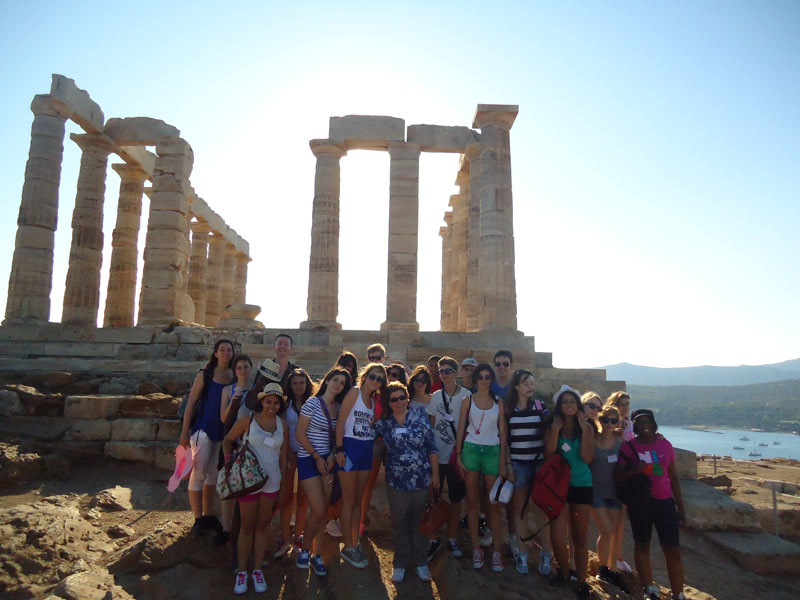
Summer schools run for a month and are divided into two two-week cycles. In this time, a theoretical interdisciplinary approach is applied to the history of Greece and its people by means of a diachronic examination of the local history, thought, speech, science and art. At the same time, students from abroad are introduced to contemporary Greece, meeting the city and its people, their everyday routine and life. The course cycle is accompanied by lectures, visits, walks, workshops and activities through which children can absorb the knowledge they have acquired through experience, can apply it and add to it. Based on this reasoning, the courses are divided into separate thematic sessions on Greek history, literature, art, the course of philosophical thought, the technological and scientific achievements of Greeks in their country and abroad, the material and everyday life of modern Greeks. Greek children and children from abroad meet, collaborate in joint events, and have fun together, exchanging experiences, concerns, thoughts and setting the foundations for future relationships. Through this comprehensive study program, summer schools emerge as efficient tools for social and cultural development.

Since the inception of the idea, the working group of the Onassis Foundation accepted that summer schools are a significant venture and focused on two axes that would ensure the program’s success. Those were the multimember educational procedure and the appropriate coordination of all teams so that both guest students and escort teachers return to their countries safe, satisfied and full of new images and experiences. The feat of organizing this year’s summer schools proved demanding and challenging right from the start.

After the study program had been finalized, the first challenge was to set forth the selection criteria for schools in Greece and abroad to ascertain which would be eligible to participate in the Summer Schools program – after all, the applications were many and the available positions limited. As far as Greek schools were concerned, the first selection criterion was for them to be located outside Athens, in the countryside, then for them to have participated in certain actions for collaboration with other Greek or foreign schools, or their children and teachers to have displayed significant presence in extracurricular activities. For foreign schools, the first criterion was geographic dispersion. Then, schools with a classical study curriculum which teach Ancient Greek were favored, and finally, schools which participate in actions trying to probe into the Greek civilization and the dissemination of the Greek language.
In the first two journeys into knowledge which took place in two cycles in the summer of 2012, the participants from Greece were students and escort teachers from the 5th High School of Ioannina and the 2nd High School of Kilkis, as well as students and teachers from the Lycée Galilée in Combs-la-Ville, France and the Klasična Gimnazija in Zagreb, Croatia. The pilot program was crowned with success.
The Onassis Foundation continued this project in the summer of 2013 by hosting 70 students from the High School of Rodolivos, Serres (Greece), the Stedelijk Gymnasium Leiden from Leiden (Netherlands), the National High School for Ancient Languages and Cultures ‘St Constantine Syril, the Philosopher’ from Sofia (Bulgaria), the Institut du Sacré-Coeur from Mons (Belgium) and the Frederick Douglass Academy from New York (USA).
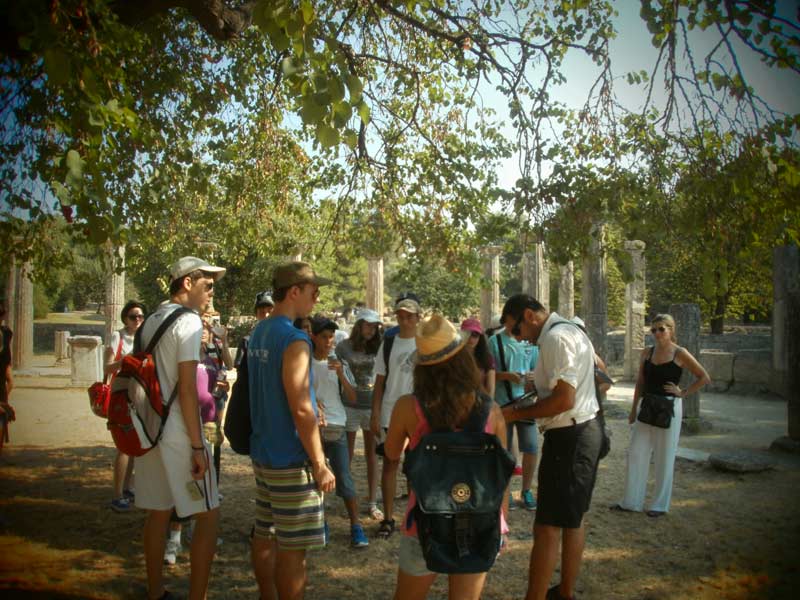
This year’s summer school started last week with the participation of students from Adelaide, Granada Spain, Beijing, New York and the Greek region of Evros. So far more than 190 high school students have taken part in the program.
The project is financed by the European Union (European Social Fund) and national resources through the operational program “Education and Lifelong Learning”.
For more information on the Summer Schools, you can visit the project’s website at http://www.plato-academy.gr.
Ask me anything
Explore related questions




