





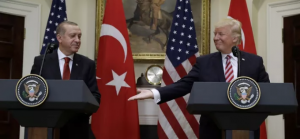
When President Donald Trump and other heads of state meet at this week’s NATO Summit it might be a good time to discuss the wisdom of keeping 50 U.S. thermonuclear weapons in Turkey, just 70 miles from Syria, the most intense combat zone on the planet.
Each of the B61 gravity bombs stored at Incirlik Air Base, 68 miles from Syrian border have a maximum yield of 170 kilotons, or 10 times more powerful than the bomb dropped on Hiroshima. But these bombs also have a “dial-a-yield” capability that allows them to be set to explode at various levels, down to less than one kiloton of force. They are the vestige of the thousands of battlefield weapons once deployed by the United States and the Soviet Union to wage nuclear war in Europe. Almost all have been withdrawn from deployment except these at Incirlik and approximately 100 other B-61’s stored at NATO bases in Belgium, Italy, Germany, and the Netherlands.
However, unlike those airfields, there are no aircraft based in Turkey capable of carrying the American nuclear weapons stored there. In a crisis, planes would have to fly from other U.S. bases, assuming they could be freed from their other assigned conventional missions. The actual strategy for their use is hazy at best.
“Today, the symbolism of these bombs is far more important than their military utility,” says nuclear historian Eric Schlosser. “Missiles carrying nuclear warheads reach targets much faster, more reliably, and with much greater accuracy.” Rather, the case for keeping the weapons is the nuclear equivalent of the old phrase about the purpose of NATO, “to keep America in, Russia out and Germany down.” In this case, the bombs are there to demonstrate that America’s nukes are in, Russian nukes will be kept out, and German nukes are unnecessary.
Is this symbolism worth the risk? Warning signs are mounting about the security of the weapons as U.S.-Turkish relations deteriorate and the war in Syria intensifies.
Just last year, the United States temporarily lost access to Incirlik during the attempted coup against Turkish President Recep Erdogan. Senior Turkish officers in charge of the base were said to be among the leaders of the coup, and were accused of flying missions from the base in its support. Turkish forces loyal to Erdogan surrounded Incirlik and cut off power for days, effectively trapping some 2,500 U.S. servicemen stationed there — and the 50 nuclear weapons. A week later, the base was again under siege, surrounded this time by thousands of anti-American protesters who burned American flags and demanded the government close the base.
Erdogan’s rule since the coup attempt has grown increasingly authoritarian. His forces killed over 250 people during the uprising, wounded more than 1,400 and arrested almost 3,000. Since then he has purged more than 2,700 judges, detained nearly 50,000 people, including many soldiers, journalists, lawyers, police officers, academics, and Kurdish politicians, sacked 120,000 public servants and vowed to “clean all state institutions of the virus of Fethullah Gülen supporters” loyal to the cleric Erdogan claims was behind the coup.
As Elmira Bayrasli wrote in Defense One, Erdogan holds his own country “hostage for his political benefits.”
Even if you believe the United States should keep tactical nuclear weapons in Europe, is Turkey a safe place to do so?
Since the attempted coup, Turkish forces carried out airstrikes in Iraq and Syria against the Kurdistan Worker’s Party, who are armed by the United States to fight ISIS. If media reports are correct, former National Security Advisor Michael Flynn blocked a plan to use Kurdish forces to spearhead an attack on the ISIS capital of Raqqa, perhaps at the behest of Turkey.
Most recently, during Erdogan’s visit to Washington, his personal bodyguards punched, choked, and kicked peaceful demonstrators outside the Turkish Embassy. Astonishingly, Turkey’s Foreign Ministry on Monday summoned the U.S. ambassador in Ankara to lodge a formal protest over the alleged “aggressive actions” of U.S. police in protecting the demonstrators, further straining relations.
Meanwhile, U.S. combat operations in Syria are intensifying. U.S.-led forces last week fended off an attack by Iranian-affiliated militia fighters operating in Syria and, according to the Pentagon, ignoring even Russia’s request to stand down. The battle for Raqqa is now back on track, and the most violent fighting of the war could occur in the coming months. As ISIS faces elimination, might it’s fighters strike out across the border inside Turkey?
Can we be sure that America’s nuclear bombs at Incirlik are secure? We cannot. There is growing concern that Incirlik is vulnerable to a terrorist attack. Last March, military families were evacuated from southern Turkey, mainly from Incirlik Air Base, as a result of security concerns from ISIS activity threatening the area. Major security upgrades to base are now underway, including around the vaults used to store the nuclear weapons. But new fences are not the answer. “The security risk of basing U.S. nuclear bombs in Europe,” warns former NSC staffer Steve Andreasen and Isabelle Williams, “clearly demonstrate the case for consolidating U.S. nuclear weapons in the United States.”
Why risk it? No member of NATO will doubt our resolve or the credibility of our nuclear assurances if we pull 50 dangerously exposed nuclear weapons from Turkey. They may actually breathe a sigh of relief.
Ask me anything
Explore related questions




