





* By Alexander Billinis
When we consider key communities of the Greek diaspora, Vienna rarely comes to mind. Yet if we are to consider historically significant communities for modern Hellenism, the Austrian capital should certainly be on the short list.
Like other Greek communities in the ex-Austrian Empire, the Greeks’ large-scale migration to the area followed the wars between the Austrian and Ottoman Empires. After the Ottomans’ failed (and second) attempt to capture Vienna, the Austrians at the head of a multinational European force pushed the Turks southward and eastward to the gate of Belgrade.
After the Treaty of Passarowitz was signed in 1717, the borders stabilised and there was a push to reopen commerce and to begin the reconstruction of a vast area devastated by decades of war. Aside from fixing the boundaries between the two empires, a key provision was the right of Ottoman and Austrian subjects to engage in commerce in each other’s realms. The Austrians lacked knowledge of the Ottoman Empire, and the Turks disdained commerce, so as a practical matter the opportunity fell on Ottoman minorities, Orthodox Greeks and Serbs, as well as Jews and Armenians.
As the capital of a large multiethnic state, Vienna was a key centre for these ‘Ottoman’ merchants. The Vienna Greeks hailed primarily from Macedonia, Epirus, and particularly from Thracian cities such as Constantinople and Philippoupolis (modern Plovdiv, Bulgaria). Bulk goods, particularly cotton, were the lifeblood of the trade. Though legend has it that Greeks set up the first coffeehouse in Vienna, Theophanis Pampas, a local Greek Viennese doctor with an encyclopedic knowledge of the community, informed me that this singular honour goes to the Armenians.
The Greek community grew and prospered. In typical Greek fashion, factions appeared. Some Greeks took Austrian nationality and in many cases entered the Austrian nobility. Others retained Ottoman nationality, which had the benefit of lower taxation but restricted their activities to the mercantile sphere. The factions both founded their own church, within a hundred metres of the other, in Vienna’s Greichenviertel (Greek Quarter). These churches remain to this day, and liturgy alternates every Sunday from one church to the next.
Education and literacy in Greek were key endeavours of the Greek community, regardless of faction. The Vienna Greek school, which I had the honour to view one Saturday morning in progress, is older than the Greek state itself, founded in 1804. Standing in a church older than the modern Greek state, watching classes that had been instructing Greek continuously since 1804, moved me as few moments have.
Aside from the educational efforts, Vienna is where Greek first appeared in print. The actual site of the first Greek printing press is gone, but within the Greek Quarter a stately baroque Viennese building houses the second Greek printing press, where revolutionary Rigas Pheraios, the ‘first martyr’ of Greek independence, edited the Greek newspaper. All Greek publications, particularly those in the diaspora, in a very real sense descend from this press. Every time I think of a Greek newspaper, particularly those abroad, my mind returns to that building, if only for a moment.
By the time of Greek independence in the 1820s, the Vienna community was at its acme, with about 5,000 members and an increasingly diverse socio-economic structure. The articulate and prosperous community naturally agitated for Greece’s liberation from the Ottoman yoke, but at the same time they were conscious that the Austrian Empire, a bundle of nationalities under a relatively benign but nonetheless absolute autocracy, was violently opposed to, and fearful of, revolution. Austrian Greeks therefore had to walk a very thin line between joy at Greece’s prospective independence and their personal safety and livelihood in the Austrian Empire. After all, the Austrians arrested Pheraios and handed him to the Turks, who strangled him in Belgrade in 1798.
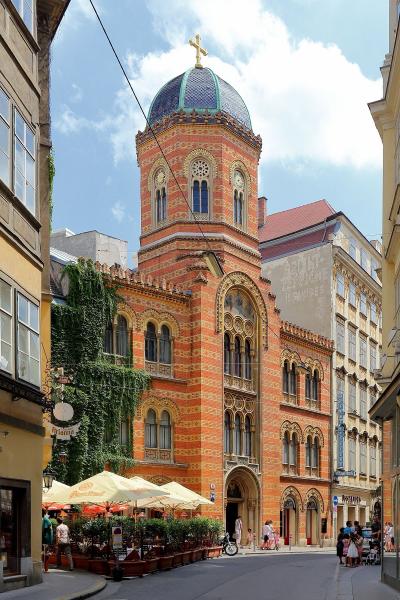
(The Holy Trinity Greek Orthodox Church in Vienna)
Greek independence did not result in a large repatriation of Austrian Greeks. A few returned but the impoverished little kingdom could offer nothing in comparison to the vast Austrian Empire. The inexorable tide of assimilation began to absorb the Greeks into Austria’s ethnic goulash, and other Greek Austrians began to move to Britain or France, where the economies were more dynamic than Austria. A trickle of new immigrants arrived through the years, which, along with the efforts of the long-established members, kept the community intact.
The two World Wars increased pressure on the Greeks to assimilate, particularly during the barbaric Nazi era, but the religious community survived. Postwar, Austria had none of the mass immigration of Greek Gastarbeiter guestworkers like in neighbouring Germany, but a fair number of Greeks did go to Austria, particularly for study, and afterwards they often stayed in the country. This includes a current deputy mayor of Vienna, Greek-born Maria Vassilakou, a member of the Austrian Green Party.
Like Austria itself, the Greek Community of Vienna is a shadow of its former size, but still prosperous and elegant.
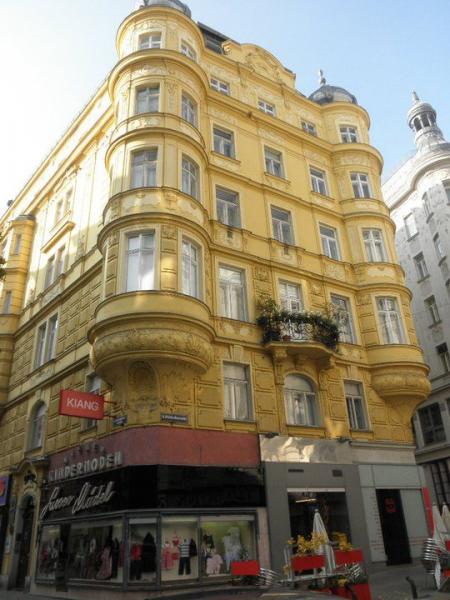
(The building that housed the Greek printing press in Vienna)
Like the Greek towns of America, today’s Viennese Greeks rarely live in the area, but some do have businesses there, and the church and community centre, as always, functions as the community’s centre of gravity. The community witnessed, and participated in, key events in the history of Hellenism. For those of us who are diaspora Greeks in America or Australia, the remarkable survival of such long established communities should be a source of pride and hope that our communities, too, will pass the test of time.
* Alexander Billinis has spent a decade in international banking in the US and Europe, most recently in London. He is particularly interested in Greece’s economic and cultural position in the Balkans.
Source: neoskosmos.com
Ask me anything
Explore related questions




