





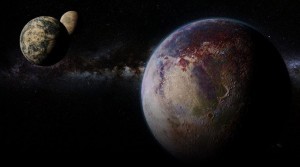
Nasa has found an entire solar system with as many planets as our own.
The discovery of a new planet around the Kepler-90 star, which looks like our own sun, means the distant solar system has a total of eight known planets. And those planets look like those in our own neighbourhood: rocky planets orbit close to the star, with gas giants further away.
The star and its family of planets were already known about, having been detected by the Kepler space telescope. But the breakthrough came when astronomers found the new world, which was done using Google’s artificial intelligence technology.
A computer was trained to look through the data from the Kepler space telescope, and look for signals that might belong to planets. And it found new planets within existing systems, by spotting signals that seemed to indicate something of interest but were too weak to have been spotted by humans.
That suggests that there might be whole worlds and solar systems hiding within the data we’ve already collected, but which we hadn’t been able to notice because there is simply so many signals to pick through. Kepler has collected four-years of data from looking at the sky, and 150,000 stars – far more than humans could ever look through.
“Just as we expected, there are exciting discoveries lurking in our archived Kepler data, waiting for the right tool or technology to unearth them,” said Paul Hertz, director of NASA’s Astrophysics Division in Washington. “This finding shows that our data will be a treasure trove available to innovative researchers for years to come.”
Researcher Andrew Vanderburg said he would be surprised if there wasn’t even more planets lurking to add to the newly discovered systems. He also said that it “almost certainly won’t be the last” system that has eight planets, suggesting our own solar system isn’t really all that extraordinary.
Indeed, the Kepler-90 system might have more planets in it that we haven’t been able to spot yet. The same has been suggested of our own solar system – leading the two to be linked in a race to find which of them might in fact be bigger.
The planets in the solar system are much more close together than they are in our own, but it is very stable. “The Kepler-90 star system is like a mini version of our solar system. You have small planets inside and big planets outside, but everything is scrunched in much closer,” said Vanderburg, a NASA Sagan Postdoctoral Fellow and astronomer at the University of Texas at Austin.
The Kepler-90 system is 2,500 lightyears away and isn’t a particularly good candidate for finding life. But the discovery about the sheer number of planets in each solar system does improve the chances of finding it, simply by suggesting that there could be far more exoplanets than we ever thought.
At the same time as they found the important new Kepler-90 planet – described as a sizzling-hot world that orbits around its star every 14.4 days – astronomers also found another planet around the Kepler-80 star.
The new planets – just like all of the thousands found by Kepler – were spotted by watching the sky for light coming from the stars. When planets pass in front of their stars, scientists can register the dimming as they go, and use the speed and characteristics of that dimming to work out what the solar system might actually look like.
Much of that work relies on pattern recognition, which until now has been done by scientists looking through the data. But the new findings are the result of work between Nasa and Google, which trained machine learning algorithms to learn to spot those patterns itself and so pick through the data much more quickly.
To train up the algorithms, the Google AI was shown 15,000 signals that have already been checked. It could then look through other, unverified data and look for those same patterns. This is thought to be the first time that neural networks of this kind were used to find planets in the Kepler data.
Scientists hope to use that same AI technology with the rest of the Kepler data set, as well as data from other telescopes. Kepler has been looking at one patch of space for four years, but is now moving around the rest of the sky and sending further information back down to Earth – all of which contains potential planets, and so will benefit from being looked at by Google’s artificial intelligence.
“These results demonstrate the enduring value of Kepler’s mission,” said Jessie Dotson, Kepler’s project scientist at NASA’s Ames Research Center in California’s Silicon Valley. “New ways of looking at the data – such as this early-stage research to apply machine learning algorithms – promise to continue to yield significant advances in our understanding of planetary systems around other stars. I’m sure there are more firsts in the data waiting for people to find them.”
Source: independent.co.uk
Ask me anything
Explore related questions




