





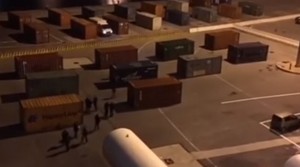
When Greek authorities boarded a ship on Jan. 6, they quickly noticed that something was wrong. The vessel, supposedly bound for the Arabian Peninsula, did not have any nautical maps of the destination area.
Then they took a closer look at the cargo and found 29 containers with over 400 tons of materials used to make explosives, as well as detonators and other equipment for blowing things up, authorities announced on Wednesday evening. A representative for the Greek Coast Guard, Giannis Sotiriou, described the discovery as a “swimming bomb” that appeared to be on its way to civil war-torn Libya.
“If something had gone wrong, the explosives would probably have destroyed the entire port,” a senior Greek coast guard official said on Thursday. He spoke on the condition of anonymity because he was not authorized to publicly discuss the operation.
Two officials said that last week’s operation and previous incidents highlight Greece’s raised profile in policing the Mediterranean in recent months, as the country’s coast guard has gradually moved from operating as an emergency task force rescuing refugees on their way to Europe to now playing an increasingly significant role in international security. Greece is spread over about 6,000 islands at a crucial naval intersection that connects the Middle East with Europe and North Africa — and has long been a major hub for drugs, arms and human trafficking. In the past, officials complained, the significance of the area to international security has too often been ignored.
“We are surrounded by a triangle of crisis and destabilization,” said Greek Foreign Minister Nikos Kotzias in a 2015 Washington Post interview, referring to the conflicts in Ukraine, Syria, Iraq and Libya. Greece was also the first country many Syrians reached on their flight from Turkey to Europe during the mass refugee influx, which picked up momentum in 2015.
For months, Greek authorities — already stretched by years of austerity due to the country’s ongoing debt crisis — were largely overwhelmed by the sudden influx of refugees. Initially, few of the hundreds of thousands newcomers underwent comprehensive identity checks; and two of them later went on to commit the devastating November 2015 terrorist attacks in Paris.
The incident also marked a turning point for Greek authorities.
At the time, a senior European intelligence official who spoke on the condition of anonymity to discuss classified information, told my colleagues Anthony Faiola and Souad Mekhennet: “The Greeks failed in protecting the borders into the E.U.”
“And we all failed by not pushing hard enough to establish that security,” he added.
Greek officials defended themselves, saying that they had pleaded for more European Union help but had their requests denied.
“Everyone knew we were facing huge financial problems. So for months we had to make do with what we had, hoping help would arrive,” Zacharoula Tsirigoti, lieutenant general of the Greek police, told my colleagues in April 2016.
But in the months since, the United States and the European Union have stepped up their cooperation with Greece, potentially bolstering the country’s critical security infrastructure, even though there may not be a direct link with the recent string of attacks in Europe.
The United States, for instance, has expanded its training missions in the country, a Greek coast guard official said. The deepening of Greek-American security cooperation was first publicly discussed last summer and appears to have affected recent Greek operations, including several large-scale seizures of illicit drugs, and recent operations targeting arms and human trafficking, the official said.
He added that U.S. and European officials have also stepped up intelligence sharing with their Greek counterparts and the country’s MYA counterterrorism unit in recent months. Illicitly trafficked goods were intercepted several times last year after European partners provided crucial hints. The official did not specify to what extent U.S. information had so far contributed to Greece’s anti-smuggling and anti-terrorism efforts. Cooperation between Greece and the U.S. military has also boosted the Greek coast guard’s capacity to respond to certain situations such as high-speed manhunts at nighttime, he said.
Greece’s experience appears to match a broader cross-European trend. The European Union’s police agency, Europol, announced last year that counterterrorism intelligence sharing within the European Union “had reached an all-time high.”
source: washingtonpost.com
Ask me anything
Explore related questions




