






For millennia people have looked at the Great Pyramid of Giza and thought, “How on Earth did they build that?” The other Seven Wonders of the Ancient World have long gone, but the Great Pyramid still looks good despite predating the other six wonders by almost two thousand years. What did the Egyptians know about building that the rest of the ancient world did not?
Certainly shape is part of it – a pyramid is a far more stable structure than a human statue. Location also helps, but one of the major things the Pyramid of Giza has going for it is the sheer scale of the blocks from which it is made, which have lasted long after the casing stones that formed the outer surface wore away.
To build the estimated 5.9 million tonne Great Pyramid, it is thought that around 800 tonnes of stone from quarries 2 km away were needed per day. Such quantities make the problem of transportation appear immense. Theories of how this was done have included dragging stones on sleds, possibly with the ground wetted beforehand, or rolling them using a type of cradle. Other ancient monuments, such as the Easter Island Statues and Stonehenge, have attracted similar debates, although with a scale of operations orders of magnitude smaller.
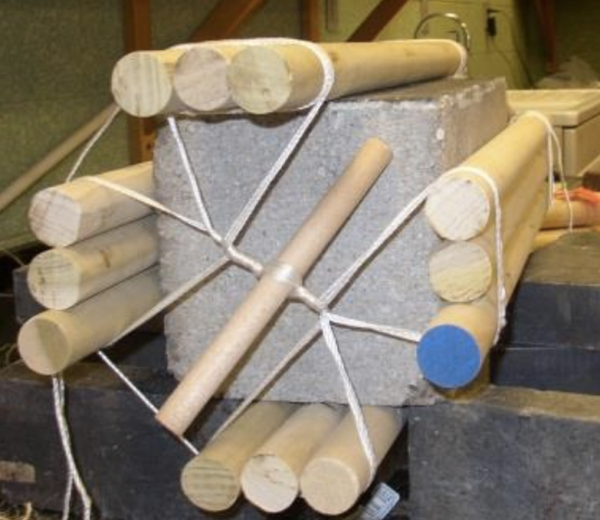
Dr. Joseph West of Indiana State University has a new proposal. He suggests the builders may have strapped three round wooden beams to each side of the stone block to “transform the square prism into a dodecagon which can then be moved more easily by rolling than by dragging.”
As West reports in Physics arXiv, “It is found that a small scale stone block converted to dodecagons can be moved across level open ground with a dynamic coefficient of friction of the order of 0.2.” This contrasts with 0.3 for stones dragged over wet sand, even with a perfect ratio of sand to water. Although the block West worked with was 30 kg, the paper argues that “for full scale pyramid blocks, the wooden ‘rods’ would need to be posts of order 30 cm in diameter, similar in size to those used as masts on ships in the Nile.”
With a force equal to 0.15 times the weight of the block required to roll the blocks, 50 fit men pulling on ropes wrapped around the shape could have kept a 2.5t block rolling at 0.5m/s (1.8kph). The effectiveness relies in part on the fact that the structure forms a sort of 2:1 pulley, a piece of technology unknown to the Egyptians at the time. The workers pulling the ropes would need to have walked twice the distance the stone was moved, but this is probably a small price to pay for the greater ease of movement.
While this shape looks more awkward to work with than a cylinder created by attaching wooden shapes to the stone’s side, as previously proposed by Dick Parry, it has the advantage of applying much less pressure to the ground. West argues that the use of wooden rockers would have required regular road maintenance, whereas his system might have done “away with the need for prepared surfaces entirely.”
Ask me anything
Explore related questions




