

×
GreekEnglish

×
  • Politics
  • Diaspora
  • World
  • Lifestyle
  • Travel
  • Culture
  • Sports
  • Cooking
Thursday
05
Feb 2026
weather symbol
Athens 13°C
  • Home
  • Politics
  • Economy
  • World
  • Diaspora
  • Lifestyle
  • Travel
  • Culture
  • Sports
  • Mediterranean Cooking
  • Weather
Contact follow Protothema:
Powered by Cloudevo
> Economy

Which Countries Are Ditching Russian Fossil Fuels? (infographic)

The US is on the top

Newsroom July 6 10:41

Despite impassioned pledges to stop supplying funds to Putin’s war on Ukraine, many countries have found ending their dependence on Russian fossil fuels rather difficult. In Europe, where this desire was probably strongest, long-standing supply chains with Russia have also proven some of the hardest to break.

Data from the Center for Research on Energy and Clean Air shows that European Union cutbacks on Russian fossil fuel imports lingered around the world average of a 15 percent reduction in monetary terms as of May. For this metric, rising world market prices run counter to reductions in the volume of imports – showing the extreme difficulty in trying to cut Russia off from one of its main revenue sources.

Spain, Finland as well as Lithuania, Poland and Estonia, and – most of all – Sweden has nevertheless managed to cut back their Russian fossil fuel imports completely or at least significantly. Germany, the Netherlands, and Italy remained below the global average.

Because of the different country sizes and different levels of dependence on Russia, these relative reductions do not all have the same weight in absolute terms. According to the report, the United States managed the biggest absolute reduction by cutting out Russian fossil fuels completely and reducing daily revenues for Russia by around $33 million between February-March and May 2022. However, the combined 16-percent reduction by European Union countries – despite being smaller in relative terms – cut a much larger $114 million from daily Russian revenues over the same time period.

>Related articles

Lagarde: International uncertainty is a key risk factor for the Eurozone

EU, Japan, and the US to sign memorandum on critical minerals next month, aiming to reduce dependence on China

ECB: Interest rates left unchanged for a fifth consecutive meeting – What the Governing Council’s decision says

One country supplying more money to Russia by buying up discounted fuel shipments is India. Between February-March and May, the country spent approximately $65 million more per day on Russian energy. All in all, Russia has been losing fossil fuel revenues of around $100 million per day since the start of the invasion. Despite the discounts on shipments and the loss of customers, Russia is still earning almost 40 percent more on its energy exports when compared to May 2021 as world market prices are through the roof.
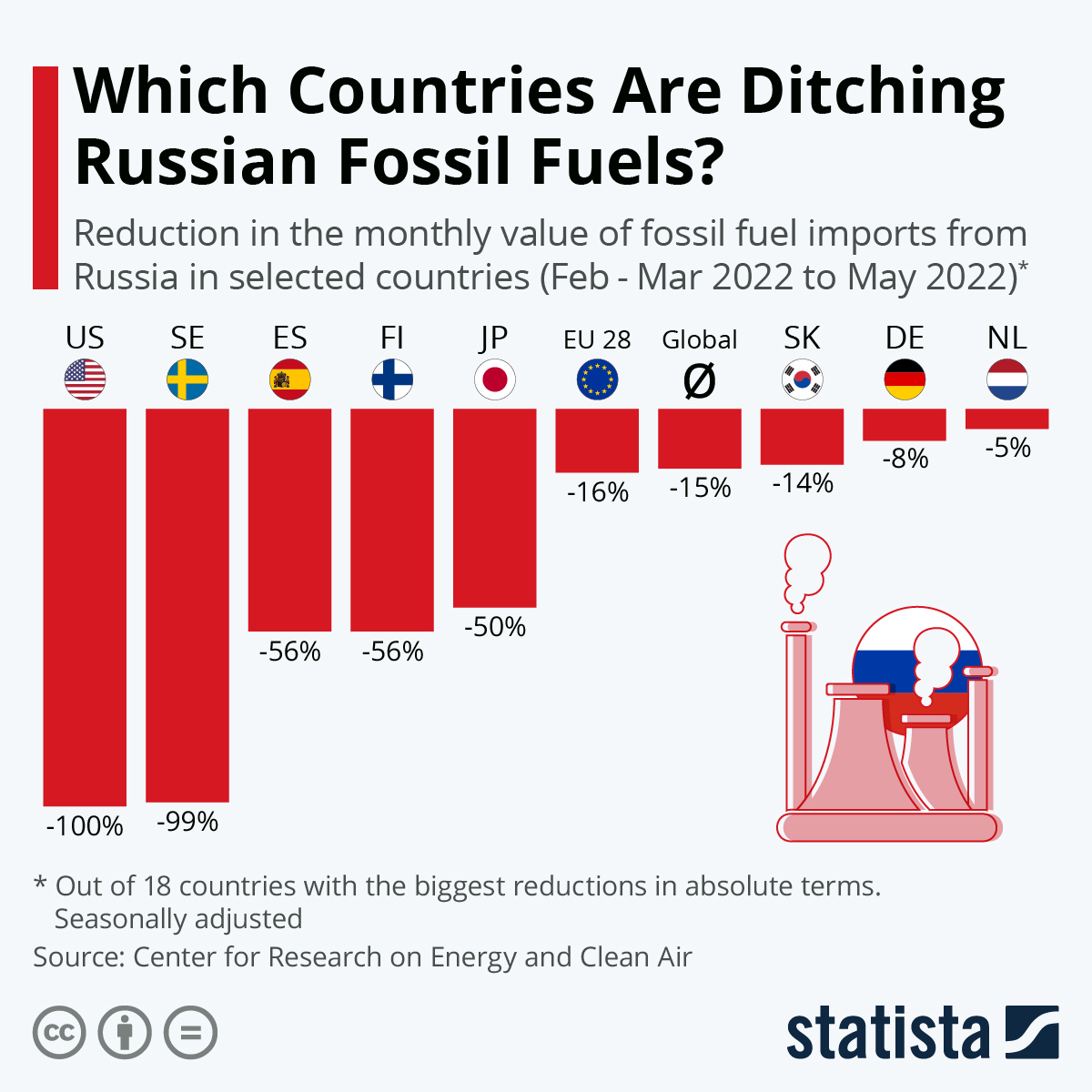
Infographic: Which Countries Are Ditching Russian Fossil Fuels? | Statista

You will find more infographics at Statista

Ask me anything

Explore related questions

#eu#fossil fuel#fuel#russia#war
> More Economy

Follow en.protothema.gr on Google News and be the first to know all the news

See all the latest News from Greece and the World, the moment they happen, at en.protothema.gr

> Latest Stories

13.5% of prisoners in Japan are over 65, turning prisons into nursing homes

February 5, 2026

“Clelia, you have breast cancer. Come back to Athens” – A moving personal testimony

February 5, 2026

Lagarde: International uncertainty is a key risk factor for the Eurozone

February 5, 2026

Giannis Panagopoulos: Who is the “eternal” GSSE president under investigation for embezzling €2.1 million

February 5, 2026

Greece – Italy 15-8: Greece “sinks” Italy and wins bronze at the European Water Polo Championship – Video

February 5, 2026

Researchers reconstruct the scents of ancient civilizations

February 5, 2026

Cuba to the US: Yes to dialogue, but we will not discuss regime change

February 5, 2026

Hellenic Heritage: The new digital hub connecting visitors with 350 archaeological sites and museums

February 5, 2026
All News

> Economy

Lagarde: International uncertainty is a key risk factor for the Eurozone

Uncertainty around global trade strategies remains a significant risk for economic activity

February 5, 2026

ECB: Interest rates left unchanged for a fifth consecutive meeting – What the Governing Council’s decision says

February 5, 2026

Government Bill ends state claims on private property, including those based on Ottoman-era decrees

February 5, 2026

Artificial Intelligence: The $1 trillion sell-off on Wall Street and fears of disrupted business models

February 5, 2026

Out-of-court debt settlement mechanism: New record of €773 million in regulated debts in January

February 5, 2026
Homepage
PERSONAL DATA PROTECTION POLICY COOKIES POLICY TERM OF USE
Powered by Cloudevo
Copyright © 2026 Πρώτο Θέμα



