





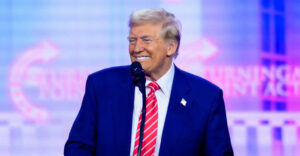
Chinese officials and the general public are both hopeful and worried as Donald Trump returns to the White House, eager to avoid a repeat of the traumatic trade war that created a wedge between economic superpowers during his first term.
Chinese Vice President Han Zheng, in meetings with Tesla CEO Elon Musk and other members of the US business community in Washington ahead of Trump’s inauguration, said he hoped US companies would “put down roots” in China and help stabilize bilateral relations, the official Xinhua news agency reported.
The last time Trump was president he accumulated tariffs of more than $300 billion on imports from China. In recent months he has said he would increase tariffs already imposed on Chinese goods by at least 10 percent, a measure that would hurt China at a time when its economy is struggling to find a firm footing.
At the same time, the US president-elect made what appeared to be a conciliatory gesture by inviting Chinese President Xi Jinping to his inauguration today. Xi sent Han in his place, a gesture of goodwill given that China had been represented only by its ambassador at the two previous inaugurations of US presidents.
In their meeting yesterday, Sunday, Han told Musk, who was appointed by Trump to head an agency aimed at a more efficient US government, that “Tesla and other US companies are welcome” to share the benefits of China’s growth and contribute to Sino-American relations.
The vice president’s meeting with US companies was chaired by FedEx CEO Rajesh Subramanian from the US side, and included the heads of eight US companies from sectors such as technology, banking, and logistics, according to a US company executive in the room, who added that the meeting exceeded the allotted time and was very cordial.
“Han Sheng is seen as a man who, because of his time spent in Shanghai, understands the concerns of the foreign business community, understands the economy,” the president of the U.S. Chamber of Commerce in China, Michael Hart, told Reuters in Beijing.
Xi and Trump had a phone call on Friday, with Trump calling it “very good” and Xi saying he and Trump hoped for a positive start to Sino-American relations.
Mao Ning, the spokeswoman for the Chinese Foreign Ministry, spoke of a “new beginning” in Sino-American relations at her regular press conference today.
Stocks in mainland China and Hong Kong rose today.
Deja vu
Despite the cordiality between the two superpowers, a sense of deja vu remains among those who remember how quickly relations deteriorated during Trump’s first term.
“From now on, until the situation becomes a little clearer, all our American customers will have to pay in advance,” said Domonique Demare, an executive at Lira Solutions, a Suzhou-based company that connects Chinese manufacturers with overseas buyers of products ranging from toys to furniture to titanium products.
“If Donald Trump does indeed impose 40%, or whatever, tariffs on Chinese goods arriving in the United States, I don’t want to be bogged down with custom-made products for special customers that just disappear,” he added.
“That’s what happened on many occasions seven, eight years ago when Donald Trump imposed 25 percent tariffs on 85 percent of goods from China.”
Another trade war will find China far more vulnerable than it was when Trump first raised tariffs in 2018, as it faces a deep housing crisis, massive local government debt, and 16% youth unemployment, among other things.
The precariousness of China’s situation is being felt by citizens on the streets of the capital.
“What I can understand is that China’s economy is not very good right now because of the effects of the pandemic, and the fact that Trump himself is a crazy, wild person doesn’t help things from our side,” said a 36-year-old Beijing resident surnamed Wang.
“The pressure is still quite high (for us).”
The effects of the latest trade war are still being felt in the world’s second-largest economy, where foreign companies are delaying investment and diversifying their supply chains by putting more money into alternative neighboring markets such as Vietnam.
Christopher Yeo, chief financial officer at a Singapore-based digital infrastructure firm in Beijing, said he expects Trump’s threats of tariffs to continue to affect cross-border investment and financing from the U.S. and other Western-connected countries.
His company’s current source of funding is from non-U.S. shareholders and therefore, he said, he does not expect Trump’s return to the White House to have an impact on his life in China.
“But I would imagine that American institutional investors will continue to reduce their exposure to China,” he said. “There used to be some U.S. companies that also invested in Chinese infrastructure — that’s not there now.”
Ask me anything
Explore related questions




