





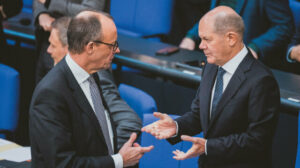
Chancellor Olaf Scholz (SPD) and the candidate of the Christian Union (CDU/CSU), Friedrich Merz, escalated their confrontation today during the final Bundestag plenary session before the elections on February 23.
Scholz warned of “difficult days ahead,” while Merz slammed the government’s policies, at the same time leaving the door open for a post-election coalition with the Social Democratic Party (SPD).
“We are facing headwinds, and this is not going to change anytime soon. I’m not promising people the moon and the stars. I, for one, won’t,” said the chancellor, accusing his opponent of making excessive campaign promises. “Tell the citizens where the money for all these promises is coming from,” he remarked pointedly, while assuring: “We will get through this.”
Referring to himself, Scholz described himself as a leader with “a steady hand, nerves of steel, and a clear direction—qualities that matter in these challenging times.” He cited the ongoing war in Ukraine, an “erratic president” in the U.S., the energy crisis, and inflation as the key challenges Germany is facing.
Scholz once again rejected Friedrich Merz’s immigration policies, arguing that they “harm German interests.” He stressed the need to preserve the cohesion of the European Union, which, he said, is undermined by proposals that violate EU regulations.
Turning toward the benches of the far-right Alternative for Germany (AfD), Scholz pointed out that the Christian Union’s proposals had gained support from the far right. He then warned: “People now know that if Friedrich Merz runs into trouble with democratic parties, he will team up with these guys,” referring to the AfD.
He once again accused the CDU leader of reckless political gambling, which, he claimed, was thwarted thanks to the democratic majority in this parliament and the “decent people” within the CDU and the Free Democratic Party (FDP).
“Far-right extremism remains a serious threat, and the SPD is the biggest bulwark against it,” Scholz asserted.
Regarding the tariffs that the new U.S. administration is threatening to impose on European products, Scholz expressed confidence that the EU would respond as a united front to defend its interests.
“If the U.S. leaves us no other choice, the EU member states will respond collectively. As the world’s largest market, with 450 million citizens, we have the power to do so,” he declared, while also expressing hope that the U.S. would reconsider to avoid a cycle of tariffs and counter-tariffs.
“Trade wars always end up costing prosperity on both sides. Even without a trade war, tough competition from the U.S., China, and other emerging markets will continue to put enormous pressure on our economy,” Scholz noted, promising new measures to support German industry, including subsidies for the “Made in Germany” brand.
Merz Hits Back: “25 Minutes of Pre-Planned Outrage”
Friedrich Merz, for his part, accused Olaf Scholz of delivering “25 minutes of premeditated outrage against the leader of the opposition,” while reminding everyone of the “chaos” within the governing coalition.
“You are leaving the chancellery with three million unemployed. What you have done to the labor market is nothing short of a disaster,” Merz charged.
He also accused Scholz and Vice Chancellor Robert Habeck (Greens) of having “driven businesses into the ground” while asking citizens to grant them another four years in power.
Merz reiterated that he has no intention of cooperating with the far right. “That is completely out of the question, and the chancellor knows this perfectly well,” he stated.
However, he acknowledged that the AfD’s poll numbers are rising and blamed the SPD’s policies for this.
“It is obviously not the opposition’s fault. This is the direct result of your government’s failures,” he told the SPD, predicting that they would have far fewer seats in the next Bundestag.
“Half of you might not even be here next week, so maybe you should put on a different show,” he added sarcastically.
On Ukraine, the CDU leader praised Scholz’s decision to modernize Germany’s armed forces but argued that it remained only on paper. He called for defense spending of at least 2% of GDP.
A Possible Post-Election Deal?
Despite their sharp differences and heated exchanges, Friedrich Merz did not rule out working with the SPD after the elections.
“February 24 will come, and then a new government must be formed with a parliamentary majority,” he stated.
He warned that if the political center fails to address Germany’s challenges, the AfD will continue to grow and inch closer to a majority.
“This is a responsibility you cannot escape—and neither can we,” he said, directing his remarks at the SPD.
Ask me anything
Explore related questions




