





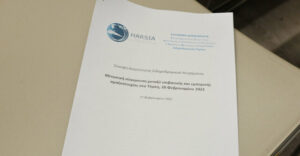
The report by the National Organization for the Investigation of Aviation and Railway Accidents and Transport Safety (EODASAAM), which was released today, details the causes that led to the Tempi accident, in which 57 people lost their lives.
The 178-page report highlights the combination of systemic failures that contributed to the disaster, including the long-standing governmental neglect of the Greek railway system, a series of human errors, and deficiencies in equipment and infrastructure maintenance that ultimately led to the tragedy.
The findings reveal serious safety deficiencies in OSE, inadequacies in personnel training and assessment, as well as dysfunctions within the Railway Regulatory Authority (RAS), which is responsible for oversight.
As stated in the report’s summary, the Larissa stationmaster did not use the automated system to set the route for train IC-62 to depart from Larissa station toward the north, towards Neoi Poroi. Had he used the automated system, all switches would have been correctly adjusted. Instead, he manually operated the individual switches and, in doing so, forgot to place switches 118 A/B in the “main” position, thus directing train IC-62 onto the wrong track. This error remained undetected by the stationmaster even after IC-62 had departed.
The summary further notes: “These actions and decisions of the stationmaster must be understood within the challenging operational framework he was facing that night. Given the available data, it is highly unlikely that the stationmaster intentionally directed IC-62 onto the wrong track. The control panel, which was supposed to be used for remote switch operation, may be easy to handle for more experienced stationmasters, but it can be confusing for someone with less experience. This was the case for the stationmaster on duty, as the control panel contained useful information scattered across different locations, alternative operating modes for switches were used interchangeably, and there were no clear written instructions.”
Additionally, the report highlights that due to staff shortages, train drivers were overburdened. “Moreover, their usual workload was significantly increased by several additional factors. There were multiple technical failures, both temporary and more permanent, which added extra responsibilities or made their duties more difficult. The drivers had to handle an unprecedented number of communications, many of which were unrelated to their primary task of train traffic control. Furthermore, the design of the work environment, particularly the placement of different operational tools, did not allow for simultaneous communication and real-time train monitoring. Finally, the stationmaster’s attention and emotional state were affected by his attempt to correct a previous mistake regarding the route of another incoming local train,” the report states.
Following this, the departure clearance for train IC-62 from Larissa station was given verbally by the stationmaster and was not confirmed through repetition by the train’s drivers. This lack of confirmation went unchallenged by the stationmaster, leaving ambiguity as to how the message was understood by the drivers. This sequence of actions was significantly impacted by the general lack of strict adherence to structured communication protocols. Additionally, the communication methodology prescribed by Greek railway regulations is outdated compared to modern international standards. Finally, the use of an open radio communication channel, a common practice in Greek railways, does not allow for direct and uninterrupted safety communications between stationmasters and train drivers.
As the report concludes regarding the causal factors of the tragedy: “Ultimately, the critical (time) threshold within which the IC-62 train drivers could have reacted to the conflicting information between the switch positions and the granted clearance was exceeded. Although it was expected that they would stop before the incorrectly set switches 118 A/B and contact the stationmaster for clear instructions, there is no indication that the IC-62 train drivers reacted to the switch positioning, which was inconsistent with the given order. The primary explanation for this is that it was a common practice for train drivers to be directed onto the opposite track. This had already occurred earlier the same day on the specific section between Larissa and Neoi Poroi. Additionally, the involved train drivers had previously driven on the wrong track to reach Larissa station from Palaiofarsalos.”
Ask me anything
Explore related questions




