





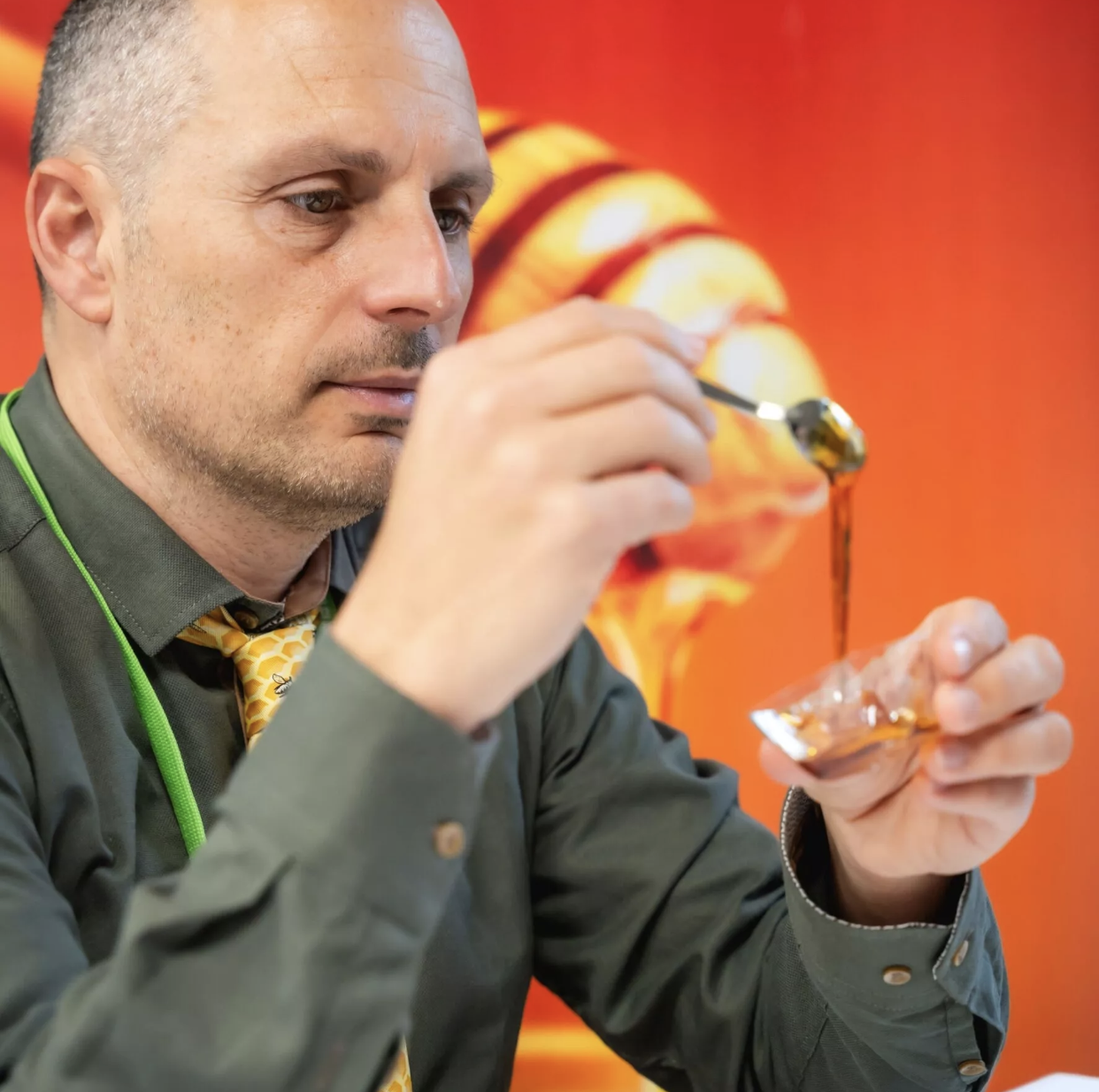
Honey is one of those goods that needs no introduction and always holds a subtle yet central place in Greek cuisine. In our breakfast, in traditional recipes, in grandma’s home remedies, and now, at the peak of gastronomic appreciation. Most people choose honey based on its color or price. Few, however, know that behind every variety lies a geographical identity, a botanical fingerprint, a specific harvest year—what we’d call “terroir” in the world of wine.
In Greece, where beekeeping spans centuries, honey tasting has become a tool for showcasing quality. Certified honey tasters evaluate samples through blind tasting, recording aromas, textures, aftertastes, and spotting flaws we wouldn’t even imagine exist. They are the experts who can describe honey the way a sommelier would describe wine: with detail, technique, and emotion.
We spoke with Spyros Skareas, agronomist and certified honey taster, about the most distinctive Greek honey varieties, the most common consumer mistakes, and whether Greek honey can truly stand alongside any other on the world stage.
1. What does it mean to be a certified honey taster? How does one train to reach that level?
Becoming a honey taster requires many years of in-depth engagement with the subject. Daily tastings of various honey varieties, a detailed understanding of honey production from bees and hives, traveling across Greece sampling unique and rare honeys, and knowing the flowering patterns, regions, and special production conditions.
Training is therefore ongoing and multifaceted, both technically and theoretically. Personally, I’ve been involved with honey and bees for over 20 years and I’m still learning new things.
The culmination of this experience is the Honey Sensory Analyst certification, which comes after months of in-person specialized training and final blind tasting exams in countries with honey tasting certification bodies, such as Italy—and more recently the USA, UK, Serbia, and Slovenia.
A honey sommelier, as the term is widely known, must not only detect differences between honeys, but describe, evaluate, compare, and justify them.
2. How many different honey varieties exist in Greece, and how do they differ?
Greece officially recognizes 8 pure honey varieties: Orange Blossom, Thyme, Sunflower, Chestnut, Heather, Oak, Fir, and Pine. In fact, Pine honey accounts for 60–65% of the country’s annual honey production.
Beyond these, there are many other monofloral varieties such as Arbutus, Goldenrod, Cotton, Carob, Acacia, Paliurus, Spiny Broom, Fir of Vytina, Pine-Thyme from Crete, and their natural combinations.
Each one has unique physicochemical and organoleptic characteristics that define it.
3. What does a professional actually look for—or rather, taste—when sampling honey?
Almost all senses are engaged in a sensory analysis. First, the visual inspection: general appearance, color, texture, clarity, presence of particles, etc. Then comes liquidity, presence of crystals, and crystallization type.
Smell is crucial—the specific aroma depending on the plant of origin. Then comes taste, which is highly complex and distinctive for each variety, followed by the aftertaste, in terms of both intensity and duration.
4. Are there “defects” in honey? What makes a honey “bad” or “average” in the eyes—and palate—of an expert?
Bees produce a flawless product. So every honey has its own taste and characteristics that may or may not be to our liking, depending on the variety and personal preferences.
Any defect arises from mishandling—by the beekeeper, the packager, or even the consumer.
A beekeeper may harvest too early, resulting in souring due to excess moisture and fermentation, or may not let it settle properly, leading to foreign particles.
A packager may overheat the honey, altering flavor and nutrients. A consumer may leave the jar open, allowing it to absorb environmental odors, or try to re-liquefy it by overheating it.
A trained taster detects these deviations easily and evaluates accordingly.
5. Which Greek honey varieties are considered world-class? Is there a “treasure” variety for you?
Thyme honey is world-renowned—and for good reason. It’s an excellent product, with floral aromas, golden color, and a long time before crystallization (which most consumers prefer).
In recent years, Oak honey and Fir honey from Vytina (also known as “vanilla honey”) have developed their own following. These are honeydew honeys from mountainous regions with distinct flavors.
Personally, I don’t single out one as the “best.” All are worth tasting, and it’s a matter of personal preference.
6. Are there “good years” for honey?
No two years are the same. Climate affects flowering patterns, which in turn shape the taste profile of each harvest.
Rain, drought, strong winds—even microclimates—significantly impact nectar flow.
7. What are the most common consumer mistakes when buying or storing honey?
When buying honey, opt for branded products—not unlabeled jars from roadside stalls.
Some people, thankfully a minority, buy solely based on low price. If it’s too cheap, be skeptical.
For storage: keep the jar tightly closed in a cool, shaded place.
To liquefy crystallized honey, use gentle heat in a water bath (bain-marie) with constant stirring.
Avoid placing jars on radiators or in sunlight for days—this likely degrades the honey.
8. What’s your opinion on “trendy” honey products—flavored, caramelized, enriched? Are they innovation or degradation?
Personally, I support honey as a pure, unique natural product. The less processed, the better.
I’d rather add my own tahini or hazelnut spread to a slice of bread with honey, than buy a multi-ingredient mix that loses its natural essence.
9. Has any honey ever moved you emotionally or sparked memories, like a good wine might?
I’d highlight three varieties that left a lasting taste impression:
- Asfaka honey from Aetoloakarnania – unique, aromatic, pale-colored with a heady flavor.
- Spring Pine honey from Rhodes – with a distinctive “metallic” and resinous aftertaste.
- Sage honey from Messinian Mani, my hometown.
10. How do you see the future of Greek honey in the global market?
Greek honey is limited, hard to produce, and costly for beekeepers, which makes it expensive globally.
But in terms of quality and flavor, it’s unbeatable—something international tasters agree on.
If we can convince global consumers of its top-tier quality and offer it in attractive packaging, we can see steady growth.
It takes constant effort, as global competition is fierce.
Some actions that help promote Greek honey worldwide include tastings I hold in tourist areas, highlighting rare local monovarietal honeys, hosting sensory seminars, and entering international taste and packaging competitions like the Specialists Awards.
11. If you had to choose just one honey for the rest of your life, which would it be and how would you enjoy it?
After 20+ years in the field, I’ve tried so many honeys that it’s hard to choose just one.
But if I had to, it would be Cretan Pine-Thyme honey, now a PDO product.
I enjoy it daily on warm bread with whole grain tahini, and also with sheep’s yogurt.
12. Compared to other European honeys, where does Greek honey stand? What makes it stand out—or what is it missing to rise even higher?
Having taken part in many international honey competitions, I can confidently say that Greek honey lacks nothing.
There are excellent Greek producers who’ve won top awards for quality and taste, appreciated by tasters and consumers alike.
What we’re missing is extroversion, promotion, global education, and constant, smart marketing.
Info
Spyros Skareas, M.Sc. Agronomist
Certified Honey Taster | Beekeeping Consultant
www.honey-experts.gr
Ask me anything
Explore related questions




