





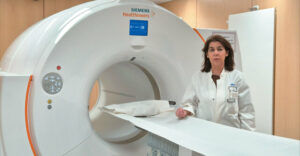
What a remarkable researcher, Andonia Dimitrakopoulou-Strauss! The renowned Greek cancer researcher at the famous German Cancer Research Center (DKFZ) in Heidelberg, Germany. It was here that Harald Hausen discovered the preventive vaccine for cervical cancer and won the Nobel Prize. Tragically, she lost both her husband and her brother to cancer. Ironically, she’s from Heidelberg, while I’m from Athens. Our conversation is both shocking and enlightening. Shocking because the number of cancers is staggering, and we’re still not paying enough attention. Diet, smoking, weight, alcohol, and sun exposure are our worst enemies. But it’s also beneficial because it emphasizes the urgent need for preventive examinations. One more crucial point: at comprehensive cancer research centers like “St. Savas,” survival rates are just 10-20%. Do you hear that?
Ms. Antonia Dimitrakopoulou-Strauss is the director of PET/CT, a hybrid cancer imaging service, where she excels. She hails from a village near Megalopolis, Arcadia, on her father’s side. “I was born in Athens, went to the German School, and earned a double school leaving certificate in both German and Greek. Afterward, I passed the Panhellenic exams for medical school. When I completed my studies, I moved to Germany.” The microphone is hers. Read on and note what to look out for.
Scene 1: New Diagnostic Methods
DIMITRIS DANIKAS: Did you specialize in Athens?
ANTONIA DIMITRAKOUPOULOU-STRAUSS: No, I just got my degree. Back when I graduated in 1987-88, waiting times for specialty programs were so long—five or even ten years for fields like dermatology.
D.D.: Ten years? Why?
AND.D.-ST: In Greece, all residents must go through university clinics, which is great, but there were fewer residency spots, so people waited for years. In contrast, Germany’s system was more open. You could complete a year or two of residency in a clinic or small hospital, collect exams, and wouldn’t have to be limited to university hospitals. However, after the crisis in Greece, many doctors left, so waiting times significantly dropped between 2010-15.
D.D.: Did you leave Greece in ’88 and go to Germany?
AND.D.-ST: Yes, to Heidelberg. Back then, without the internet, we had to find university addresses in libraries and send letters. Some hospitals invited me to come as a guest doctor, which is how I started. I initially worked in surgery, the worst department at the time—no female staff. Then, I ended up at the German Cancer Research Centre (DKFZ), where I began a PhD.
D.D.: What research did you focus on?
ADD: Cancer. In Greece, after finishing medical school, everything is clinical, mainly dealing with patients. When I came to Germany, I realized the clinical approach was just one part of the story. We performed various diagnostic tests—CT scans, MRIs, and even positron emission tomography (PET) scans, which were new and unfamiliar to me at the time.
D.D.: What’s the link between surgery and oncology?
ADD: As a student, you think surgery is a powerful specialty, that if you remove a tumor, you cure the patient. In some cases, that’s true if the tumor is primary and hasn’t metastasized. But when I worked in Heidelberg, I encountered patients with multiple metastases. Surgical oncology was frustrating then, and even now, not much has changed. In colon cancer, for instance, the focus shifted toward vaccine development.
Scene 2: Experimental Vaccines
D.D.: Are there therapeutic vaccines for cancer?
ADD: There are some experimental ones, but as far as I know, they’re not in clinical use yet. Cancer is not just one disease—it’s a vast collection of diseases. For example, colon cancer differs significantly between patients, with varying molecular profiles. Even in the same patient, the tumor’s profile can change over time, especially in recurrence or metastasis. These complexities were not known 30 years ago.
D.D.: So, cancer profiles vary greatly?
ADD: Exactly. We’re aiming for what we call 3P or 4P Medicine—Predictive, Preventive, Personalized, and sometimes Participatory, where patients are actively involved in their treatment. Essentially, we personalize cancer treatment based on a patient’s molecular profile, which we analyze through molecular tests. These are based on genomics, proteomics, and metabolomics. Today, 50% of primary tumors, without metastasis, can be cured.
D.D.: But what if there are metastases?
ADD: It depends on the tumor. Once cancer metastasizes, treatment becomes more challenging. In some cases, if there are limited metastases, they can be surgically removed or treated with radiation.
D.D. Is there a difference between metastases in the head versus the lungs?
ADD: Yes, it’s different. Metastases in the head can often be treated with radiation, allowing the patient to continue living. Metastases in the liver can sometimes be surgically removed. The difficulty arises when there are multiple metastases in various organs, such as the liver and lungs.
Scene 3: The Miracle of PET/CT
D.D.: Is cancer research being followed closely around the world?
ADD: Yes. I work in oncology imaging and keep a close eye on the latest developments.
D.D.: What does oncological imaging involve?
ADD: It’s about diagnostic tests for cancer patients—identifying primary tumors, assessing recurrence, and monitoring how patients respond to treatments. I work with PET/CT, a hybrid imaging technique that combines positron emission tomography (PET) with a CT scan. It allows us to detect metastases or tumors that might not show up on regular CT or MRI scans.
D.D.: Do these methods exist in Greece?
ADD: Yes, the PSMA drug we developed at DKFZ for prostate cancer is now available in Greece. It was later bought by Novartis. The drug, when labeled with a radionuclide, helps us detect prostate cancer via PET/CT scans.
Scene 4: Lost Husband and Brother to Cancer
D.D.: Strauss is your late husband’s name?
ADD: Yes, it’s my husband’s surname, whom I lost to colon cancer.
D.D.: When did this happen?
ADD: I lost my husband in 2013, and my brother in 2019. Both from the same cancer, at ages 63 and 53, with no known family history.
D.D.: From your research, is cancer hereditary?
ADD: Some cancers are hereditary, which is why Heidelberg is working on a large prevention center. For metastatic colorectal cancer and other cancers like lung cancer, no effective treatment has yet been found. Colon cancer, in particular, presents challenges—50% of patients with colorectal cancer develop metastases right from the start.
D.D.: So, 1 in 2 people with colon cancer will immediately develop metastases?
ADD: Yes, and once metastasis occurs, survival rates are grim. My husband survived for three years with extensive treatments and experimental vaccines. My brother survived just a year and a half.
D.D.: Twelve years ago, research wasn’t as advanced.
ADD: Unfortunately, colon cancer hasn’t progressed much. The main solution now is prevention. In Heidelberg, they’re running massive campaigns to raise awareness about cancer prevention, especially for colorectal cancer. I believe similar campaigns are also happening in Greece.
Scene 5: The Importance of Prevention
D.D.: What percentage of cancer cases are hereditary?
ADD: I can’t say exactly, but I do know that with prevention, we can prevent 30-50% of cancers. Prevention includes diagnostic tests, avoiding smoking, alcohol, maintaining a healthy weight, exercising, and limiting sun exposure. These factors are well-known, but still often ignored.
D.D.: How important is weight?
ADD: It’s not just about weight; diet plays a huge role. Our food today is filled with preservatives and sugar, and air pollution is also a factor. Cancer is primarily a disease of old age, with most cases occurring after age 60. That’s why it’s so important to start regular screenings—colonoscopy, mammograms, Pap smears, PSA tests—from age 50 onwards.
D.D.: Has cancer research worldwide progressed significantly?
ADD: Yes, there have been significant advances, particularly in basic research. Immunotherapies are showing promise in certain cancers, like melanoma. When I started in ’88-’89, patients with metastatic melanoma had a survival time of about a year. Now, some can live for up to ten years thanks to immune checkpoint inhibitors. However, for colon cancer, progress has been slower due to the complexities of its tumor microenvironment.
D.D.: Why are you focused on colon cancer?
ADD: Because that’s where I started, and it remains one of the hardest cancers to treat. Pancreatic cancer is similar, and very difficult to cure. However, certain treatments, like PSMA for neuroendocrine tumors, are showing promise.
Scene 6: Heidelberg and Innovations
D.D.: We read that cancer vaccines have been developed in the US.
ADD: here in Germany, Harald Hausen, the former director of DKFZ, discovered the preventive vaccine for cervical cancer. He won the Nobel Prize for this. He always emphasized that prevention is key. In the past, some people dismissed his ideas, but now, it’s becoming clearer.
D.D.Is there a shortage of doctors in Germany?
ADD: Yes, Germany trains very few medical students. The process is highly selective. However, due to a shortage of doctors, especially after the Greek economic crisis, many doctors have moved to Germany, where it’s easier to get their degrees recognized. Now, there’s a significant number of Greek doctors in Germany, and others from places like Poland and Syria.
Scene 7: “St. Savas” Cancer Center
D.D.: What are the prospects for cancer research? Can we expect a breakthrough in the next five or ten years?
ADD: While we won’t eradicate cancer in ten years, significant progress will certainly be made. Better prevention will reduce cancer incidence, and new treatments will emerge for certain types of cancer. For example, lung, prostate, and breast cancer now have more treatment options than ever before. Personalized treatment based on molecular profiling will be key, and comprehensive cancer centers like those in the US are vital.
D.D.: What are these comprehensive centers?
ADD: These centers bring together researchers and clinicians from various specialties—oncologists, surgeons, radiotherapists, molecular biologists, and others. I was involved in a project to establish an integrated cancer research center in Athens, in collaboration with DKFZ and the National Research Foundation. These centers have better survival rates due to better coordination, access to advanced treatments, and clinical trials.
D.D.: So, “St. Savas” is becoming a success?
ADD: Yes, it’s making great strides, although it hasn’t received full certification yet. Integrated cancer research centers like this improve survival by 10-20%. The collaboration between researchers and clinicians leads to better outcomes, and patients get access to the latest treatments and clinical trials.
D.D.: It sounds like a great Greek success.
ADD: It’s a step in the right direction. However, “St. Savas” needs support. The infrastructure is old, and additional funding from wealthy individuals or organizations, like shipowners, could make a significant difference. With proper planning, it could thrive.
Before we ended the conversation, she shared one final thought:
“Mr. Danika, I believe in public healthcare and education. We can’t rely solely on private institutions. In Germany, public hospitals provide excellent healthcare, and Greece demonstrated that during the pandemic. But our hospitals need help, and we must do something about it.”
Ask me anything
Explore related questions




