





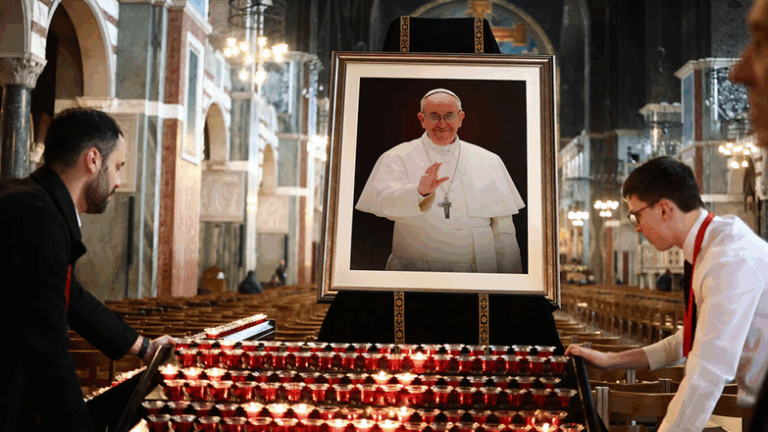
The activation of a strictly defined protocol was triggered in Vatican by the death of Pope Francis, on Easter Monday morning.
However, despite the procedures and traditions, some of which date back to ancient Rome, the Pope’s desire for a simpler funeral ceremony, in a wooden coffin and avoiding the elaborate rituals common when the Pontiff dies, has already been announced.
Already, Cardinal Joseph Farrell has taken over as interim Vatican commander and, among other things, officially announced the death of Pope Francis. His announcement opened a process at the end of which a new head of the Roman Catholic Church will be elected. The election process, which is being conducted in complete secrecy, is usually tense as progressive and conservative cardinals seek to gain control of the Vatican, which appeals to more than a billion believers around the world.
The confirmation of death, the seal and the papal apartments
As a matter of form, the confirmation of Papa’s death was made by the camerlengo, which is a senior official, namely Cardinal Cevin Farrell, who also took over as interim governor of the Vatican.
According to tradition, the cameraman visits the Pope’s body in his private chapel and calls out his name to “wake him up”. Now the procedure is considered symbolic, as doctors confirm death by medical means.
When the pontiff fails to respond, his ring, which also serves as a seal for official papal documents, is destroyed or defaced, marking the end of his term of office. The papal apartments are also sealed.
Prior to announcing the news via Vatican to the media, the chamberlain also informs the College of Cardinals of the Pope’s death.
The period of mourning
The death of Pope Francis is followed by nine days of mourning, known as the Novendiale, a tradition with roots in Roman antiquity. National mourning is also declared in Italy.
The body of Papa will be blessed, dressed in papal vestments and displayed in St. Peter’s Basilica for popular veneration. Hundreds of thousands of people are expected to line up. Among them are foreign leaders and officials.
The Pope’s body was previously displayed on an elevated pedestal. However, following his wishes, Pope Francis will lie in an open coffin.
Previously, the Pontiffs were embalmed and certain organs were removed before burial. In fact, in a church near Fontana di Trevi, more than 20 hearts are preserved in marble urns. However, these practices have been abandoned.
During the nine days of mourning, the Vatican enters a transitional phase called sede vacante (“the seat is empty”). During this time, the Roman Catholic Church is governed by the Conclave, or the College of Commissioners. However, no major decisions can be made until the election of a new pope.
The burial
The Pope’s funeral will likely be held in St. Peter’s Square. Hundreds of thousands of people are expected to flock in the coming days. The ceremony will be presided over by the dean of the College of Cardinals.
The burial of Papa, according to tradition, takes place in the Vatican caves beneath St. Peter’s Basilica, where nearly 100 papal burials are located. Pope Francis’ predecessor, Benedict, who resigned in 2013 and died in 2022, is also buried there.
However, Francis said in 2023 that he chose the Basilica of Santa Maria Maggiore in Rome for his burial. Thus, he will become the first pope in a century whose burial will take place outside the Vatican.
According to tradition, the Pope will be buried in three coffins: one made of cypress, one of zinc and one of elm, placed one inside the other. Pope Francis, however, has asked to be buried in a single wooden coffin.
“Habemus Papam”
Two to three weeks after the Pope’s funeral, the College of Cardinals will convene in the Sistine Chapel for the conclave, which is a secret process to elect the new Pope. According to the rules, any baptized male Roman Catholic can be elected Pope. However, for the last 700 years, the pope has always been chosen by the College.
Candidates do not openly campaign for the position, and the battles for the title are considered very intense.
On the day of the vote, the Capella Sistine is sealed and the cardinals, who have taken an oath of secrecy, are locked inside.
Only cardinals under the age of 80 are allowed to vote. About 120 cardinals will vote in secret for their chosen candidate, writing their name on a ballot paper and placing it on a chalice at the top of the altar.
If no candidate receives the required 2/3 majority of the College, another round of voting takes place. In total there may be up to four rounds per day. The conclave that elected Pope Francis in 2013 lasted about 24 hours and five ballots, but the process can take longer: one conclave in the 13th century lasted about three years, while another in the 18th century lasted four months.
Once the ballots are counted, they are burned in a stove inside the Capella Sistina, which has been installed in advance by the firefighters of Vatican. A second stove burns a chemical that sends a smoke signal through a chimney to the outside world: Black smoke means a new pope has not been chosen, white smoke means he has.
Once elected, the new pope appears on the balcony of St. Peter’s Basilica and announces, “Habemus papam,” which means “We have a pope.”
Then the newly elected pope, after choosing his papal name (most likely one that honors a saint or predecessor) and donning a white robe, steps out onto the balcony to give his first address to the audience. And with that, the Catholic world has a new leader.
Ask me anything
Explore related questions




