


×
GreekEnglish

×
  • Politics
  • Diaspora
  • World
  • Lifestyle
  • Travel
  • Culture
  • Sports
  • Cooking
Thursday
04
Jun 2026
weather symbol
Athens 29°C
  • Home
  • Politics
  • Economy
  • World
  • Diaspora
  • Lifestyle
  • Travel
  • Culture
  • Sports
  • Mediterranean Cooking
  • Weather
Contact follow Protothema:
Powered by Cloudevo
> Economy

Greeks are the Europeans who work the most hours per week – The Dutch the least

Agriculture, forestry and fishing the sector with the most working hours

Newsroom May 15 10:43

Δείτε περισσότερα άρθρα μας στα αποτελέσματα αναζήτησης

Add Protothema.gr on Google


The Greeks were ranked first in the list of those who worked the most hours per week by Eurostat survey based on 2024 data.

While the average workweek for people aged 20-64 in Europe was 36 hours (one hour less than in 2014), Greeks were found to work 39.8 hours a week.

In second place were Bulgarians with 39 hours, followed by Polish (38.9 hours) and Romanians (38.8 hours).

At the opposite end of the spectrum, Dutch (32.1 hours) work the fewest hours per week, followed by Danish, Germans and Austrians (33.9 hours).

In 2024, people aged 20-64 worked (both full and part time) an average of 36.0 hours per week in their main job.💼⏱️

Longest in:
🇬🇷Greece (39.8 hours)
🇧🇬Bulgaria (39.0)

Shortest:
🇳🇱Netherlands (32.1 hours)
🇩🇰Denmark, 🇩🇪Germany & 🇦🇹Austria (all 33.9)

👉 https://t.co/gpT55nZB9D pic.twitter.com/6kfggxGKJ1

>Related articles

Summer Sales 2026: When they start, which Sunday shops will be open

Theodorikakos: The profit margin cap protects consumers at this time

Mitsotakis in Sofia: New European defense financing tool, joint Greece-Bulgaria front on competitiveness

— EU_Eurostat (@EU_Eurostat) May 14, 2025

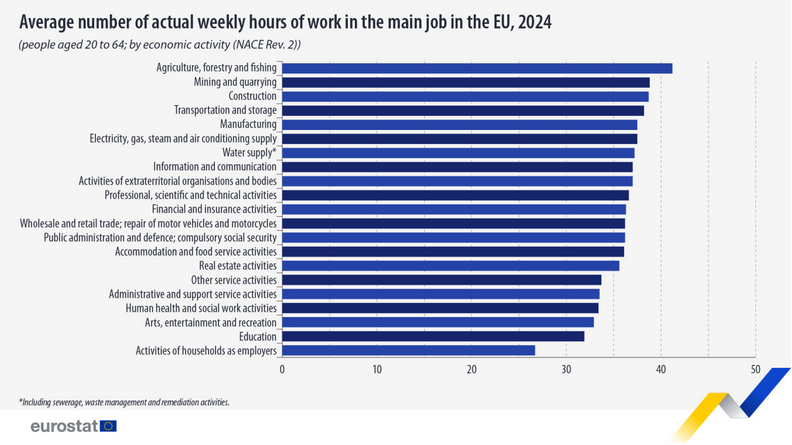
In the same survey, Eurostat also listed the sectors of activity with the longest working week in the EU in 2024.

At the top is agriculture, forestry and fishing (41.2 actual hours worked), followed by mining and quarrying (38.8) and construction (38.7).

The shortest workweeks were recorded in household activities as employers (26.7), education (26.7), and education and arts (31.9).
Ask me anything

Explore related questions

#economy#eu#greece#work
> More Economy

Follow en.protothema.gr on Google News and be the first to know all the news

See all the latest News from Greece and the World, the moment they happen, at en.protothema.gr

> Latest Stories

Summer Sales 2026: When they start, which Sunday shops will be open

June 4, 2026

Theodorikakos: The profit margin cap protects consumers at this time

June 4, 2026

Mitsotakis in Sofia: New European defense financing tool, joint Greece-Bulgaria front on competitiveness

June 4, 2026

Stournaras: Greece is entitled to be optimistic about the future of its economy

June 4, 2026

Commission approves the Marine Observatory – Papastavrou: Greece at the forefront of Marine Environment protection

June 4, 2026

USA and UK warn: China is using LinkedIn to recruit spies in the West

June 4, 2026

Contaminated food causes 1.5 million deaths a year, children under five the most affected

June 4, 2026

In Parliament: Spatial planning – Urban Planning Code ends legal fragmentation on construction, permits, and illegal buildings: See what it includes and Q&A

June 4, 2026
All News

> Greece

In reverence, the emotional deposition in Jerusalem, see photos & video

The Holy Temple of the Resurrection opened after many days due to the war between Israel and Iran

April 10, 2026

In the final stretch for the accreditation of joint master’s degrees: Aiming for their launch in the coming academic year

April 10, 2026

Schedule for Epitaph Procession today (10/4)

April 10, 2026

Perfect weather for Easter excursions, according to Tsatrafyllia’s forecast

April 10, 2026

Easter in Greece: The customs that continue in Greek tradition – From Nafpaktos to Corfu

April 10, 2026
Homepage
PERSONAL DATA PROTECTION POLICY COOKIES POLICY TERM OF USE
Powered by Cloudevo
Copyright © 2026 Πρώτο Θέμα



