






Germans and Britons continue their upward trend again this year—even if spending remains uncertain—fueling high hopes and expectations. This summer is set to break records for connections from the U.S. to Athens International Airport “Eleftherios Venizelos”, while French visitor numbers are declining across Greece, except in Athens, which they have particularly favored in the first five months of 2025. Polish travelers appear hesitant, and the Israeli market had been showing a sharp rise, which is now expected to slow due to geopolitical developments and flight suspensions in the coming weeks.
This is the current picture concerning how the main inbound tourism markets for Greece are behaving ahead of the upcoming peak season, in an economic climate that is far from favorable for the budgets of European travelers—the country’s core pool of foreign visitors.
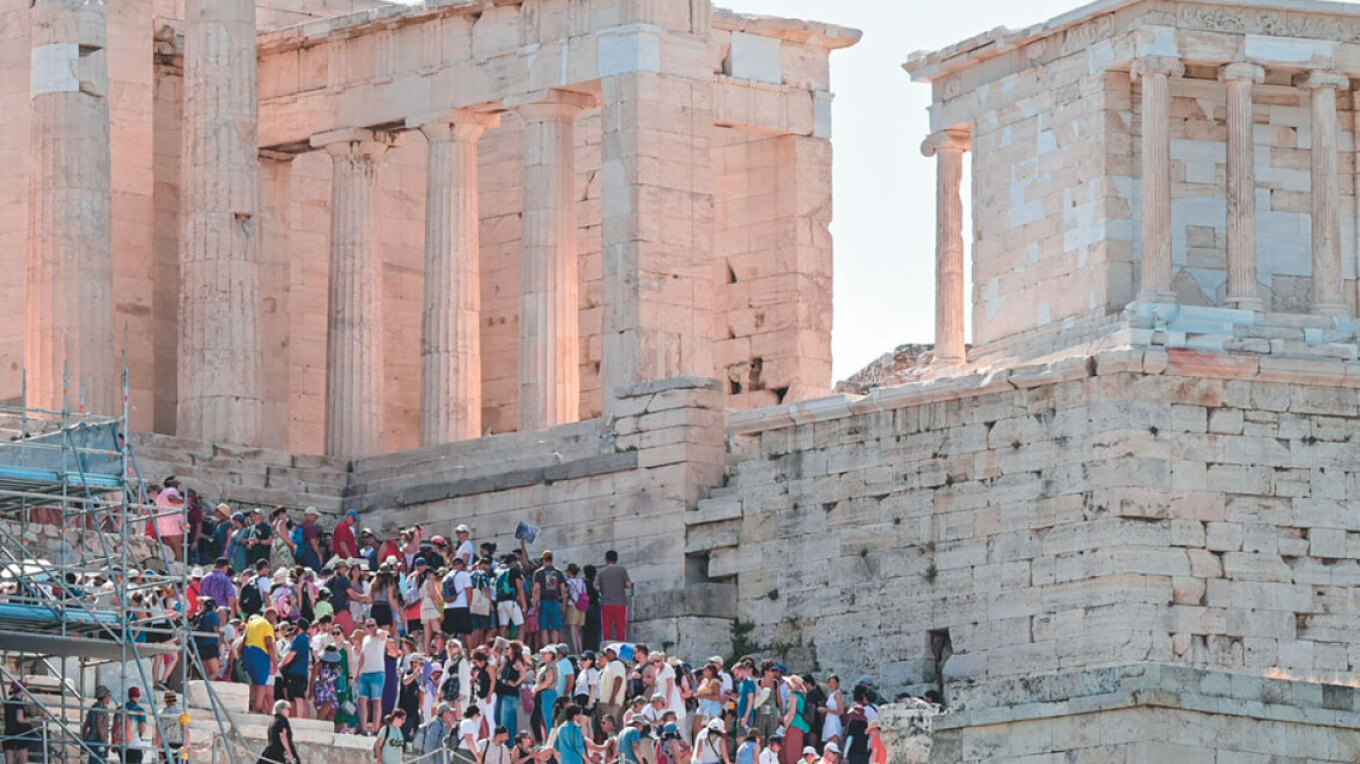
For this reason, and despite the 4.4% increase in available air seats to Greece during the June–October period—amounting to 22.72 million seats on incoming international flights—there are valid concerns about how much tourists are actually willing to spend at their destinations this year, especially following the lukewarm start to the season in May.
Additionally, last Friday’s developments in Israel served as yet another reminder that the tourism sector remains highly vulnerable to sudden events—especially when these happen during the summer, affecting travelers’ confidence.
2.8 Million in Athens
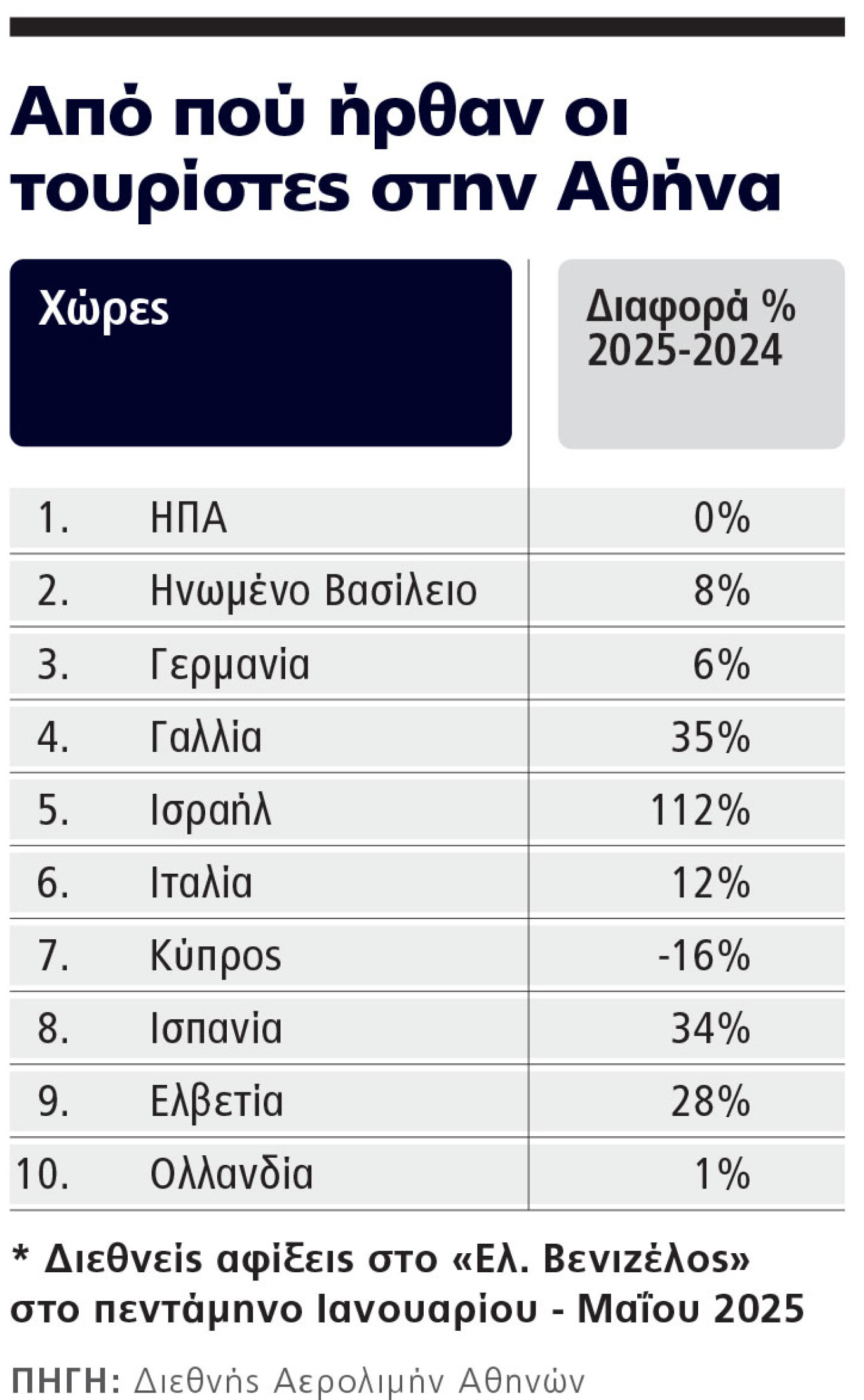
May was milder even in this year’s tourism “champion”, Athens, which has already received 2.8 million international arrivals in the first five months of 2025—a 7% increase compared to the same January–May period in 2024, according to airport data.
May closed with a modest 2.9% rise in total passenger traffic (domestic + international), reaching 3 million travelers (11.62 million over five months, +8.5%), with 2.22 million accounting for international traffic (arrivals and departures), which rose by 5%.
Overall for the five-month period, the top nationality at “Eleftherios Venizelos” was Americans, although numbers remained stable compared to last year, with greater expectations for the summer thanks to enhanced connectivity.
In second place were the British (+8%), followed by the Germans (+6%), while the big surprise—contrary to the rest of Greece—was France, with a 35% increase over the same period last year. Israel also showed more than double the figures in the capital compared to last year—but from now on, numbers are expected to decline following Friday’s announcement of flight suspensions to and from Tel Aviv.
Rounding out the top 10 are Italians, Cypriots (with a 16% decline), Spaniards, Swiss, and Dutch.
Concerns
The main concern this year isn’t so much the number of trips—where the outlook remains positive—but rather spending levels, given the overall shorter stays in destinations across the Mediterranean’s major tourism markets. This concern is also reflected in industry stakeholders’ forecasts.
For example, insights from Germany—the largest tourism source market not only for Greece but also its competitors—are generally positive according to the German Travel Association (DRV). However, shifts are noted in consumer behavior and purchasing power. Amid economic uncertainty, Germans do indeed plan to travel more abroad again this year—reaffirming their strong travel reputation—but they’re cutting back on destination spending, with cost now ranking as their top priority.

Estimates suggest that Germans will spend approximately €85 billion on travel services ahead of their summer holidays
(+6% compared to last year), with the largest increase recorded in organized holiday packages, which will receive around €40 billion as a way to better control costs. Turkey holds the top spot due to… pricing, followed by Spain and Greece in third place, while Bulgaria, Tunisia, Egypt, and lesser-known Balkan destinations like Montenegro and Albania are also seeing a rise. Consumer spending pressure among Germans is clear, with one in three stating they will need to cut back for their holidays, and 32% saying they will not take a main holiday this year—a number significantly up from 17% three years ago.
For Greece, flight scheduling from Germany points to a moderate increase of 2.5% for the summer season from early June through late October, with 3.79 million available seats over this five-month summer period.
A moderate increase of 3.1% from the United Kingdom as well
More than 4.5 million seats have been scheduled for Greek destinations, with Britons also chasing last-minute deals. According to Nikos Petrakis, head of VISA in Greece—the international digital payments company which, through Ipsos research, recorded travel trends for Greece in 2025—“It’s common in the UK for major discounts to be offered for last-minute bookings, and many Britons rush to take advantage of these deals.”

It’s worth noting that, based on the VISA – Ipsos research covering three key markets for Greece (UK, USA, France), a surprising trend emerges: nearly nine out of ten visitors plan their trip approximately one month before arrival.
The U.S. Case
Due to both distance and trip duration, visitors from the United States spend significantly more, making them one of the most valuable markets for inbound tourism. Notably, Americans rank first in spending according to VISA’s research: 21% of respondents stated they plan to spend over €18,000 per trip. On average, U.S. travelers to Greece are expected to spend €3,040 per person.
Expectations are also extremely high for the number of arrivals from the U.S. during the 2025 summer season, at least based on scheduled seat availability and weekly flight frequency, which will for the first time exceed 100 flights per week.
“We’ll have to wait until October to see whether and how American outbound travel will be affected by Trump-era politics,” tourism officials say, noting that January–May 2025 arrival numbers from the U.S. at Greece’s main airport are the same as last year—yet still hoping for a substantial summer increase.

Optimism stems from the fact that among Greece’s five primary inbound tourism markets (Germany, UK, USA, France, Italy), the American market shows the largest increase in available air seats for the June–October period compared to last year. The summer programs essentially began in May. According to data from OAG analyzed by the Institute of the Greek Tourism Confederation (INSETE), flights from the U.S. are up 22.6%, with over 555,000 seats on incoming flights to Athens International Airport from six airlines—not counting travelers entering Greece through other airports such as Istanbul, Frankfurt, etc.
At the peak of the season, 103 weekly flights are scheduled (up from 82 last year and 46 in 2019), as the summer program of American airlines is already in full swing, alongside Emirates’ year-round service to New York.
For example, on June 5, American Airlines launched a new route connecting Athens with Charlotte Douglas International Airport. The Greek capital is now one of eight European destinations directly served from Charlotte. The roughly 10.5-hour journey to Athens is the longest commercial flight the airline has ever operated from Charlotte.
A first for Los Angeles as well:
Norse Atlantic Airways inaugurated its direct flights from Los Angeles to Athens on the 3rd of the month—marking the first time the Greek capital is directly connected to the West Coast of the U.S. According to Konstantinos Harokopos, head of the Greek National Tourism Organization (GNTO) for North America, not only is California—and particularly Los Angeles—one of the most important gateways for international travelers, but the broader West Coast area has shown impressive growth in recent years. Furthermore, members of California’s Greek-American community, one of the largest Greek diaspora communities in the world, will now be able to visit Greece more frequently and with greater ease.
France and Poland
Expectations are lower from France, as French tourists are under financial pressure this year and are opting to vacation within the country, where a notable increase of 12% has been recorded—based on the latest May barometer from EDV, the organization representing 85% of the travel agency market in France. Compared to May 2024, most European and Mediterranean destinations, including Spain, Greece, Italy, Morocco, and even budget-friendly Turkey, have seen a drop in bookings.
This decline is reflected in scheduled air seats to Greece, which are down by 2.8% for the five-month period through October, totaling 1.34 million seats across the country. However, it is striking that in Athens, during the low season (January–May), the French ranked as the 4th largest nationality, with a 35% increase compared to last year. According to VISA’s data for this year, September is expected to be the peak month for French tourists, with 20% planning to travel then.
Italy shows stronger numbers
More arrivals are expected from Italy this year, with a 4% increase in scheduled air seats over the five-month summer season, totaling more than 2.15 million seats to Greek airports. In addition to air travel, a significant share of Italian visitors also arrive in Greece by ferry. Italian arrivals in Athens specifically have also risen—up 12% in the first five months of this year compared to the same period last year.
On the flip side, markets that surged last year but are slowing down this year include Poland. The decline is attributed to income pressures and negative sentiment due to geopolitical concerns, particularly Poland’s proximity to Ukraine, according to tourism officials.
Israel: A Mixed Picture
In contrast, Israeli tourists have returned to Greece in strong numbers this year, with arrivals in Athens alone up 112% since the start of the year. For the upcoming high season (the next five-month summer period), the number of scheduled air seats has seen the largest increase of any market—over 41%—surpassing 1 million, up from 755,000 last year.
However, a pause in this market is now expected in the short term, following Friday’s announcement of a suspension of flights in the coming weeks. It’s worth noting that over the past two years, the Israeli market suffered losses due to developments involving Hamas, and 2025 was seen as the first full recovery year for this key tourism source.
According to available data, in 2024, arrivals from Israel amounted to 621,000—representing a 1.7% share of total inbound tourism to Greece. Overnight stays reached 3.93 million (also a 1.7% share), and revenues stood at €419 million, or 2% of total tourism receipts. Projections for this year had anticipated a strong increase, largely based on the surge in scheduled international inbound flights.
Ask me anything
Explore related questions




