






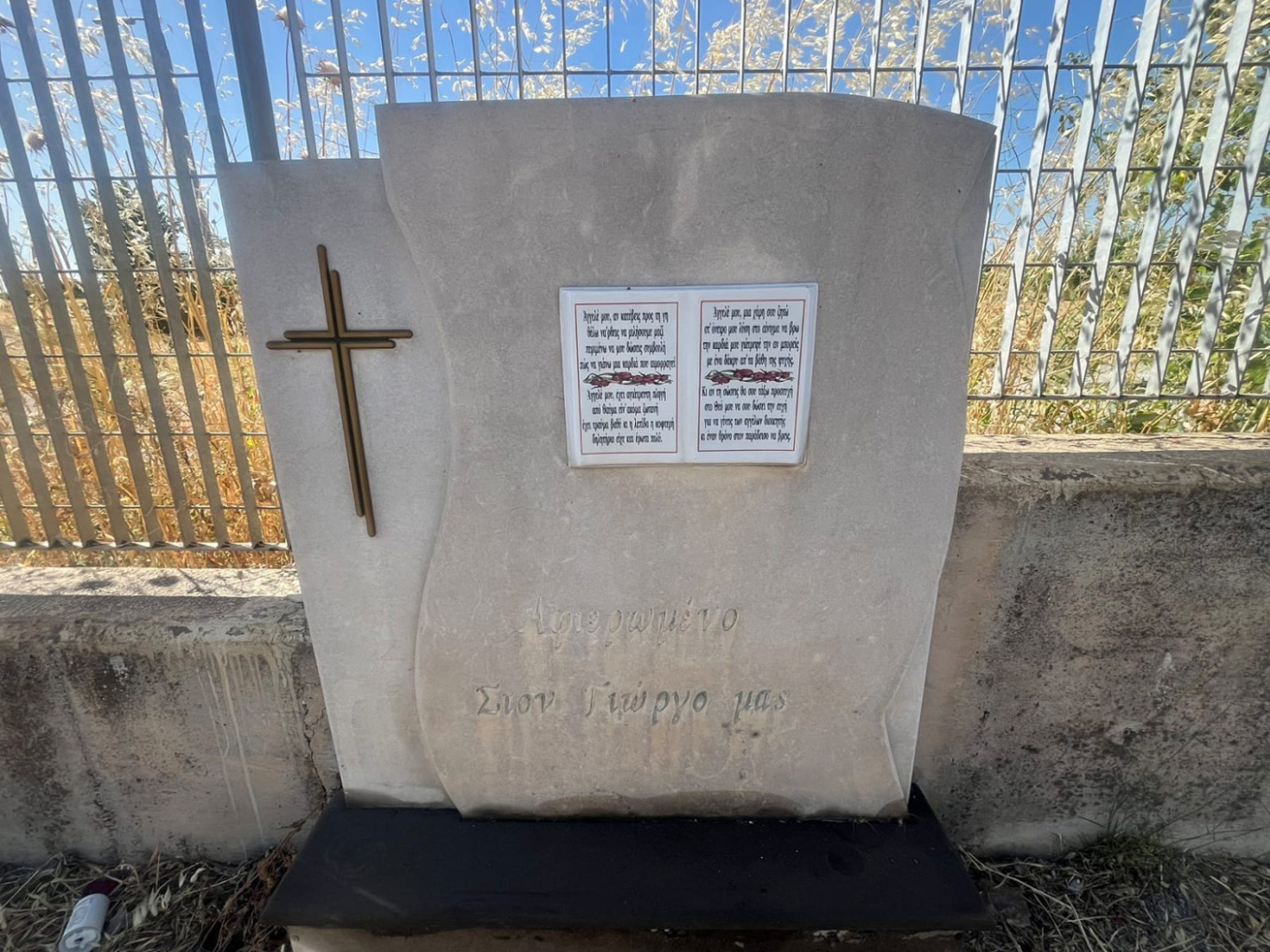
A small memorial plaque on Asklipiou Street in eastern Thessaloniki, placed there by his family at the spot where he was found murdered inside his taxi, is all that remains to remember 32-year-old Giorgos Chliapas, whose killing remains, even after 16 long years, unsolved.
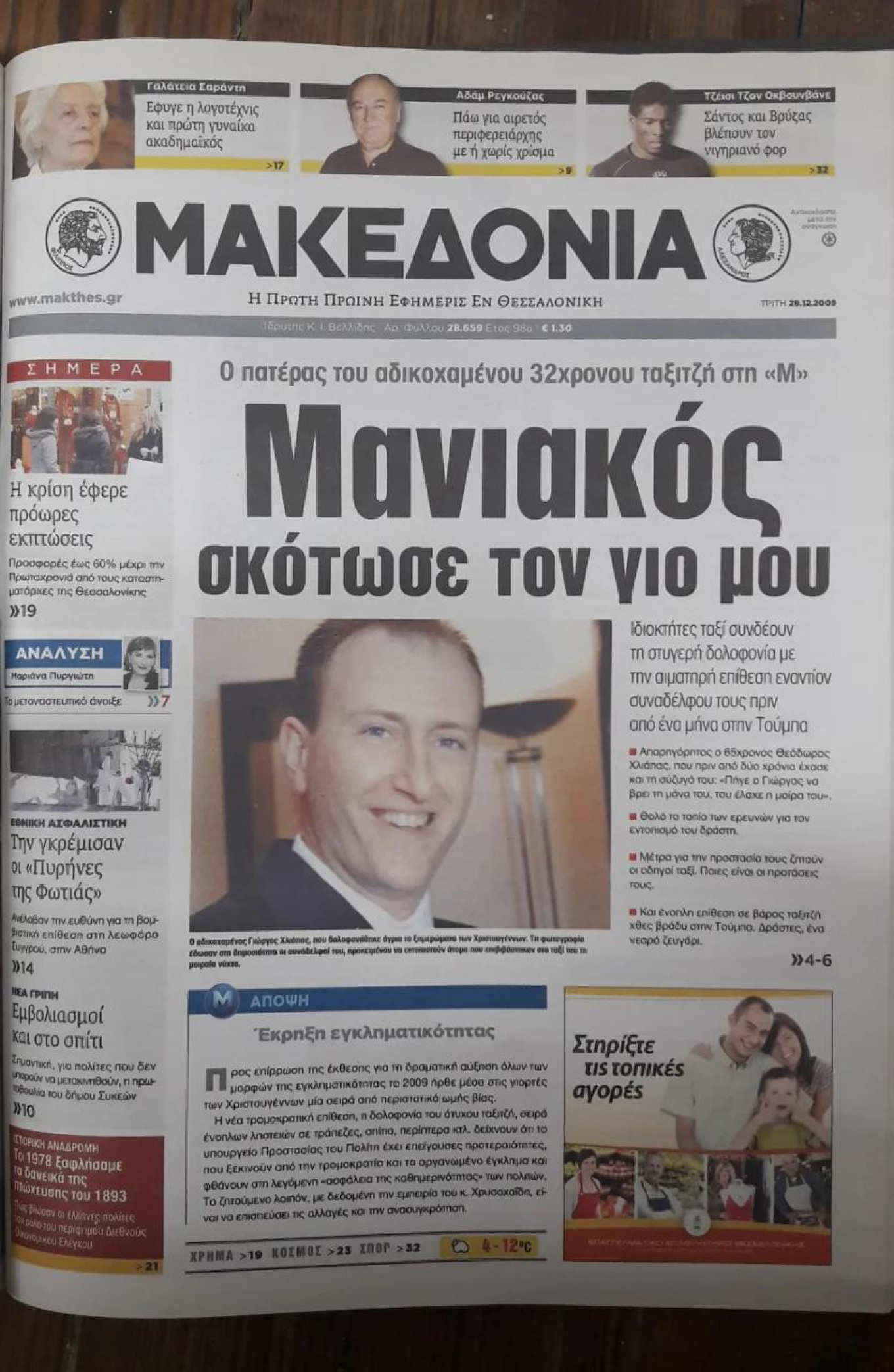
It was December 24, 2009. Giorgos Chliapas, 32 years old, left the festive dinner table, said goodbye to his wife—whom he had recently married—and to his father, and set off in the taxi he had purchased—half-owned—with big dreams to run his own business. It was Christmas Eve, and there was plenty of work to be done.
Found Dead in His Taxi on Christmas Eve
As the night went on, people in Thessaloniki were out partying, and taxi drivers were working nonstop. At around 3:50 a.m., now Christmas Day, a taxi driver was driving along Asklipiou Street, located between the Interbalkan Medical Center and the IKEA shopping complex.
He noticed a taxi with its headlights and hazard lights on, and the driver sitting motionless in his seat. Just a few meters away, there was a taxi stand. The driver wondered why the taxi was parked there and not at the stand. Sensing something was wrong, he stopped and approached the vehicle. What he saw made his blood run cold.
Giorgos Chliapas, 32, was dead—covered in blood—with a scarf tied around his neck, securing it to the headrest of the seat. The scarf bore the logo of a Thessaloniki sports team. A full alert was issued immediately. Police arrived at the scene in record time, along with dozens of other taxi drivers.
The unknown perpetrator (or perpetrators), who remain at large, is believed to have been sitting in the back seat of the taxi. He took Chliapas by surprise, immobilizing him with the scarf, which he wrapped around the driver’s neck and tied to the headrest, then stabbed him multiple times in the neck.
The “Orphan” Fingerprint and the Search Every Three Months
The floor behind the driver’s seat had become a pool of blood. A small water bottle was also found at the scene. According to protothema.gr, the forensics team meticulously examined the interior of the taxi to uncover any clues that might reveal the killer’s identity.
They collected DNA, shoeprints (including one on the back of the driver’s seat), and fingerprints from the rear left door handle.
One of the fingerprints, however, has haunted the investigation to this day. It was classified as an “orphan” print—meaning it did not match any record in the police database of known offenders, so the identity of the person remains unknown.
Even now, 16 years after the heinous murder, the forensics team in Thessaloniki checks the database every three months, hoping to match the orphan fingerprint and finally identify the killer.
Surveillance Cameras Provided No Clues
Unfortunately, the security camera at the first guardhouse of the Interbalkan Medical Center did not capture anything due to the distance from the parked taxi. There was no security camera at the second guardhouse at the time.
“It Was Chaos – Many Colleagues Carried Weapons”
Those bloody Christmas holidays in Thessaloniki remain etched in the memories of many taxi drivers, who still recall the murder of Giorgos Chliapas with sorrow—and the fear that followed, which led many to carry weapons illegally, even pepper spray.
One of them, Thodoris Stavridis, who was working at the “Lefkos Pyrgos” taxi company at the time (now president of the Taxiway cooperative), recalls the shock experienced by himself and his colleagues, who made many protests asking for protective glass barriers to be allowed inside taxis, as used abroad.
“The taxi stand near IKEA had other taxis, but Giorgos’s taxi was parked about 50 meters away, and his colleagues didn’t have visual contact. A colleague found him on the way to a nearby hotel, saw the taxi, and stopped. It was something that shocked us,” said Mr. Stavridis.
“We were scared, it was chaos. Many colleagues started carrying weapons, most had pepper spray. There was a lot of unrest. The fear lasted a long time, especially because no motive was found—there was no robbery, no apparent reason. It was insane,” he added.
A “Precursor” to the Murder
In November 2009, a month before Giorgos Chliapas’s murder, another incident involving a taxi driver occurred—which, although it’s unknown if it was connected, was seen as a potential precursor to the fatal attack.
A 52-year-old taxi driver, identified as H.L., had a passenger in the back seat who, without warning or reason, began stabbing him.
“I remember it like it was yesterday. It was in the afternoon. The colleague was in Ano Toumba, near the church of Agia Marina in a narrow alley, and the passenger suddenly started stabbing him while he was driving. As soon as the stabbing began, he crashed the taxi into parked cars, opened the door, and escaped while the attacker had already stabbed him two or three times. He shouted for help and ran. Fortunately, the driver had managed to get on the radio and alert everyone,” said Mr. Stavridis.
Notably, this incident also remains unsolved. The attacker took neither money nor any valuables—not even the driver’s phone.
Ask me anything
Explore related questions




