





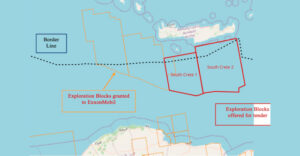
Athens is sending a stern message to Tripoli following Libya’s note verbale to the UN, in which the Government of National Unity attempts to challenge Greece’s delineation of its Exclusive Economic Zone (EEZ) south of Crete, basing its claims on the invalid Turkey-Libya Memorandum of Understanding.
According to diplomatic sources, “Greece rejects any action or initiative based on null and void agreements with no foundation in the International Law of the Sea.” As they emphasize, “an official response will be submitted to the UN,” refuting the content of Libya’s communication and reiterating Greece’s strong opposition to the Turkey-Libya memorandum, which constitutes a blatant violation of international legality.
In its note verbale dated June 20, 2025, Libya characterizes Greece’s announcement of exploration blocks south of Crete as “a clear violation of its sovereign rights” and “a unilateral measure without legal basis.” However, for the first time, Libya outlines its claims in an official document, presenting maps based on the illegal memorandum with Turkey—maps that effectively erase Greece’s EEZ.
The disputed maps, attached to the communication, go as far as to nullify even the maritime influence of Crete, entirely disregarding international law. Tripoli labels the contested areas as “Libyan maritime zones,” despite admitting that there is an “unresolved dispute” with Greece regarding EEZ delineation.
Athens’ response is unequivocal: “No reaction will deter the Greek government from responsibly and effectively exercising the country’s sovereign rights,” the same sources stress. They also recall that Greece has repeatedly expressed its willingness for dialogue with Libya, based on the Law of the Sea, when circumstances allow.
According to reports, Athens had anticipated Libya’s submission of the note verbale to the UN. The Libyan side aims to assert its positions on the international stage, reacting to Greece’s activation of exploration blocks, in which major international energy companies are already involved.
Despite using rhetoric around “open dialogue,” the Libyan government continues to assert claims stemming from the illegal memorandum. Greece, maintaining diplomatic composure, will insist on the need for technical talks on delimitation, with the goal of eventual resolution by the International Court of Justice in The Hague—a process that would, by default, invalidate the Turkey-Libya memorandum.
Domestically, opposition parties have reacted with varying tones. PASOK-KINAL urged the government “not to refrain from exercising sovereign rights” and to prevent any further challenges. SYRIZA accused the government of “lacking a clear and coherent national strategy,” while the Communist Party (KKE) stated that the development “exposes the foreign policy of New Democracy.” The Greek Solution party described the situation as a “threat to national sovereignty.”
Athens is expected to submit its official response to the UN in the coming days, likely including corresponding maps and legal arguments based solely on the International Law of the Sea. In any case, the Greek Ministry of Foreign Affairs makes it clear that it will not accept faits accomplis and will continue to actively exercise its rights in all areas under Greek jurisdiction.
Ask me anything
Explore related questions




