





“The results of my DNA test as a Turkish woman show that I am 47.8% Greek,” Ozge writes on her TikTok account. “Welcome, our sister,” Greek and Greek users comment to her, while some Turks in the comments caution their compatriots not to give their DNA to the company that analyzes their ancestry, “because it belongs to Jews who want to harm us.”
One of the latest, delightful trends on TikTok wants young men and women from Turkey to post the results of their DNA test. In most cases, a high percentage of Greek ancestry emerges, which dozens of Greek users of the medium comment on with the phrase “welcome, our brother”, while prompting a storm of questions from other users.
How genuine are they?
The trend is reminiscent, in a way, of the case of Ibrahim Yailali, the Turkish ultra-nationalist, Samsun-born member of the Grey Wolves, who had volunteered to join the Turkish army. Yailali, brought up with the Islamic Turkish ideology, had been taught to hate other peoples and so, as a trained commando (Special Forces sniper), proudly declared in 1994 that he wanted to fight the Kurds of the PKK he so hated.
The truth is that if he had been killed in the fierce fighting with the organization led by Abdullah Ocalan, he would have been another martyr, a hero of the Turkish nation. But life had other plans. Yailali was captured by the Kurds and held hostage for two years.
During this time, a series of coincidences and journalists’ investigations revealed a shocking truth: Yailali is a Greek of Pontus. His grandfather was Konstantinos and his grandmother, Paraskevi, from the settlement of Yaila in the village of Asar. “If the Kurds had told me I was Greek before I was captured, I would have cursed them,” he said.
Now free, Yailali made a spectacular turnaround after seeing the truth. From being a member of the Grey Wolves, instead of spreading hatred, he began speaking out about the historical truth of the Pontian Genocide. He was arrested and held in a military prison for months and released until he was tried on serious charges.
Today, Yailali, who has changed his name to Yannis-Vassilis, is an activist – a supporter of Pontian truth and historical justice. A few months ago, he described the shocking story of his life at the events on the Pontian Genocide organized by the Municipality of Nice – St. I. Rentis, in cooperation with the Union of Pontians of Nice – Korydallos and the Recreational Cultural Association of Rentis “Ionia”. Previously, he kneeled with respect at the monument “Uprooting” of the Park of Pontian Hellenism in Nikaia.
Back to DNA tests. Can these create new Yailali? The truth is that this trend has created many new components. It has aroused the – natural – curiosity of many young people in the neighbouring country to discover everything about their ancestry, but it has also created waves of attempts to avoid using these new services. And on the other hand, many Greeks feel that they are finding their … lost brothers and sisters. But what happens to those who discover their Greek ancestry?
A common question that users from third countries usually ask Turks and Turkish women whose DNA test shows Greek ancestry is how they feel. That is, whether the result made them feel differently. “I have always felt an attraction to the Aegean, a special love, which is now explained,” says Ozge.
“I didn’t expect to be just 10 percent Turkish,” says Giouz, whose test showed her to be 46 percent Greek. Giouz, whose nickname was “Turkish girl,” is now being teased by – mostly Greek – users who wonder if she should change her nickname to “Greek girl,” even though she clearly states that she is Turkish.
Emre, whose test shows that she is 53.4 percent Greek, 11.6 percent is of Central Asian descent, 10.2 percent is from Georgia and 9.4 percent is from Turkey, is happy to receive “welcome to the family” comments.
“We are always people who remain people,” he comments, while in the comments of his post there is… a party. “MyHeritage (the company that did the DNA test) is Israeli-owned and headquartered in Israel. It intends to divide us,” writes a Turkish man, while a Greek comments that “Mama Greece is opening her arms for all her lost children.”
Gamze says she took the test thinking it would make her “100% Turkish”. In reality, however, the test revealed that she is 45.8 percent of Greek descent, and as young Gamze is beautiful, her Tiktok has been inundated with comments from Greeks boasting about their “beautiful sister” – some even in Turkish – and discouraging her from applying for Greek citizenship.
Sean Dokan also expected that the DNA test would make him 100% Turkish. With 49.1 percent Greek ancestry, he jokingly says that “now I will have to state on my resume that I am half Greek and half Italian” (based on the rest of the test results). To the Greeks’ “welcome”, Sean replies “welcome, what’s for dinner”, with some Greeks seriously responding that they are waiting for their… lost brother to make him dinner at their house. And he is also seriously considering it, as he wonders if they will make him moussaka and what other foods will be on the table.
With the trend of “I took the DNA test thinking I’d come out 100% Turkish” taking huge proportions, there are many who wonder why this is happening, with some Greeks explaining that these are Anatolian Greeks who survived the genocide, and Turks complaining that the results are doctored by… Mossad, who wants what’s bad for Turkey.
At the end of the day, however, Greeks and Turks wonder if in a war between the two countries they would become “fratricides” and are reduced to debating with jokes like “since we are proven Greeks, we should annex Greece because we will need some islands” and “you should start a revolution for union with mother Greece.”
Celebrities and the boycott
The issue of… revealing the identity of the Turks’ DNA is anything but new. Suffice it to think that since (not so near) 2021 there have been calls in the neighbouring country for a boycott of companies that do DNA tests, and similar discussions on all social media.
The most recent such example, which even took on huge proportions in Turkey, is that of the famous Turkish (?) youtuber Orkun Isitmak. Isitmak, whose YouTube channel has more than 10 million subscribers (the size of… Greece) and recently made his film debut, did a live DNA test. It revealed that his ancestry is 57% Greek and 84% European, sparking debate after debate in the country.
And earlier, however, on Reddit, one of the most popular questions was from a Turkish man who had uploaded a screenshot of his DNA test, asking why the results spoke of 69% Greek ancestry from western Asia and (again) Greek and 19.5% Italian from Europe.
The author said that “to my surprise, it showed no connection to my DNA from Central Asia, 0.0%. As far as I know, no one in my family, at least back to my great-grandparents, speaks Greek. Is it reasonable to assume that I’m probably a Pontian Greek who was Islamized/exiled back in the day?”
Another Reddit user, in his analysis, tries to explain: “The region of modern Turkey has never been homogeneous. It is a huge country. Eastern Turks are much closer to the Armenians/Upper Mesopotamians/Caucasians, with very little Turkish interference. Western Turkey has some of the more real Turkish admixture (which remains a minority in their DNA), but the population before the Seljuks/Ottomans (the majority of their DNA) was more western and similar to Cypriots and Dodecanese Greeks.
The pre-Turkish Anatolians were not Mycenaean, so they were not fully Greek, but they had extensive Hellenistic influence and there was a significant amount of Mycenaean/Greek mixing (30%-40% in Roman samples) in western Turkey. At the same time, there was also significant domestic eastern admixture (from Caria, Lycia, Lydia), as well as eastern oriental/mesopotamian admixture.
Turkey is diverse. And Turks are neither fully Turkish nor Turkified Greeks, but the result of complex migrations to Anatolia. As a Turk, I can say that the facts are true.
And that doesn’t surprise me much. It is obvious that Turks only started migrating to Anatolia 1,000 years ago. As the Turks became the dominant culture, the others assimilated over time. Maybe I’m Greek or Persian or Kurdish. It doesn’t matter, in my opinion. I grew up as a Turk, so that’s what I am, regardless of my ancestors.”
From the Middle Ages
Maps circulating in Turkey are indicative of the fact that Greek DNA clearly predominates in areas where solid Greek populations have been found for thousands of years.
At the same time in the same provinces there are large percentages of people with blond hair, characteristics that do not match those of the Turkish races.
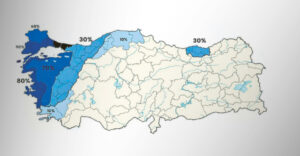
In support of the above, there is another Ancestral Whispers map circulating on the Internet, based on data from the Turkish DNA project, regarding the “relatedness” of today’s Turks to the Turks of the Middle Ages, which shows that in no region of Turkey is the DNA of modern Turks “related” to that of the Turks of the Middle Ages by more than 50%.
They do not have more than 50% of the number of Turkic Turks in the Middle Ages.
These percentages start from 1%-2% on the northeastern border of Turkey, in most of them range from 15%-35% and only in a few regions (opposite the Dodecanese and in 2-3 other regions) they exceed 40%, reaching up to 48%.
Ask me anything
Explore related questions




