





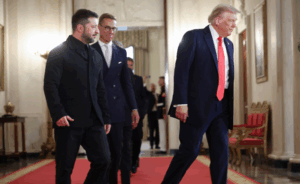
The White House meeting lasted, if you include the time of Donald Trump‘s 40-minute phone call to the Kremlin, almost the same time as the bipartite meeting that the US president had on Friday with his Russian counterpart in Alaska. The six or so hours Donald Trump spent in Alaska and the six hours it took him to meet with the Ukrainian president and the most powerful players on Europe may have been the most difficult twelve hours – diplomatically – since the beginning of the war. What has been produced yesterday is a fact much more – cumulatively – as Europe as a size and dynamic on the one hand is far from small and on the second hand because it seems that the Franco-German objections regarding Russia’s intentions had to find a way to be bent.
Germany and France made a clear differentiation in front of open cameras from NATO, Italy, Britain and Finland regarding the fact that it is rather inappropriate to discuss total peace agreement leaving the war fronts active… When the solution was given or for others postponed until later with Trump’s personal commitment to Paris and Berlin for answers immediately and pressure if required in that direction the US President forwarded the Russian message he received in Alaska…
The convergence points and gain of the White House conference
It is clear from what all the participants in yesterday’s conference said publicly that the US is now on the same page as Kiev’s allies at least when it comes to where and how Volodymyr Zelensky should be at the main table. Trump’s US at the start of the process excluded the Ukrainian President from the Lavrov-Rubio meeting in Saudi Arabia, and the briefings received by the Presidential Palace in Kiev were either terse or vague from the White House every time the US President spoke to Moscow… As of yesterday, the black-clad Zelensky stopped being the black sheep” that Trump and Vance thrown out of the White House last February and the US seems to be giving the Ukrainian president space to state his own positions without being attacked…
Meanwhile the France-Germany-Britain front still seems solid with Macron – Merz and Starmer insisting that they will stand by Zelensky both through the coalition of the willing and individually for as long as the situation requires. At the same time, the European Union, through the Commission, also still appears willing to continue to support this effort with the means at its disposal – mainly financial – and will continue to support it in the coming day. Another important development is the announcement by Zelenski that he has accepted the Russian – ultimately not the American – proposal for a direct meeting with Putin, a development that shows that there may be a clear strategy from Moscow but that some important – and not small – steps have been taken. Who would have argued that a dialogue between Russia and Ukraine would ever have been possible before yesterday’s events and developments? In the same pattern of “pluses” we should also include the now clear change of attitude by the US which, through Trump, did not hesitate to leave open even the possibility of an immediate commitment to the next day in Ukraine even if this will be paid dearly – literally – by Ukrainians and Europeans alike.
The pitfalls and costs of American friendship
The data meeting had several“cloudy” points in addition to the positive ones. One of them is the fact that Volodymyr Zelensky publicly referred to the agreement already concluded with the US for purchase of weapons directly for $100 million. Both the Ukrainian President and his US counterpart did not hide the fact that this money comes mainly from Ukraine’s European partners through the NATO channel. Europe is also even deeper in Ukraine’s war as the President during his speech after the end of his long stay in the White House made it clear that he considers it part of the security guarantees that Europe will contribute even more money to Kiev’s budget which has made it a requirement for any agreement that it has one of the strongest armies at every level
For this to happen, Kiev will first have to have the funds to pay those who will be members of the troops, Zelensky said meaningfully in response to a question. Europe in this way is now clearly caught between the US and Ukraine and despite the fact that it has bridged the gap with the Oval Office it is very unlikely that it will not reach even deeper into its pockets to ensure that its easternmost borders do not soon turn into battlefields… One trap that does not seem to be solved immediately and easily has to do with the axis of France and Germany, which yesterday may have folded in the face of Trump’s commitment but will hardly insist on demanding tangible proof from Moscow that what Putin is saying today means what he says today. Murch was clear regarding the ceasefire an idea that Paris also supports and will especially demand if there is a meeting between Zelensky and Putin by the end of August and its immediate implementation without “yes but”. “Minus” is clearly the fact that today the Union and the continent in general is under constant and multidimensional pressure from either the West or the East and can hardly manage it without economic – so far – bleeding.
The Union must and must quickly and effectively change not just a process but important parts of its rules and formulate a framework in which efficiency and speed are paramount if it does not want to be the next big victim of those who prey on it. The stakes are high and the priorities are different today but that does not mean the problem can wait much longer…
Ask me anything
Explore related questions




