





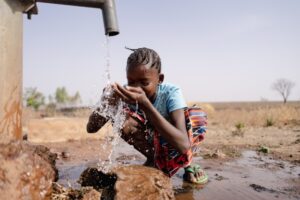
More than 2 billion people still lack access to safely managed drinking water, the United Nations said today in a report, expressing concern over the insufficient progress toward universal coverage.
UN agencies responsible for health and childhood estimate that one in four people worldwide did not have access to safely managed drinking water last year, while more than 100 million people continued to rely on surface water sources such as rivers, lakes, and canals.
The World Health Organization (WHO) and UNICEF state that delays in the water, sanitation, and hygiene (WASH) improvement program are placing billions of people at increased risk of disease.
In their joint study, the two UN agencies also concluded that the goal of universal access by 2030 remains far from being achieved. On the contrary, they noted, the target is “slipping further out of reach.”
“Water, sanitation, and hygiene are not privileges: they are fundamental human rights,” said Rüdiger Krech, WHO’s Director for Health Promotion, Environment, and Climate Change. “We must accelerate our efforts, particularly for the most marginalized communities.”
The report assessed five levels of drinking water services:
- The highest level, “safely managed” drinking water, means access to drinking water on premises, free from fecal or chemical contamination.
- The following four levels are: “basic” (access to improved water within 30 minutes), “limited” (access to improved water but requiring more time), “unimproved” (sources such as unprotected wells or springs), and finally “surface water” (from rivers, lakes, or canals).
Since 2015, 961 million people have gained access to “safely managed” drinking water, raising global coverage from 68% to 74%, according to the report.
Of the 2.1 billion people who still lack access to safely managed drinking water, 106 million depend on surface water — a number that has fallen by 61 million over the past decade.
The number of countries that have eliminated the use of surface water for consumption rose from 142 to 154.
As of 2024, only 89 countries had basic drinking water services, including 31 with universal access to safely managed drinking water.
The 28 countries where one in four people still lack access to basic services are mainly located in Africa.
Ask me anything
Explore related questions




