





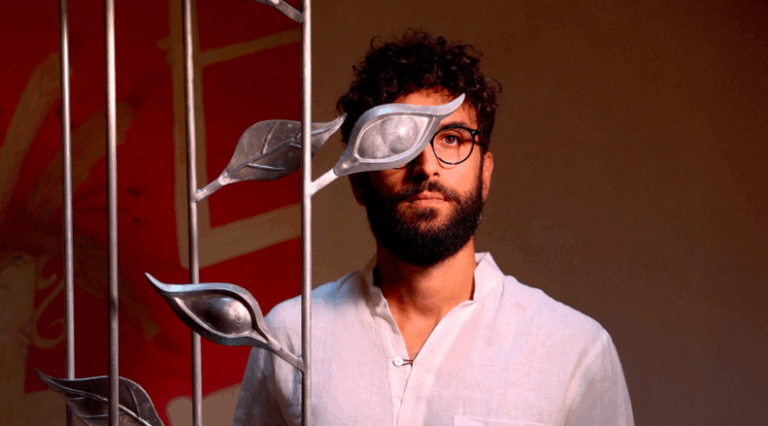
The most representative visual artist of his generation “flutters” his new creations alongside the breeze of Alekos Fassianos’ works. His exhibition is one of those that make Athens beautiful during the summer.
Interview with Giorgos Papaioannou.
GALA: Is there a work of yours that acts as a mirror to a piece by Alekos Fassianos?
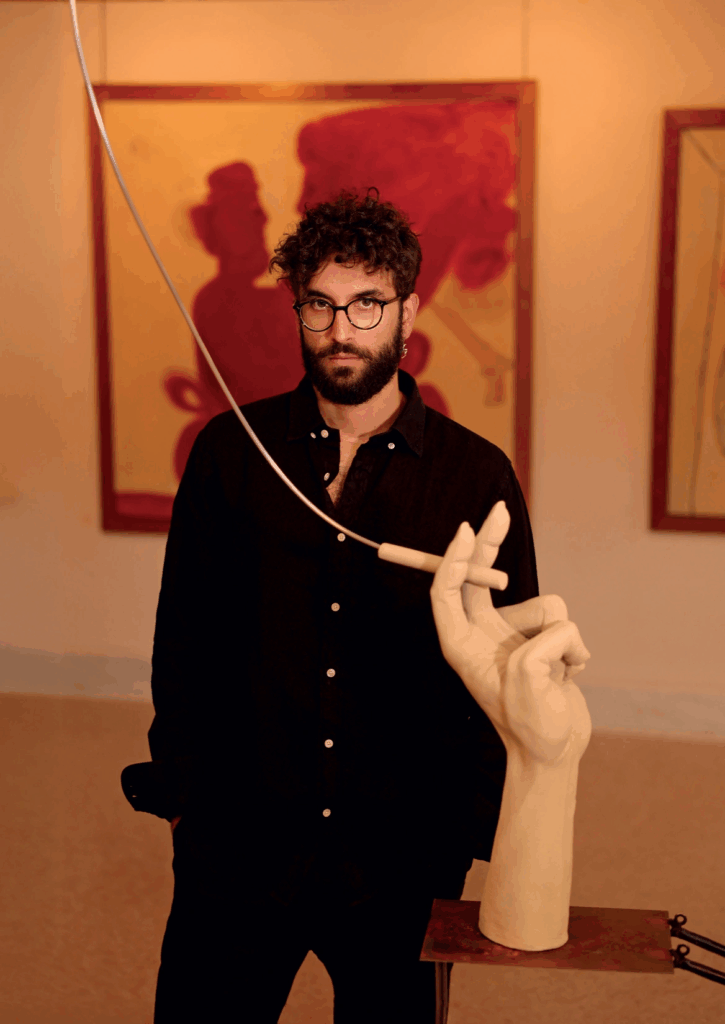
Panos Prophetis: Yes, in a way there is. It’s called “Biker (2025),” a sculpture I created specifically for the exhibition. It’s influenced by the bicycle figures Fassianos often depicted—mainly female, riding and smoking, with smoke and hair billowing in the air. It reflects the relationship between machine (bicycle), human, and fire (cigarette—smoke), projecting an image of freedom and emancipation. The cyclists with clouds of smoke resemble steam engines. The composition seems somewhat seductive and provocative, especially today, as it contrasts smoking with athletic bodies—an image at odds with modern standards of polished, flaw-free bodies promoted by consumerist political correctness. Yet, in a time when poverty, wars, and discrimination can be more destructive, the cigarette on the bicycle takes on a different dimension.
GALA: Do your masks aim to reveal or hide something?
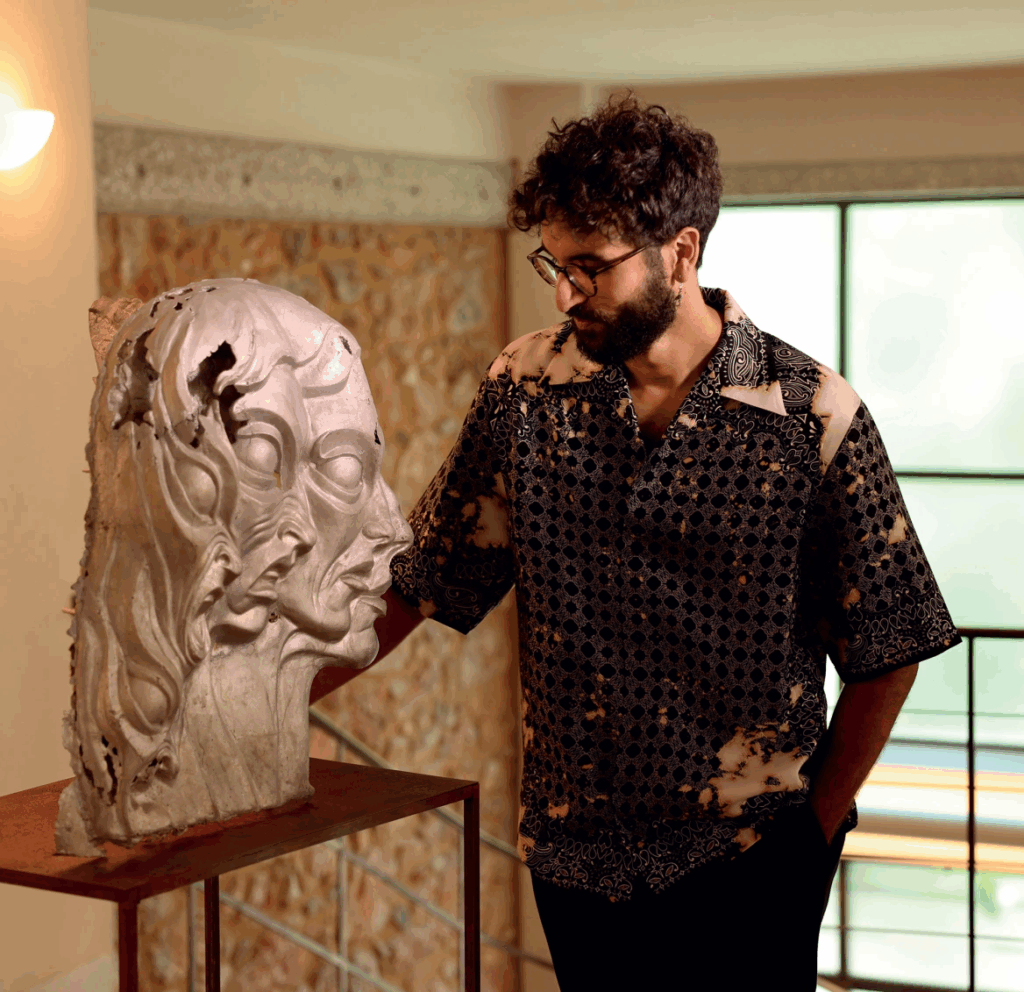
Panos Prophetis: In my work, masks are tools to explore political, anthropological, and philosophical issues. Masks appear in nearly all cultures; in ours, they are deeply connected from ancient drama and rituals to carnival festivals. In comedy, especially in Aristophanes, the “face” is the most exposed part of the body—not just visually but also in terms of awkward or comic accidents. Turn those heads around, and you discover they are hollow behind, revealing their theatrical and hypocritical nature. To paraphrase symbolically, the masks I create reveal something by hiding it.
“Dialogue is essential for learning to coexist with the different, the ‘other,’ the strange.”
GALA: Your work draws from influences like ancient Greece, Byzantine art, Picasso, Goya, and Alien. What unites them within you?
Panos Prophetis: I think, in a strange way, all these are interconnected, as well as with the present. Art often follows a linear evolution: one movement hands the baton to the next, preserving elements from the previous. This evolution is usually linked to social or political change. For example, Hellenistic art connects to early Byzantine art (mosaics, rituals), and we can see qualities of Cycladic art—primitive or naive—in Picasso and other modernists. Goya’s later works carry mythological motifs inherited from Hellenistic art, and Alien can be connected to Goya and the above influences. I was born in the late ’80s, immersed in sci-fi movies and comics, so science fiction fascinates me.
GALA: What’s the dominant feeling in your studio when you work alone, isolated from the outside world?
Panos Prophetis: It’s somewhat chaotic. When I’m in the studio, especially creating a piece, it’s a state of explosive disorder: scattered materials, sketches, tools—until the project is finished, then they need to be organized for the next. Sometimes I feel the studio is a cave; other times, it transforms into something livelier and noisier. I try not to be completely cut off from the outside world. I enjoy interacting with the neighborhood and people. I also seek collaborations beyond the studio with choreographers, performers, and other artists, which often lead me to new paths and discoveries.
GALA: Has there been a work that, upon completion, surprised you, as if someone else had created it through you?
Panos Prophetis: I think that sense of surprise, of entering uncharted waters during the process, is common among many creators. When I start a work, I research, sketch, gather references, but when I actually make it, I don’t follow all the preliminary steps strictly. I leave room for the unexpected and the chance. It might sound mystical, but I often feel a third force at play. Then I look at my hands and realize I am the one creating the work—though I joke about it!
GALA: When did you realize that you don’t just love art but need it to continue?
Panos Prophetis: I realized this already during my student years at the Athens School of Fine Arts. The hardest times in my life were when I couldn’t do what we call “art.” Yet, to keep going, you also need courage, luck, stubbornness in the face of failure, and other qualities.
GALA: Which part of yourself do you try to understand or reconcile each time you start a new piece?
Panos Prophetis: I’ve grown and come to terms with some aspects of myself. I don’t think you need to be completely reconciled or understand yourself fully to create. Often, my works are projections of thoughts I dislike or anti-heroes of a narrative—beasts that take form.
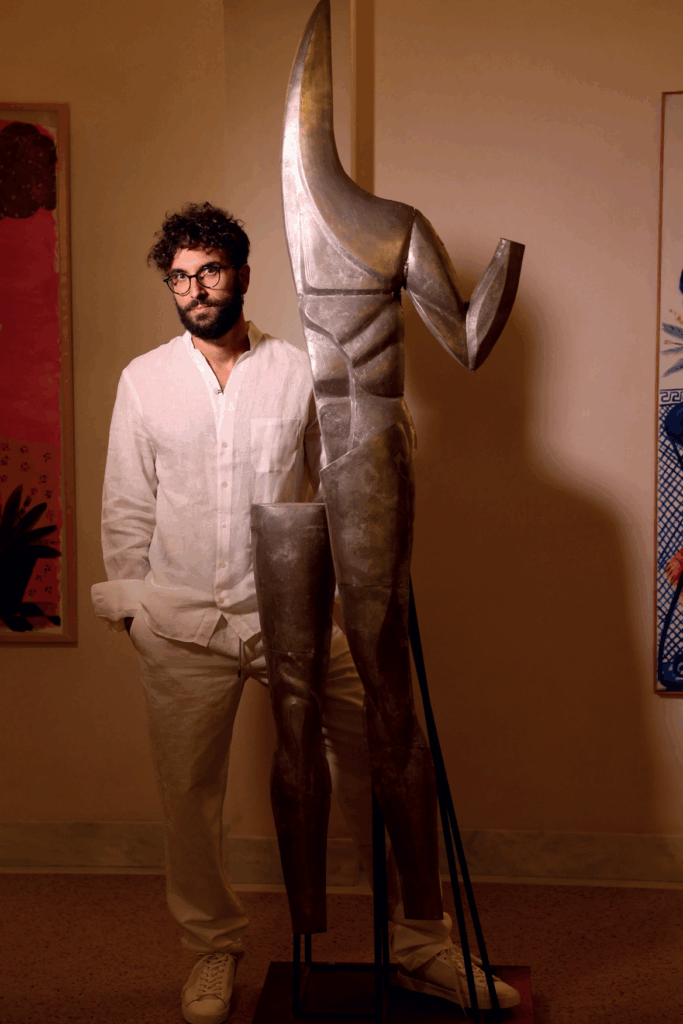
“I like when viewers touch my works. Most are sculptures, so touch is very important.”
GALA: Is there a childhood memory or object that seems to reappear in your work like a ghost?
Panos Prophetis: I have various childhood memories that somehow come back in my work, especially the sense of play. Playfulness is vital in creating art—the experimentation with materials and ideas. Without that curiosity and impulsiveness, it becomes a sterile, rational process, which I find dull. There’s a piece my mother embroidered with my uncle when they were teenagers, always in the house. I recently moved it to my home and observed its imagery and designs. I realized that what I do in my art was already there: faces, repeated forms, botanical motifs, symbols. It felt like those patterns are imprinted in my subconscious. That embroidery is like a ghost that was always present, accompanying me, and I recognized it more vividly when I looked at it closely.
GALA: Do you ever feel that the viewer intervenes in your works with their own interpretation? If so, does it bother or enchant you?
Panos Prophetis: I would like viewers to intervene. When I do an installation, I want the audience to become part of it. I consider them very important; through their gaze, the works come alive. Like books—when we open and read them, they breathe. I don’t want my works to be entirely closed; I encourage viewers to piece together their own connections and meanings. I enjoy when they touch my works—most are sculptures, so touch is very meaningful. It’s nice to feel a work with all our senses.
GALA: If a visitor leaves your exhibition at the Alekos Fassianos Museum with just one emotion, what would you want it to be?
Panos Prophetis: I’d like it to be the feeling of coexistence through dialogue. In the exhibition, we emphasized that art often doesn’t have completely closed boundaries. It’s very relative what we consider contemporary and how works from the past can still be relevant. This idea should also apply socially: dialogue is essential for learning to coexist with the different, the “other,” the strange, the opposing, to avoid polarization and alienation.
Info:
Exhibition “The Wingbeat of the Line | Dialogue with Alekos Fassianos,” until September 14, at the Alekos Fassianos Museum (Neofytou Metaxa 15, tel.: 210 8819079).
Instagram: @panosprofitis
Ask me anything
Explore related questions




