





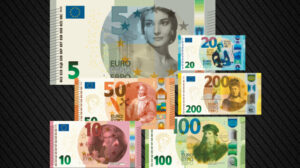
The euro is being reintroduced with redesigned banknotes carrying an even stronger Greek identity. The word “euro” will be printed in Greek on the new notes, while one side of the new €5 bill will feature the portrait of Maria Callas – one of six emblematic figures of European culture who left an indelible mark on the continent’s history.
The changes are already underway. After 23 years of the first two editions of euro banknotes, the European Central Bank (ECB) is proceeding with their redesign, aiming at aesthetic renewal and strengthening the European identity they represent. Within 2026, final decisions will be made, and the new banknotes will be put into circulation.
This period will also coincide with major events such as Bulgaria’s entry into the Eurozone, requiring the printing of additional notes to supply the country. In total, euro banknotes in circulation will surpass the 30 billion mark.
Meanwhile, the discreet withdrawal of the now-rare purple €500 bills continues. While still legal tender, they are rarely seen in daily transactions. The ECB is also accelerating preparations for its next big step: the creation of the digital euro.
The New Banknotes
The word “euro” will continue to appear in three scripts: Latin, Greek, and Bulgarian Cyrillic. However, instead of the previous “Ages and Styles” theme of European architecture, two new thematic categories have been selected:
- European Culture: celebrating historic figures who shaped Europe’s collective identity. Featured portraits include:
- Maria Callas (€5) – the legendary soprano, dubbed La Divina.
- Ludwig van Beethoven (€10) – Germany’s towering classical composer.
- Marie Curie (€20) – physicist and chemist, Nobel laureate, pioneer of radioactivity.
- Miguel de Cervantes (€50) – Spain’s greatest novelist, author of Don Quixote.
- Leonardo da Vinci (€100) – Renaissance master and polymath.
- Bertha von Suttner (€200) – Austrian novelist, peace activist, first woman Nobel Peace Prize laureate.
A dispute has already broken out between France and Poland over Marie Curie’s naming. Born Maria Sklodowska in Warsaw, she later took her husband’s surname in France. The ECB’s use of only her French name has sparked controversy in Poland, though the country is not part of the eurozone.
- Rivers and Birds: focusing on Europe’s landscapes and biodiversity. Each banknote will feature a characteristic natural scene alongside representative fauna. A Europe-wide design contest was announced for graphic artists, with finalists to be chosen in October 2026 and the final decision taken later that year.
ECB President Christine Lagarde is keen to finalize the process within her term, which ends in autumn 2027.
The Gift of Kohl to Andreas Papandreou
For Greece, the continued presence of the word “euro” in Greek carries special significance. This was decided at the December 1995 EU Summit in Madrid as a “gift” from German Chancellor Helmut Kohl to Greece, along with wishes for the recovery of Prime Minister Andreas Papandreou, then hospitalized.
Coin Minting in Greece and Albania
Greece has minted euro coins since November 1999 at the Hellenic Arms Industry’s Epirus Metallurgy Plant in Kefalovryso, Ioannina, near the Albanian border. The facility produced euro coins and blanks for Greece and other countries but faced challenges during the financial crisis. Today, under ElvalHalcor S.A., it remains a major European supplier.
The Vanished €500 Note
The €500 note stopped being issued in 2016 due to its use in criminal activities, including money laundering and tax evasion. Lightweight and high in value, it remains legal tender but scarce in transactions. On collector markets, it sells for around €530. Germany still has over 300 million €500 notes in circulation, worth €150 billion.
Digital Euro
The next step will be digital. The ECB aims to introduce the digital euro between 2027–2029. It will not replace cash but complement it, enabling secure, instant digital payments while safeguarding privacy. Users will access it via a digital wallet from banks or public authorities. Offline transactions will preserve cash-like anonymity.
From Earth to the Moon x10
Today, more than 29 billion euro banknotes worth €1.5 trillion are in circulation – double the number from the euro’s 2002 launch. Lined up end to end, they would now stretch the Earth–Moon distance ten times.
Did you know…
- The word “euro” appears in Latin (EURO), Greek (ΕΥΡΩ), and Cyrillic (EBPO).
- Greek euro coins began production in 1999 near the Albanian border.
- €500 notes, discontinued in 2016, are collector’s items today.
- The digital euro is expected by 2027–2029.
Ask me anything
Explore related questions




