





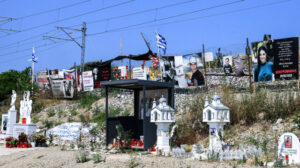
The Larissa Appeals Prosecutor, Mr. Lambros Tsogas, has requested the referral of 36 non-political individuals to trial before the Three-Member Court of Appeal for Felonies over the Tempi tragedy. His proposal, consisting of 996 pages, has been sent to the President of the Court of Appeal of Larissa.
In his proposal, the Appeals Prosecutor does not focus solely on the direct responsibilities of those immediately involved — inexperienced stationmaster Vasilis Samaras and his two colleagues, Kostas Pavlopoulos and Panagiotis Chamilos, who left before their shift ended on the fatal night of February 28, 2023, leaving Samaras to manage train movements at Larissa station alone — as well as OSE inspector Dimitris Nikolaou, responsible for monitoring the stationmasters’ shifts. He also highlights the long-standing failures of the bodies responsible for railway safety — namely executives of OSE, RAS, ERGOSE, and senior officials of the Ministry of Infrastructure and Transport. Criminal liability is also attributed to senior executives of Hellenic Train, as well as the OSE employee who sat on the committee that approved Samaras’ hiring as a stationmaster despite the fact that he exceeded the age limit of 48 years specified in the job posting.
The Larissa Appeals Prosecutor’s proposal includes charges of dangerous interference in fixed-track transport with possible intent through actions endangering railway safety, resulting in the deaths of many people, serious bodily harm to many others, and significant damage to public infrastructure. Other charges include multiple counts of negligent homicide, serious bodily harm through negligence by persons with special responsibility, simple bodily harm through negligence, as well as breach of duty committed jointly.
OSE: The then-president of the organization, Spyros Pateras, and all senior executives are defendants. The prosecutor notes that, despite his legal obligation, the OSE president did not propose to the Minister of Infrastructure and Transport or to the Regulatory Authority for Railways (RAS) the enactment of a New National Rule as an urgent, temporary preventive safety measure. At the same time, train speed limits were never imposed — a measure that could have decisively prevented a collision or at least mitigated its consequences — and the Larissa remote control system, disabled since a 2019 fire, was never restored.
RAS: Regarding then-president of the Regulatory Authority for Railways, Ioanna Tsiaparikou, the prosecutor stresses that although she knew the GSM-R communication system, installed since 2018, was operating with deficiencies, she failed to certify it in time. This system would have provided continuous and reliable radio communication between stationmasters, drivers, and traffic regulators. She is also charged with failing to impose regulatory measures on OSE — through inspections, supervision, fines, or even revocation of safety certification — despite being aware of deficiencies in critical railway safety systems on that section of the double track.
ERGOSE: The proposal stresses that the conduct of the accused is directly linked to the collision, since had they not neglected the restoration of key safety and traffic control systems, and had they implemented contract 717 on schedule, ensuring full operation of the ETCS Level 1 system, the disaster could potentially have been avoided.
Ministry of Infrastructure and Transport: The prosecutor notes that the ministry had the authority, upon advice from RAS and OSE, to approve and immediately apply a New National Rule, but never did — a failure that could have prevented the tragedy by enforcing safety standards.
According to procedure, the parties now have about 10 days to file legal remedies if they deem necessary. The prosecutor stresses that there is no need for further investigative actions, as all necessary inquiries have been completed, the Court of Appeals has issued relevant decisions expanding charges and ordering investigative acts, and testimonies from passengers — direct eyewitnesses — have already been gathered in sufficient number.
The Appeals Prosecutor concludes that there is no need to return the case for additional questioning of other victims who suffered injuries but have not yet testified.
The prosecutor’s proposal, sent to the President of the Court of Appeal, marks the case’s entry into its final phase. Families of the victims and Greek society now await the trial, which they hope will finally deliver accountability for the deadliest railway accident in the country’s history.
Ask me anything
Explore related questions




