





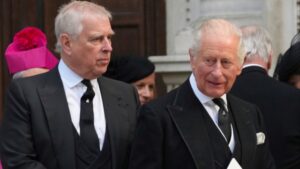
Buckingham Palace announced Thursday that King Charles has begun the process of removing all royal titles and honours from Prince Andrew, following renewed scrutiny over his long-standing association with convicted sex offender Jeffrey Epstein.
The former prince will also be required to vacate the Royal Lodge near Windsor Castle, his residence since 2003.
In a statement described by commentators as unusually blunt, the Palace said:
“His Majesty has commenced formal proceedings to remove Prince Andrew’s titles, styles, and honours. Prince Andrew will henceforth be known as Andrew Mountbatten-Windsor. His lease of the Royal Lodge, which had afforded him legal protection to remain there, has now been revoked. He has been formally notified to surrender the property and will relocate to a privately funded residence.”
The Palace added that the decision was taken “despite his continued denial of all allegations.” Andrew, 65, is expected to move to Sandringham Estate, around 100 miles north of London, where he will live in a residence funded personally by the King.
A Decision Long in the Making
Palace insiders described the King’s move as “inevitable,” noting that the controversy surrounding Andrew had become a persistent shadow over the monarchy. According to British media, Charles III had faced mounting pressure from advisers and members of the royal family to act after new evidence surfaced contradicting Andrew’s earlier statements.
The decision follows years of public frustration over the Duke of York’s handling of allegations brought by Virginia Giuffre, a victim of Epstein who accused Andrew of sexual assault when she was a teenager. Giuffre, who maintained her claims until her death earlier this year, reached an out-of-court settlement with Andrew in 2022 for a reported £12 million.
Although Andrew continues to deny any wrongdoing, he has accepted the King’s decision “to avoid further damage to the institution,” according to The Guardian.
Reactions Across Britain
Politicians across the spectrum welcomed the move. Culture Secretary Lisa Nandy told the BBC it sent “a strong message that no one is above accountability,” while Conservative leader Kemi Badenoch praised the King’s “very difficult but necessary” decision. Liberal Democrat leader Sir Ed Davey said Andrew had “brought shame upon his office.”
Public opinion remains divided. Many believe the action is overdue, while others question why it took the Palace so long. During a recent royal appearance at Lichfield Cathedral, one protester shouted to the King, “How long have you known about Andrew and Epstein?” — highlighting ongoing public unease.
Legal and Financial Questions
It also emerged that Andrew purchased the Royal Lodge in 2003 for £1 million and has since paid only a nominal rent. Despite stepping back from public duties in 2019, questions persist about the source of his income.
The anti-monarchy group Republic said it plans to pursue legal action against Andrew, calling the removal of titles “insufficient.” Chief executive Graham Smith stated:
“Let’s be clear — Andrew Mountbatten-Windsor has not faced justice. Losing titles does not address allegations of such seriousness.”
Pressure also continues from the United States, where lawmakers are urging Andrew to testify before Congress about his connections to Epstein.
Why the Name Mountbatten-Windsor
Following the loss of his royal titles, Andrew will now be known as Andrew Mountbatten-Windsor — a surname created in 1960 to combine the family names of Queen Elizabeth II and Prince Philip.
The name “Windsor” was adopted by King George V in 1917 to replace the German-sounding “Saxe-Coburg and Gotha” amid anti-German sentiment during World War I. “Mountbatten” is an anglicised version of “Battenberg,” the family name of Prince Philip’s mother, Princess Alice of Battenberg.
Impact on Family Members
Andrew’s daughters, Princess Beatrice and Princess Eugenie, will retain their titles under existing royal protocol. His ex-wife, Sarah Ferguson, who currently lives with him at Royal Lodge, will also have to vacate the property and is expected to move to a separate residence.
This marks the first time in more than a century that a British prince has been stripped of his title. The last instance was in 1917, when Prince Charles Edward, Duke of Albany, was deprived of his honours for siding with Germany during World War I.
A Defining Moment for the Monarchy
The fallout from the Epstein scandal — and Andrew’s involvement in it — remains one of the most damaging chapters for the modern British monarchy. King Charles’ decision underscores his determination to present a “leaner, cleaner” royal family focused on duty and accountability.
As public scrutiny intensifies, the monarchy faces a defining test: balancing tradition and loyalty with the demands of a society that increasingly expects transparency — even from its royals.
Ask me anything
Explore related questions




