





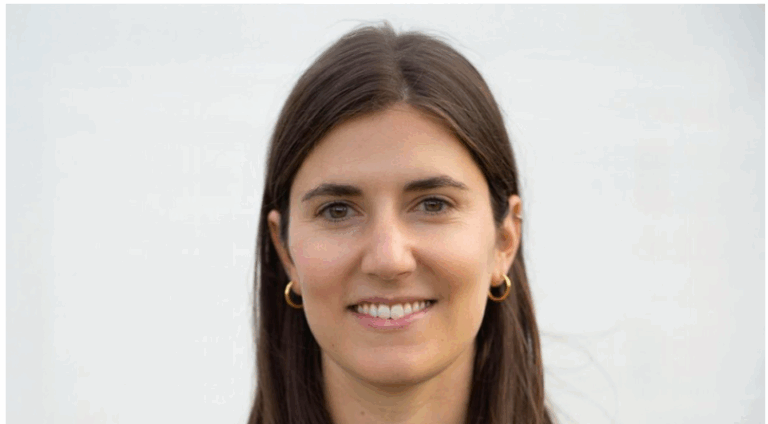
Every three years, at Bauma—the world’s leading construction-industry trade fair in Munich—amid robotic arms, safety helmets, cranes and thousands of visitors, mostly middle-aged men, Eirini Psalida hears the same question more times than she can count:
“Do you work at the coat check?”
Or, at best: “Are you the secretary?”
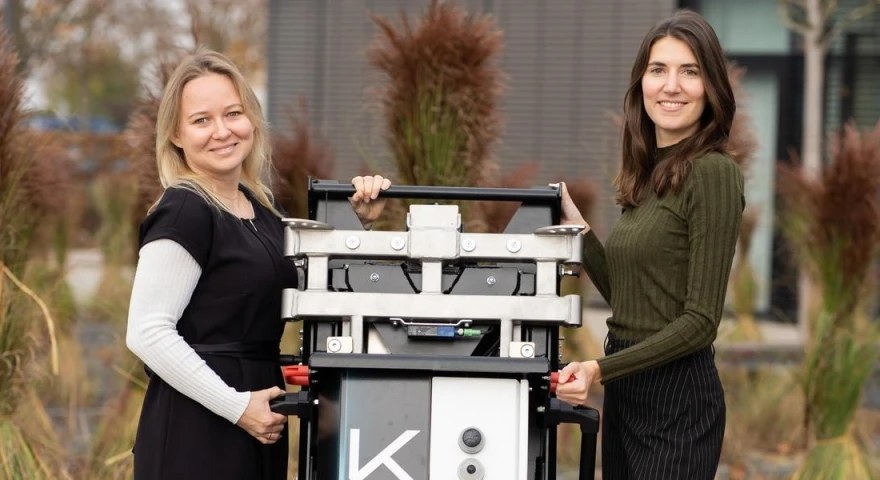
When she replies that she is the co-founder and Head of Software at Kewazo, a Munich-based robotics startup in the construction sector, the intrusive looks suddenly soften with embarrassment.
“They don’t do it to insult me. It’s just the first thing that comes to mind because they’re not used to the idea that a woman might own her own company.”
Photo caption: Eirini Psalida (right) with her co-founder at Kewazo, Ekaterina Grib.
Munich’s Technical University as a Catalyst
Eirini herself never imagined she would start her own company—certainly not the version of Eirini from ten years ago, when she was studying computer science in Athens before leaving for an internship at CERN in Geneva. Later she moved to Munich for her master’s degree at the Technical University of Munich (TUM).
“Honestly, it wasn’t part of my plans at all,” she tells Deutsche Welle.
Her story could have been another standard one: study abroad, work a bit, gain experience, return home. “Yes, mom, I’ll be back by thirty,” she remembers saying, laughing.
But a mix of curiosity, skill, and the right timing changed everything. Munich was beginning to transform into a hub for tech startups, and TUM was at the center of that movement, supporting and encouraging technological and entrepreneurial initiatives.
“It was really the university that gave us all the stimulus and support,” she recalls.
In the second semester of her studies, she met her future co-founders: Ekaterina and Artem from Russia, Sebastian from Germany, Alimzhan from Kazakhstan, and another Greek, Leonidas Pozikidis. Together, they decided to take part in a hackathon.
“Smart Cities”… but Construction Sites Stuck in 1950
During the event, where programmers and researchers collaborate intensively for days or weeks to create software or a technological prototype, the group developed an intelligent hoisting system capable of lifting and lowering construction components with safety and precision.
There was no “big idea” and no business plan—just the observation that the construction industry, unlike every other sector, lagged behind in an era of AI and automation. The world had “smart cities” and “smart homes,” yet workers on construction sites still carried pipes and platforms as if it were 1950.
“I never imagined it would become a company,” Psalida says. “We named the system ‘Kewazo’—basically from the Greek word for ‘to construct’—almost carelessly. For me it was a university project, nothing more.”
A Startup Takes Shape
But TUM and its entrepreneurship center, UnternehmerTUM, saw something more. They gave the Kewazo team space, mentors, access to technology, and most importantly, belief.
“They also helped us secure our first funding, which was public and didn’t require us to give away equity,” Psalida recalls.
In this ecosystem that encourages risk-taking and collaboration, the idea took shape. UnternehmerTUM went on to become one of Europe’s most recognized innovation hubs—a sort of “incubator” for technological visions—focusing on diverse teams and supporting female founders in tech-driven startups.
Few Female Role Models in Tech
Gunda Opitz, Director of the Entrepreneurial Network at UnternehmerTUM, explains:
“Even in Munich’s strong innovation ecosystem, female founders—especially in deep tech—face structural barriers. Access to capital is harder, investor networks remain male-dominated, and female leadership role models are few.”
To counter this, UnternehmerTUM created programs like the Women Start-up Initiative and the Women Start-up Award, offering coaching, mentoring, funding networks, and public visibility.
“Visibility and role models are crucial if we want more women in entrepreneurship,” Opitz tells DW.
Germany certainly needs more women founders:
“Only 20% of startup founders in Germany are women,” says Alexander Hirshfeld, head of research at the German Startup Association and author of the Female Founders Monitor. Women have less access to investor networks, face more difficulty balancing family and entrepreneurship, and still confront gender-role stereotypes.
Some venture-capital funds that identify as activist investors—such as Auxxo and Fund F—try to close the gap by investing only in founding teams that include at least one woman.
But Hirshfeld adds: “It’s very important in the coming years to raise awareness among men, who are usually in key decision-making positions.”
Psalida agrees. “It’s mostly a problem of the older generations. With the new generation, things will get better.”
“I founded the company—not my father”
Eight years after its founding, Kewazo now has offices in Munich and Texas and works with major industrial facilities in Europe and North America. The company develops intelligent robotic hoisting systems that replace cranes and heavy manual labor. With a team of 40 people, it helps clients like BASF, Chevron, and Shell improve safety and efficiency at work sites.
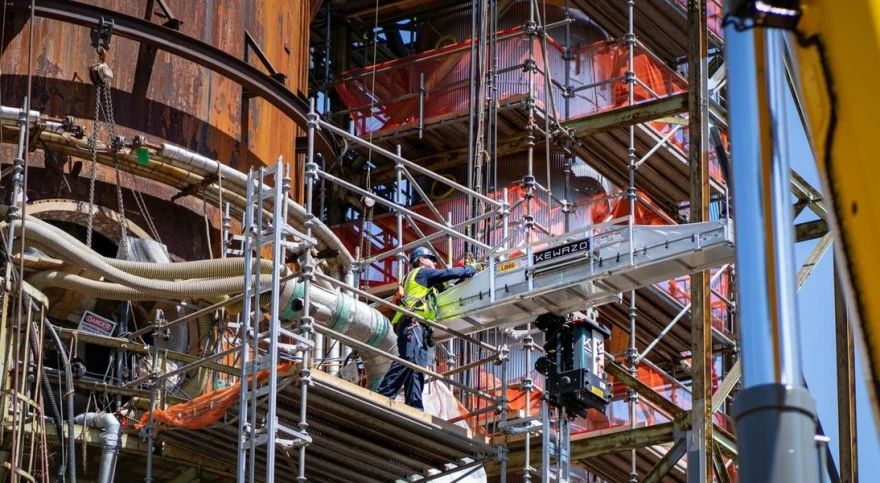
Kewazo’s systems run on batteries, eliminating the need for power cables or generators—systems often associated with risks of accidents or ignition hazards in potentially explosive industrial environments. The Kewazo robot can operate vertically, moving materials between levels of construction with greater speed and safety.
“In a project where ten workers were needed, now two are enough,” Psalida explains. “This helps address labor shortages in the sector. And the risk of accidents drops dramatically.”
Companies save both time and cost because they don’t need cranes or large teams, allowing them to finish projects weeks earlier.
Armed with these successes, Kewazo will once again exhibit at the next Bauma trade fair. And when middle-aged men ask—yet again—whether she inherited the company from her father, she will now reply with something she probably never would have imagined a decade ago.
Ask me anything
Explore related questions




