





“Germans, listeners! Before your enraptured eyes parade images that, to anyone who still possesses a sense of human dignity, provoke horror and revulsion: the infuriating and repulsive sight of the swastika flying over Mount Olympus. Soon it will be flying over the Acropolis as well — it is inevitable.”
These were the words of Nobel Prize–winning author Thomas Mann in April 1941, addressing German listeners who could still hear his voice via the BBC. Since 1938, Mann had been living in exile in the United States, after the Nazi regime stripped him of his German citizenship. At the time of his broadcast, German forces were advancing from Bulgaria into Greece.
He continued, speaking directly to the German people:
“Does your chest swell with pride? Pride for what? One Greek stands against six or seven of you. What astonishes is not that you win, but that he dares — that he lays down his body on the narrow path of freedom. Do you truly feel comfortable with the role into which the game of history has cast you — reliving Thermopylae on the spot, that symbol of humanity? And once again it is the Greeks — and who are you?”
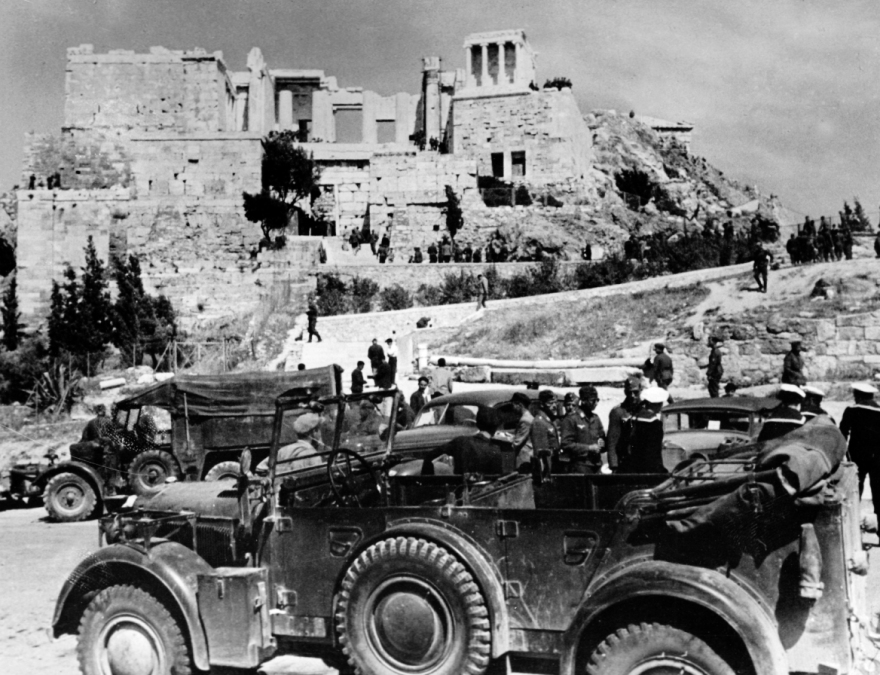
German troops in front of the Acropolis after the fall of Athens
As early as 1940, the BBC had invited Thomas Mann to address Germans through its long- and medium-wave broadcasts, because the so-called “Volksempfänger,” the only radio set permitted by the Nazis, did not receive short-wave frequencies. Mann recorded 59 broadcasts between 1940 and 1945—initially five minutes long, later eight.
Recordings were made at NBC studios in Los Angeles, flown to New York, then transmitted by telephone to London, where the BBC created a duplicate disc. That second disc was played on air at the time of Mann’s scheduled broadcast.
His “prophecy” of Nazism’s collapse
Mann commented on the course of the war, revealed the crimes of Nazism and the persecution of Jews, denounced Hitler, and urged Germans to overthrow him—insisting that Germany was bound to lose a war waged against the freedom of nations. In his April 1941 address, prompted by the invasion of Greece, he said:
“Do not think the aim is merely to create unshakeable faits accomplis before which humanity will bow. Humanity will not bow, because it cannot. One may think what one likes of humanity, may despise it, distrust it — yes, it may be wretched, but it carries within it a divine spark, undeniable and indelible, the spark of spirit and goodness. It cannot accept the final triumph of evil, falsehood, and violence — for it simply cannot coexist with it.
A world born of Hitler’s victory would not only be one of universal enslavement, but one of absolute cynicism — a world in which it would be impossible to preserve faith in the good, in the higher nature of humanity, a world surrendered to evil. Such a world cannot come to pass; it cannot be tolerated.
Humanity’s uprising against a Hitlerian world, a world of ultimate betrayal of spirit and goodness — that uprising is the certainty of certainties. It will be fundamental, and when it comes, those supposedly ‘unshakeable faits accomplis’ will go up like kindling in a fire.”
The political evolution of a bourgeois intellectual
Thomas Mann was not always a champion of liberal democracy. A refined upper-middle-class figure and a superb writer, he had been politically ambivalent. His long essay Reflections of a Nonpolitical Man (1918), written during World War I, was unmistakably an argument in favor of German nationalism.
His transformation into a committed democrat appears to have been triggered by the 1922 assassination of Walther Rathenau, the Jewish foreign minister of the Weimar Republic, murdered by right-wing extremists. From that moment on, Mann opposed the rise of National Socialism without wavering.
His messages to German listeners, however, did not fall solely on receptive ears. Germans did not rise up and overthrow Hitler; it was the free world that ultimately defeated Nazi Germany.
Mann also provoked hostility in his homeland, especially when, during Allied bombardments of German cities, he insisted that these strikes constituted just punishment for Nazi crimes—an argument difficult for civilians sheltering in air-raid bunkers to accept.
In the dramatic moments of history, war and death blur the boundaries between right and wrong. After the war, Mann returned to Europe, but not to Germany. He settled in Switzerland, where he died in 1955.
Ask me anything
Explore related questions




