





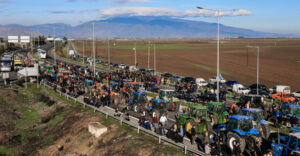
The farmers’ plan to escalate their struggle — through roadblocks mainly on the national road network but also with other dynamic actions in the coming days — began unfolding yesterday, Monday.
After the blockade at Nikaia and the E65 outside Karditsa by farmers from Thessaly, farmers from Macedonia followed yesterday with a blockade at Malgara, eventually closing the direction toward Athens and causing major traffic chaos.
Farmers: They also closed the direction toward Thessaloniki
It is certain that in the coming days more roadblocks will follow in Viotia and Evros, while farmers openly state their intention to proceed with blockades at ports and customs posts as well.
The strategy of escalation
Yesterday at the Nikaia and E65 blockades it became clear that the next step for the existing blockades — and the new ones expected to be set up — will be to reinforce them with additional tractors in order to create a strong visual presence and a powerful negotiating leverage.
Farmers’ assembly in Nikaia — Goal: to exceed 1,000 tractors
Thus, both of these blockades will receive additional agricultural machinery, while shepherds from Thessaly are also joining the mobilizations today. They will hold a motorcade through the center of Larissa, spill milk as a form of protest, and then head to the Nikaia blockade in solidarity with the farmers.
At yesterday’s assembly of the Larissa blockade, it was decided to hold a protest event next Thursday outside the courthouse, at the time when two of their colleagues — arrested during Sunday’s incidents at the Platykampos junction — will stand trial. Meanwhile, the blockade planned by farmers from Magnesia at the port of Volos has been finalized and will last until December 10.
Next Wednesday, farmers from Trikala are expected to move to the Megalochori junction, while also looking toward the nearby E65.
The “cocktail” of problems fueling the blockades
It is clear that this year the participation of farmers in the blockades exceeded all expectations — possibly even those of the organizers. Their determination is also unprecedented, insisting on blockades primarily on the national network. They have already announced that the holidays will find them on the road, showing they do not intend to withdraw before solutions to their problems are found.
The atmosphere toward the Ministry of Rural Development was already tense after last Friday’s reduced payments, as farmers saw very small amounts deposited into their accounts for the advance of the basic income support. Most have been waiting at least a year for compensations and subsidies, while some are still waiting for money owed from Daniel and the 2023 disasters. In some way, they feel they are the ones paying for the OPEKEPE scandal, while they themselves owe money for fuel, supplies, and many other costs of the farming season.
But there is also an unseen side that makes the already suffocating situation even worse: A number of basic products this year — despite having good yields — have very low market prices. These include durum wheat, cotton, and corn. On the other hand, livestock farmers have been hit hard by the outbreak of sheep pox, and this also affects farmers in those areas who cultivated animal fodder (such as alfalfa, vetch, and corn) but cannot sell it because it could potentially transmit the disease.
Ask me anything
Explore related questions




