





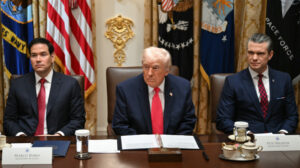
The doctrine of the American president, Donald Trump, regarding how the United States should approach its foreign policy and shape its international relations, is fully reflected in the National Security Strategy, released by the White House in a 33-page document.
The new strategy defines American foreign policy for the remainder of Trump’s term, with “America First” emphasizing the strengthening of U.S. dominance in the world, while simultaneously delivering sharp criticism toward Europe and Russia.
Challenging, as The Economist observes, traditional policies of alliances and values, the strategy moves toward asserting American dominance in the Western Hemisphere and embracing a “flexible realism,” noting that America must act in accordance with its own interests, without relying on traditional ideologies – or, even further, on already established and “deeply forged” diplomatic relationships.
The strategy states that America should ensure stability in the Western Hemisphere by preventing mass migration to the U.S. and calls on Latin American governments (e.g., Venezuela and Colombia) to curb drug flows and allow Washington to control strategic locations and resources, with the ultimate goal of recognizing America as the dominant power in the region.
Some international media, such as the Financial Times, report that this strategy represents a new version of American influence in the region, aiming to prevent Chinese intervention. The same article emphasizes that the strategy has caused serious concerns about a recurrence of old, manipulative American interventions in the region, including military actions and support for authoritarian regimes.
Asia and Chinese Influence
Trump’s strategy also recognizes the need to maintain order in Taiwan and Southeast Asia, while assuring U.S. allies in Asia that the United States will remain strong to prevent China’s expansionist ambitions in the region.
However, Axios notes that the strategy is less critical of China, while requiring Asian allies to help the U.S. limit Chinese ambitions in the region, raising concerns about escalating tensions in the Pacific.
Support for Patriotic parties in Europe – Concern over illegal migration
Europe is a primary target of the strategy, with the acceptance of a new European identity and support for the continent’s right-wing parties, which it considers the only path for the survival of European culture.
In Ukraine, Trump’s strategy proposes a rapid ceasefire and a reduced sense of threat from Russia, causing reactions in many European governments. The Guardian reports that the strategy has raised concern in Europe, as the U.S. openly expresses support for, what it calls, “far-right movements”, emphasizing the need to “celebrate the individuality” of European nations and support patriotic European parties, with reference to political forces such as France’s National Rally and Germany’s AfD.
The New York Post emphasizes Trump’s “direct criticism of Europe,” as he expresses concern about the ongoing weakening of European identity and the influence of migration flows. The US acknowledges that the future of European societies is at stake due to the lack of a national identity.
Trump’s strategy for 2025 is an approach that combines extreme realism with the need to maintain U.S. strategic dominance.
Ask me anything
Explore related questions




