





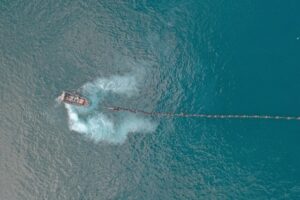
Only a miracle can now save the Great Sea Interconnector – the flagship electricity-interconnection project once presented as the energy “bridge” between Greece and Cyprus, capable of pulling Nicosia out of its energy isolation. Officially, the GSI has not been cancelled; in practice, however, the situation resembles a project with no point of return. Three developments have triggered the reverse trajectory and have radically altered its dynamics in recent weeks: the shift in political balances in Nicosia, the clear position taken by the European Commission that undermines the narrative of needing a new cost–benefit analysis, and the quiet but decisive stance of Nexans – combined with the funding pressures facing IPTO.
Political change in Cyprus
The recent government reshuffle in Nicosia was the first “crack.” Energy Minister Giorgos Papanastasiou – one of the project’s strongest supporters – was removed. In contrast, Finance Minister Makis Keravnos, who had called the project “non-viable,” strained relations between Athens and Nicosia two months ago with sharp remarks against IPTO, and insisted on recalculating the costs while refusing to approve the payment of the €25 million Cyprus had already agreed to cover, remained in his post.
Papanastasiou was replaced by Michalis Damianou, a technocrat with legal expertise but without the necessary time to adapt. On 15 December he will attend the EU Energy Council, where the progress of the cable is expected to be discussed on the sidelines—following the latest messages from Commissioner Jørgensen which, instead of “clarifying” matters, raised even more questions.
The Commission cuts the thread of a new study
The strategy of buying time through a new cost–benefit analysis took a hit when the European Commissioner responded clearly that no new CBA is required, since one has already been approved under the PCI framework, accompanied by €657 million in funding.
As a result, the argument for an “update” loses ground, and what looked like a delay increasingly resembles an outright postponement. In other words, Europe is saying that the green light is there—but political leaders are not using it.
Nexans & IPTO – low profile but major dilemmas
The string of postponements is also being dragged along by the French company Nexans, which signed the €1.4 billion contract with IPTO and had told analysts last August that if the project collapses, it will sell the cable to another project—highlighting the significant global demand for major electricity interconnections.
Its quiet stance reinforces market speculation circulating for months that there may be a “deal” between the French company and the Greek side so that the cable can be used either in another project abroad or even in major projects that IPTO has planned in Greece. IPTO’s insistence on proceeding with a €1 billion capital increase both confirms its urgency to finance its ten-year €6 billion development plan and its need to cover the costs of the GSI portion that Cyprus refuses to pay—costs which exceed €300 million.
The Papastavrou line – new investors, new structure
Amid all these developments, Environment and Energy Minister Stavros Papastavrou continues to project a different picture: not of a project that simply needs to continue but of one that must be redesigned with more players at the table. Speaking at the DFF think tank last Friday in Washington, he referred to investor interest, an expanded shareholder base, and the possible inclusion of the GSI in IMEC, the Europe–Middle East energy and trade corridor.
Ask me anything
Explore related questions




