





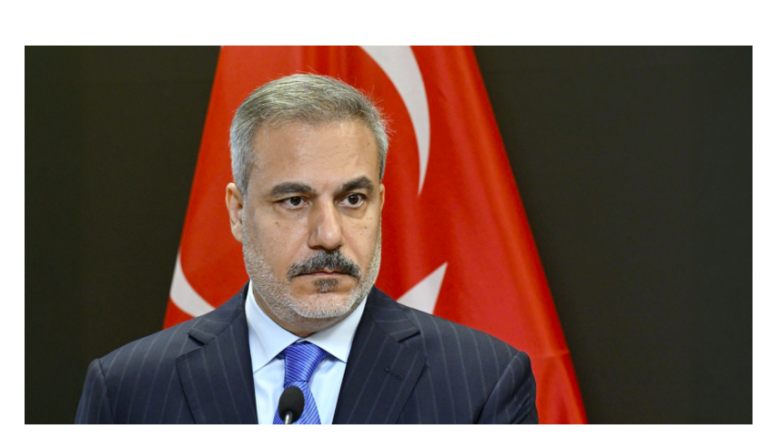
Speaking during the Turkish Parliament’s debate on the Foreign Ministry budget, Fidan revived positions that Athens views as deal-breakers, insisting that Turkey seeks a “fair sharing” of the Eastern Mediterranean and is “taking determined steps to protect its rights and interests.”
He also repeated Ankara’s long-standing demand that all Aegean disputes be treated as a single package, and resolved through “constructive dialogue” based on international law—an approach Greece rejects as an attempt to broaden the agenda beyond the one issue it recognizes.
Fidan further claimed that Turkey continues efforts to protect the rights of the so-called “Turkish” minority in Western Thrace, adding that Ankara takes “reciprocal steps when necessary.”
Greek diplomatic sources responded immediately, stressing that the only dispute between the two countries is the delimitation of the Exclusive Economic Zone and the continental shelf, and that any revisionist claims are “entirely unacceptable.” Regarding the Muslim minority in Thrace, they reiterated that the Lausanne Treaty explicitly defines it as a religious minority, whose members enjoy full equality under Greek law.
Despite Ankara’s sharper tone, Prime Minister Kyriakos Mitsotakis continues to pursue a balance: defending Greece’s sovereign rights while maintaining channels of communication. Last week he said conditions are now suitable for convening the High-Level Cooperation Council in Ankara in early 2026, after repeated postponements. He added that the Council does not always need to produce spectacular outcomes; it can also serve to review progress and sustain the “positive agenda.”
However, Fidan’s latest intervention suggests that Ankara may use the meeting to put forward the full range of its claims—highlighting the enormous distance that still separates the two sides.
Mitsotakis, addressing concerns that the “functional relationship” could dilute Greece’s red lines, reminded that Athens has not hesitated to take firm positions—such as vetoing Turkey’s participation in the EU defense program SAFE, and significantly strengthening its own deterrent capabilities. Later this month, Greece will raise its flag on “Kimon,” the first French-built Belharra frigate, which will soon join the Hellenic Navy.
Ankara’s irritation has also deepened due to Cyprus’ closer ties with the US, expanding Greek–Israeli defense cooperation, and Greece’s acquisition of Israeli long-range missile systems forming the backbone of the new “Achilles Shield”. The program includes PULS launchers capable of strikes up to 300 km—and eventually 500 km.
Turkey had hoped that a second Trump presidency would boost its strategic ambitions, but so far this expectation has not materialized. Instead, the US continues to prioritize Israel on critical regional files such as Gaza, Lebanon and Syria, while Erdoğan’s hoped-for mediator role in Ukraine has largely faded—especially after incidents involving attacks on vessels of Russia’s “shadow fleet” in the Black Sea.
Optimism from US envoy Tom Barrack that the F-35 issue might be resolved in “4–6 months” is also tempered by Washington’s unchanged condition: the removal of the Russian S-400 system.
Despite the tense atmosphere, Athens believes that Turkey is unlikely to escalate militarily, as this risks triggering an unpredictable intervention by President Trump in the Aegean or Eastern Mediterranean—an outcome Ankara would prefer to avoid.
Ask me anything
Explore related questions




