





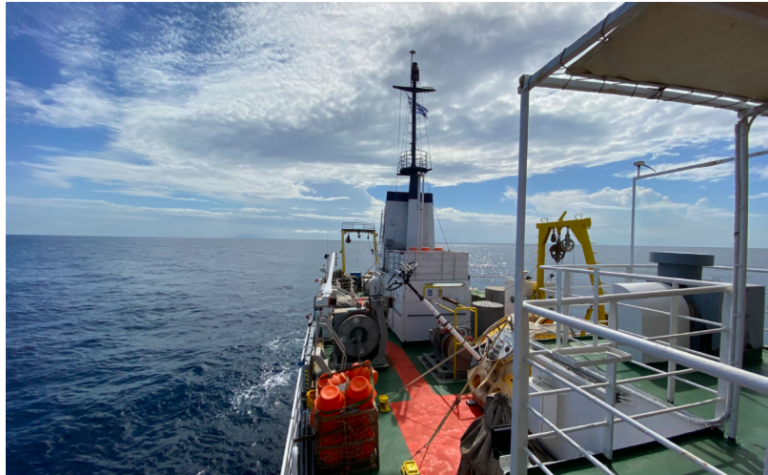
It was in 2013 when the Greek oceanographic vessel AIGAIO set out on its most distant and demanding mission: an international scientific expedition in the Red Sea, under extremely difficult weather conditions. Twelve years later, a new article based on the material from that mission reconstructs the environmental and climatic changes of the region over the past 12,000 years.
Although the AIGAIO ship of the Hellenic Centre for Marine Research (HCMR) had previously conducted research missions in the Black Sea and the western Mediterranean, on this particular 2013 mission, it reached the southernmost point it has ever been: the southeastern Red Sea, a straight-line distance of 3,000 kilometers from Piraeus. The research was carried out in collaboration with the University of York in the UK and the Saudi Geological Survey, funded by the European Research Council.
Greek scientists revealed the history of the Red Sea
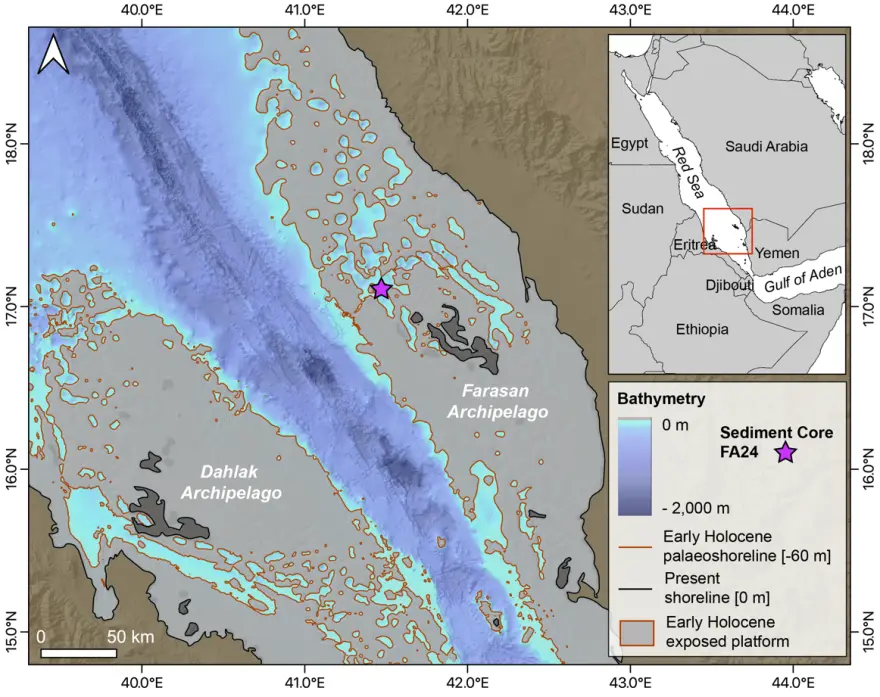
A bathymetric map of the southern Red Sea shows with a purple star the sampling point and with gray the exposed seabed at the beginning of the Holocene, when the sea level was 60 meters lower than today. Also marked are the depressions that functioned as hypersaline paleolakes.
The mission aimed to map and study the continental shelf of Saudi Arabia in the area of the Farasan Islands, a region with more than 80 coral islands and rich marine life. There, many isolated basins were identified, with diameters no larger than three to five kilometers and depths ranging from 150 to 500 meters. During glacial periods, when the sea level was 120 meters lower than today and the continental shelf was exposed land, these basins were lakes. Sediment samples were collected from the bottom of these basins to investigate whether the lake water was fresh (and thus drinkable) and whether these lakes attracted prehistoric humans, as well as to study the environmental conditions of the region over millennia.
Harsh conditions and the uniqueness of the material
The mission was conducted under harsh conditions, as described to the Athens News Agency-Macedonian Press Agency (ANA-MPA) by its leader and Research Director of HCMR, Dimitris Sakellariou: outside temperatures reaching 40 degrees Celsius, very high humidity, and dust in the atmosphere made the daytime unbearable, forcing scientists to collect sediment and water samples after sunset. The sea temperature was over 30-35 degrees Celsius, and the warm seawater could not sufficiently cool the ship’s engines, resulting in frequent mechanical problems. “It was perhaps the most difficult research trip I have undertaken in my 30 years at HCMR and on missions with the AIGAIO. Nevertheless, we managed to complete the mission with great success and collect scientific data from a completely unexplored area, which has become extremely valuable to the international scientific community because to this day it remains unique,” emphasized Mr. Sakellariou. He added that now that AIGAIO is 40 years old, it struggles to carry out such distant and demanding missions, so “it is imperative and in Greece’s interest, as a fundamentally maritime country, to replace AIGAIO with a new, modern research vessel to maintain its prominent position in marine research in the Mediterranean, the Black Sea, and the Red Sea.”
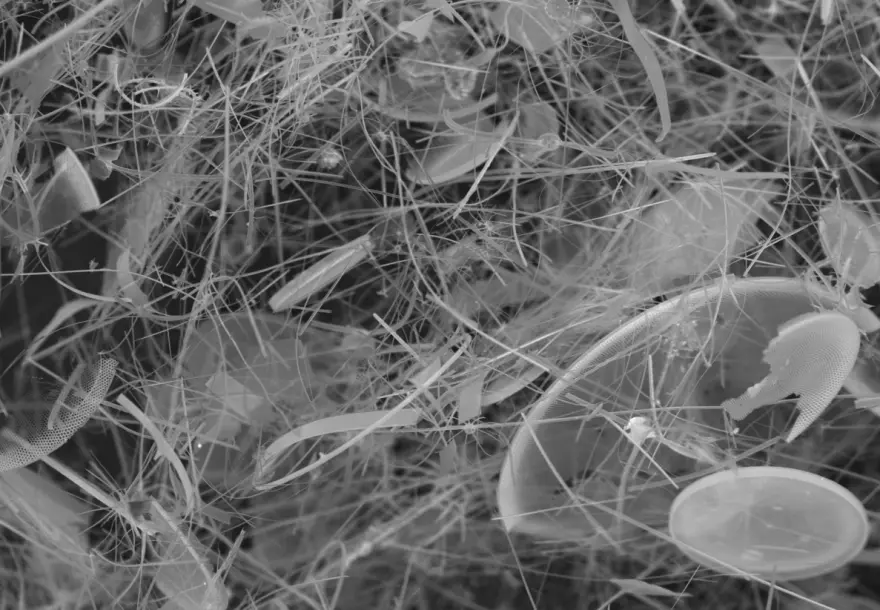
The valuable scientific data collected during the 2013 mission are still being analyzed by research teams worldwide. Geologist Frantzeska Paraschou, then a doctoral candidate at the University of Patras and HCMR, focused on a sediment core to study the impacts of climate change on the southern Red Sea over the past twelve thousand years. “We wanted to create a paleoenvironmental reconstruction of the area using various proxies, mainly geochemical. We essentially studied how the unique marine ecosystem of this region adapted to climate changes after the last glacial period, when the sea level rose significantly,” Frantzeska Paraschou told ANA-MPA.
Closing
The southern Red Sea was one of the crossings of modern humans (Homo sapiens) from Africa to Eurasia when sea levels were lower. Also, the region holds unique global environments and biocommunities, which have been little studied. Its coastal landscapes preserve key records of environmental changes over centuries.
Through a series of scholarships, Ms. Paraschou traveled to Heidelberg University in Germany and the University of Notre Dame in the USA to perform sample analyses, due to the lack of specialized facilities in Greek research institutes.
Andreas Koutsodendris, professor at Heidelberg University, recalls the uniqueness of the material, its intense green color, and smell when it was opened for study. “I have seen material from all over the world, but none like this. It is intensely biogenic with a large amount of organic material, and its vivid green color comes from the deposition of organic material from the unique biocommunities living in this extreme environment with high temperatures, high salinity, intense evaporation, and minimal runoff.”
Mr. Koutsodendris highlights the importance of the Red Sea for many different scientific fields. “In paleoanthropology, it is considered one of the bridges necessary to understand human evolution. For paleoclimatology, it is interesting because it provides information on climate changes that occurred in extreme environments such as deserts. In paleoceanography, you can do very detailed recording of sea level changes. Of course, it is also very important for biology and other fields studying modern environments, due to coral reefs, which are under pressure from human activities,” he noted to ANA-MPA.
Climate change, from past to future
The analyses revealed information contained in this sediment core about changes in the marine ecosystem, microbial, and planktonic organisms. “These changes show the adaptation of organisms to environmental changes and the transformation of this basin from an isolated hypersaline lake to a marine environment,” notes Ms. Paraschou. The research results were published in the journal Global and Planetary Change by Elsevier.
Studying such a past ecosystem gives researchers many useful insights into the impacts climate change will have in the future. As Andreas Koutsodendris emphasizes, “By studying past ecosystems, our goal is to understand the tolerance limits of different biocommunities when under stress. This research shows how these unique biocommunities in the southern Red Sea in the past responded to increasing temperatures and the transition from a paleolake to a marine environment. In the future, of course, we will see a completely different model because climate change will occur in a much shorter time frame, within a few decades.”
Ask me anything
Explore related questions




