





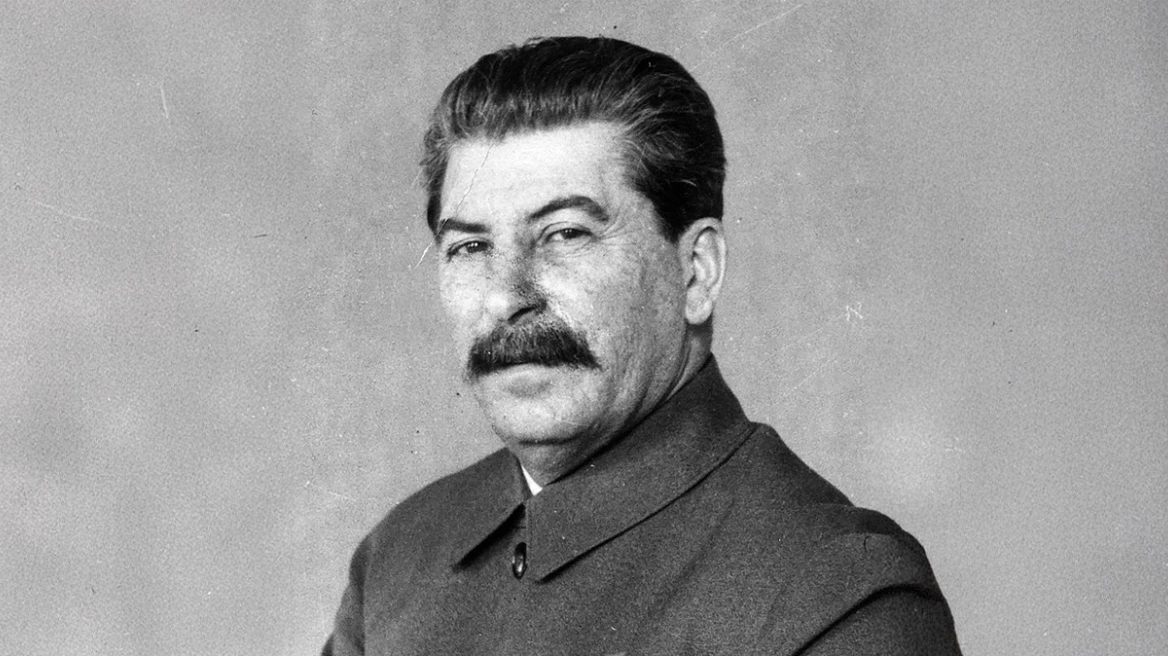
An almost unknown story, the plan and the attempt to assassinate Stalin by the Germans in the autumn of 1944, will occupy us in today’s article. Its main protagonist was Pyotr Ivanovich Shilo, who defected to the Nazis in 1942. A fanatical anti-communist, he was rigorously trained by the Germans to kill Stalin. The plan was very well organized, but it failed because it had become known to high Soviet circles through their counterintelligence in Berlin. In Greek bibliography, perhaps the only relevant reference exists in the article by Iakovos Chondromatidis, “THE GERMAN ATTEMPT TO ASSASSINATE STALIN,” in the magazine MILITARY HISTORY, Issue 33, May 1999. Mr. Chondromatidis, a graduate in Military History from the Faculty of Philosophy of Aachen, has also dealt extensively in his books with topics concerning the years of the German Occupation in Greece, Hitler, Rommel, etc.
The defection of Pyotr Ivanovich Shilo to the Nazis
On the night of May 30/31, 1942, on the Eastern Front, a group of Russian scouts, led by Second Lieutenant Pyotr Ivanovich Shilo (1909–1952), attempted to break through the German lines. They did not succeed, however, as the night was moonlit. Some Russians were killed, others managed to escape, while Shilo defected to the Germans.
As he told them, his father had been a colonel and landowner in the years of the Tsar. He was murdered by the Bolsheviks, and Shilo himself, now a second lieutenant in the Soviet Army, had been seeking an opportunity to defect to the Germans and take revenge on the Bolsheviks.
Some Soviet secrets that the Nazis did not know and which Shilo told them did not fully convince German counterintelligence. They sent Shilo to a camp for Russian prisoners and asked him to identify the commissars of the CPSU and Soviet spies there and denounce them. Indeed, Shilo denounced many of his compatriots, something that led to positive comments and assessments by his superiors in the file “Politov” that had been opened for him. Gestapo officers monitoring his progress described him as “intelligent, extremely capable, and stubborn,” possessing all the qualities that would characterize a “ruthless terrorist.”
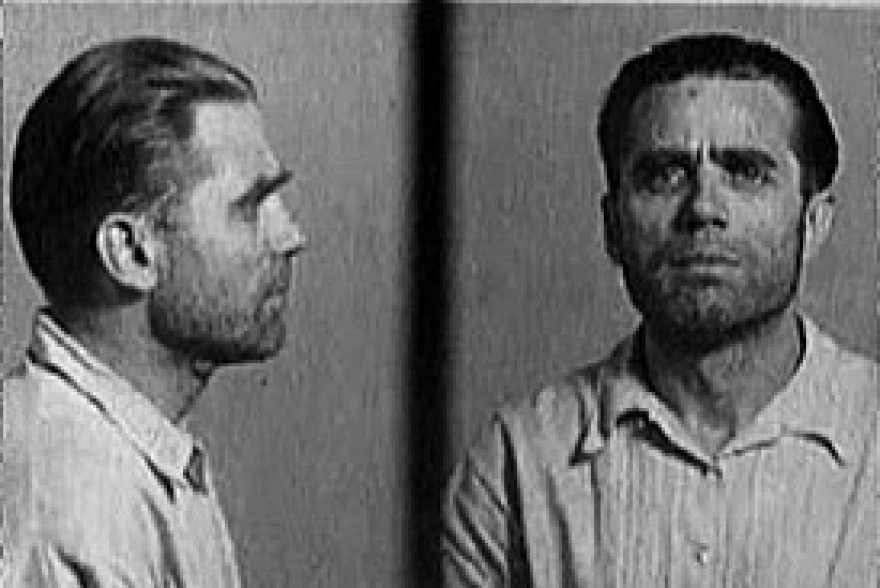
(Pyotr Ivanovich Shilo)
SS Brigadenführer (Major General) Schellenberg of Department VI of the Reich Main Security Office (RSHA) was informed about Shilo. He assigned his training to Georg Greife, a very tall SS non-commissioned officer who had grown up in Russia and spoke flawless Russian. The “Politov” file was supplemented with yet another positive report. It seemed that Shilo was the right man sought by Schellenberg and Skorzeny, the legendary major, head of the German commandos who freed Benito Mussolini from the “Campo Imperatore” hotel on the Gran Sasso plateau (September 1943). The Duce had been deposed by the Grand Fascist Council and placed under arrest at the hotel on Gran Sasso. He was replaced by General Pietro Badoglio, who had occupied Albania in 1939 and was the mastermind of the Italians in the war with Greece, although all the blame for the debacle fell on Visconti Prasca…
Shilo’s initiation into Operation “Panzerfaust” (“Anti-tank Fist”) to assassinate Stalin
Gradually, Greife began to reveal to Shilo that he was destined for a special mission in Moscow. This happened about a year after his defection. Greife knew exactly what Shilo would do, but did not reveal it to him. Shilo himself, however, had realized that he had no room for choice. If he did not undertake the mission, he knew the Germans would execute him. Shilo did not hate his compatriots. But he was incredibly anti-communist. He had aligned himself with General Vlasov (see our related article on 12/05/2025). He believed that Russia’s future would be secured by a bloodless system of bourgeois democracy and dynamic fascism. In a report on Shilo, written several years later, Greife stated:
“He was more than a volcano. A very active and energetic man. He knew no compromises and hated cynicism more than anything in life. Because he traveled often in the Soviet Union (i.e., as an officer of the Red Army) and mingled with many people, he managed to learn the common language of criminals. Although somewhat eccentric, he was generally a multifaceted person, a tough fighter when needed, and knew the use of almost all weapons and explosive devices. I would say, however, that it was not entirely indifferent to him to fight alongside us against his compatriots…”
Shilo’s change of identity – Psychological preparation for Operation “Panzerfaust”
In the spring of 1943, the Germans still believed in victory. Greife told Shilo: “The mission will bring you glory, honors, and money. We are both fighting for the common cause: the annihilation of Bolshevism. This will become easier once Stalin is neutralized.”
Subsequently, Shilo “became” Major Pyotr Ivanovich Tavrin, decorated with the highest distinctions of the Soviet Army: the Orders of Lenin, Alexander Nevsky, and the Red Star. At the same time, he received the title “Hero of the Soviet Union.” Gradually, training moved to the stage of Shilo’s (or Tavrin’s) psychological preparation. He was informed that in Moscow he would kill a high-ranking official. Perhaps he himself had understood that it would be Stalin. In September 1943, Greife informed his superiors that Shilo–Tavrin was ready to undertake any mission. From that moment, his practical training began under the guidance of SS Commander of Hauptkommando Nord/Riga, Otto Kraus, at the camp located in the Berlin suburb of Pskov. There, under the strict supervision of two additional agents and an SS officer, he learned all the methods of executing his prospective victims. Shilo proved to be a very good student. His instructors noted that he was “reliable, tough, and very active.” In December 1943, Greife visited Pskov and was particularly pleased with Shilo’s excellent performance. Shortly afterward, Shilo married a very beautiful compatriot, Lidia Shilova, who worked at a textile factory in the area. Lidia, as we shall see, accompanied her husband on the mission to Russia.
After completing his training, “Tavrin” went, accompanied by Greife, to Potsdamer Strasse 28 to meet the legendary Major Skorzeny. Skorzeny was impressed by Shilo. He did, however, suggest to Greife that Shilo be sent to the agents’ school in Oranienburg for a few more weeks of training. “Tavrin,” writes I. Chondromatidis, was fiercely ambitious. His instinct resembled that of a hunted animal and he devised unimaginable solutions. Incredibly calm, he could proceed to carry out the most unlikely action.
The plan to assassinate Stalin
After the failed assassination attempt against Hitler on July 20, 1944, the procedures for Shilo’s operation were expedited, and naturally Shilo and Lidia were informed of the details of the plan and, above all, of their “target”: Stalin. Shilo and Lidia would travel at night deep into Russia in an Arado 232 B aircraft. They would disembark with a motorcycle, while the Arado would return to Germany. In Moscow, Shilo would assassinate Stalin with a special type of weapon, and together with Lidia they would inform Berlin via radio. Both were supplied with Soviet military uniforms and forged identities.
They carried clippings from Soviet newspapers, forged documents for the “heroic deeds” of Major Tavrin, while in Lidia’s luggage there were seals and other necessary documents. In Moscow, other agents of Skorzeny would take care of the couple’s safe accommodation and provide them with information on the routes and times followed by Stalin when traveling from the Kremlin to the Headquarters of the Soviet General Staff near the Kirowskaya underground station. Shilo was equipped with a specially constructed weapon whose bullets were poisoned. Even a minor injury to Stalin would cause his immediate death. If Shilo could not strike him at the station entrance, he would hit Stalin with an “anti-tank fist” that fit into the sleeve of his tunic. In this case, “Tavrin” would strike Stalin’s armored limousine on the established route to the General Staff. Finally, Shilo also had a third weapon: a magnetic mine operated by remote control. Greife proposed that Shilo undergo surgery on his leg due to an alleged battle injury. The Russian refused. He did receive some stitches for supposed injuries to the stomach and left leg. Now, as a senior staff officer of the 1st Baltic Army Corps, Shilo was preparing to undertake the most difficult and ambitious mission of his life.
Operation “Panzerfaust”
Operation “Panzerfaust” was decided to take place on the night of September 4, 1944. It started from the German headquarters Russland/Nord in Riga, in then German-occupied Latvia. Three trucks escorted by two motorcyclists left the headquarters and after 40 minutes arrived at a small military airfield. There, a huge transport aircraft awaited them, the Arado 232 B, the latest achievement of the German aviation industry. Among other things, its engines were equipped with silencers. It had 10 machine guns and could fly at an altitude of 7.5 km, over a distance of 4,000 km without refueling, in any weather conditions, and land in clearings, even in swampy areas. The pilot was the experienced Second Lieutenant Neumann. Also on board were 14 experienced German soldiers. Shilo and Lidia boarded without saying a word. For 1.5 hours, the flight was smooth. Then some anti-aircraft shells exploded behind the Arado. It was flying east of Velikiye Luki. With continuous maneuvers, Neumann brought the Arado, after three hours, over the predetermined landing area.
While it had descended to 100 meters and the landing lights were on, Neumann was astonished to see grassy trenches and a dense forest ahead. He did not manage to raise the aircraft, which crashed into the first trees. A strong jolt followed and Neumann’s voice urged those on board to disembark quickly, as there was a danger of explosion since the aircraft’s tanks were almost full. Everyone got out and quickly took cover in a defensive trench. No explosion occurred. “Tavrin” told the German escorts to unload the motorcycle they would use and disappear, because if the Soviets captured even one German soldier, with the appropriate interrogation methods they would be on his trail. The Germans unloaded the motorcycle. Shilo and Lidia said goodbye to the Germans and eventually managed to orient themselves. They were near the Rzhev–Moscow highway. “Tavrin” reached a speed of 120 km/h. Lidia sent the first signal to their base in Riga: “Forced landing without losses.”
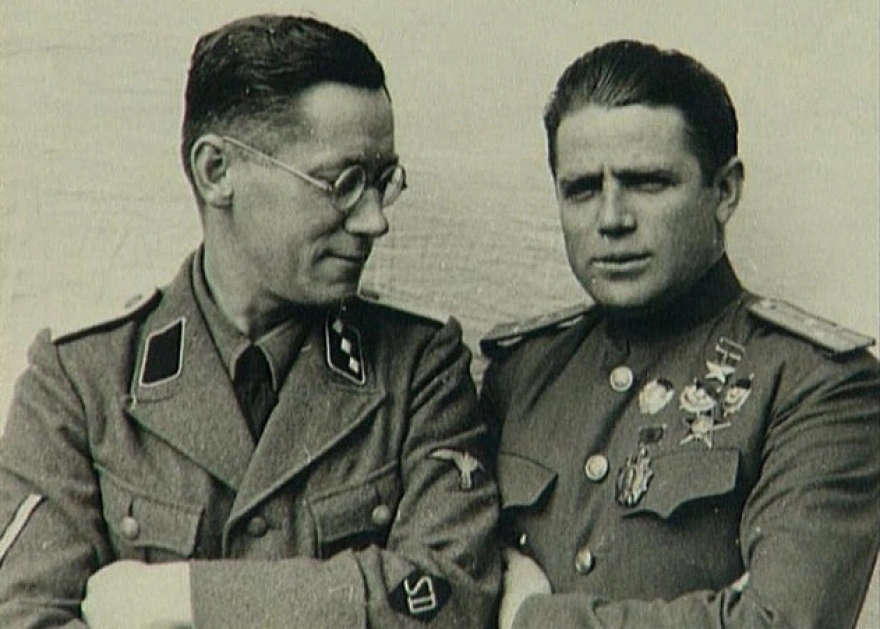
(Greife & Shilo)
Meanwhile, dawn had broken and traffic had begun. “Tavrin” preferred small side roads. This, however, was a mistake. At the exit of the first village, they were stopped by a group of Red Guards. “Tavrin,” calmly, showed them his papers and continued on his way. Shortly afterward, they were stopped by a forester. “Today just before dawn they pulled us out of our beds. They told us that somewhere around here German spies parachuted in during the night,” said the forester and approached the motorcycle. Unperturbed, Shilo dismounted and offered a cigarette to his compatriot. As the latter reached out to take it, Tavrin incapacitated him with punches. With Lidia’s help, they tied him to a tree in a nearby forest and Shilo executed him. By now, however, he was certain that the Germans who had accompanied him had been captured. He had to reach Moscow as quickly as possible.
Thirty kilometers before the Russian capital, Shilo took the main avenue to arrive faster. But this was a fatal mistake. Fifteen kilometers before Moscow, they ran into a roadblock. A Red Army officer asked for their travel orders and IDs. A missing stamp on one travel order betrayed them. The officer asked them to step into a nearby building for some formalities. There, Russian soldiers jumped out with weapons drawn. Shilo protested the “unprecedented treatment.” But when the Russians discovered the radio transmitter on Lidia, the Soviets were certain this was the man they were looking for. The couple understood that the end had come…
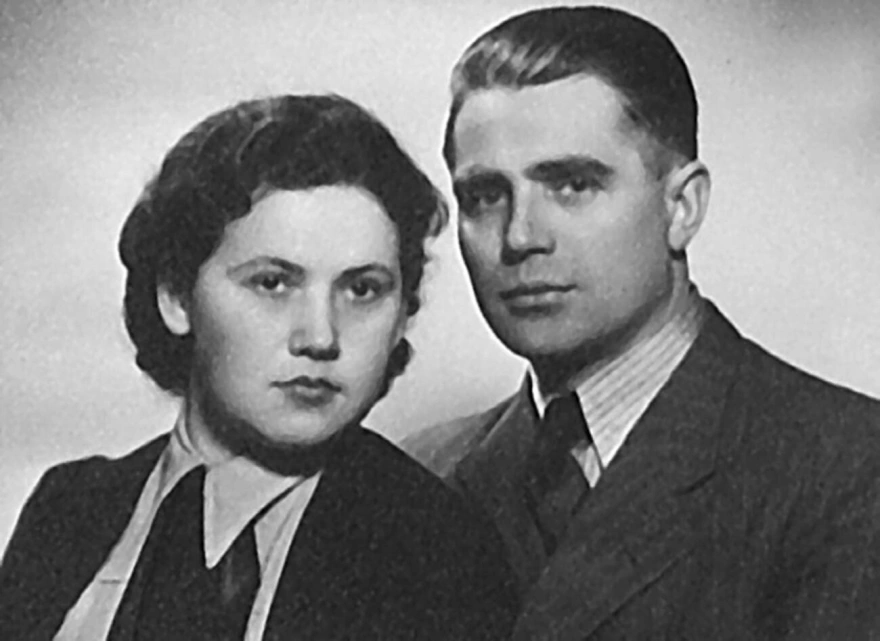
(Shilo and Lidia)
Who betrayed “Tavrin”?
“Tavrin” and Lidia fell victim to Soviet counterintelligence, which had known since late August 1944 about the “Anti-tank Fist.” Their informant was their man in Berlin, at the headquarters of the State Security (RSHA), SS Standartenführer (Colonel) Stirlitz. Stirlitz, with the code name “Judas,” worked for Soviet counterintelligence. He was in fact the Soviet Colonel Maksim Isayev.
What became of the Germans and the Shilo–Lidia couple?
Neumann and the other 14 Germans aboard the Arado wandered for a few days. On September 9, 1944, they were captured and executed. Iakovos Chondromatidis states that Shilo and Lidia were also executed, but provides no further details. On en.topwar.ru, we found that they remained imprisoned until 1952. The Soviets waited to see if they could use them against the Germans or identify other collaborators. Neither happened. It is characteristic that Walter Schellenberg, head of the German Secret Services after 1944, waited for quite some time for “news of Tavrin.” In a final attempt at atonement, the highly capable, it seems, Shilo worked for a short period in the NKVD, the Soviet Secret Police – Security Service. It is also disputed whether “Stirlitz” was the man who betrayed Shilo and Lidia, as some consider him a “fictional” person. It is certain, however, that there was a Soviet spy in Berlin who informed Moscow about the entire operation. It is, of course, somewhat strange that while the Germans were in a difficult position in late summer 1944, they were dealing with Stalin. Perhaps they believed that with his elimination the communist regime would collapse. Stalin had many opponents even within the Red Army, and there would be signs of disintegration. Stalin survived and the rest is known. Shilo and Lidia were finally executed on March 29, 1952, as we located in foreign sources.
Other attempts to assassinate Stalin
In total, there were four attempts to assassinate Stalin. One in 1931 by Leonid Ogaryov, who was neutralized by a secret agent; one in 1942 by Savely Dmitriev, a soldier who left his unit with a rifle, went to Red Square posing as a guard and shot at the car of Anastas Mikoyan before being arrested (Mikoyan was unharmed and Dmitriev was executed); and a third, organized by Skorzeny, during the Tehran Conference (Stalin, Churchill, Roosevelt) in October 1943, which failed, as the first group of Germans dropped by air near the city of Qom, 70 km from Tehran, was eliminated by the Soviets, who had been informed by the spy Kuznetsov. The third attempt also aimed at eliminating Roosevelt and Churchill. The fourth, which we discussed, may have been very well organized, but the timely information provided to the Soviets by their spy led to its failure.
Our main source was the article by Iakovos Chondromatidis, “THE GERMAN ATTEMPT TO ASSASSINATE STALIN,” in the magazine MILITARY HISTORY, Issue 33, May 1999. On the internet, if you google Pjotr Silo, Tavrin, you will find some additional information, but not the details provided by Iakovos Chondromatidis.
Ask me anything
Explore related questions




