





Although Donald Trump’s apparent step back on Greenland helped to defuse tensions during last night’s extraordinary Summit of European leaders in Brussels, this does not mean that there is no longer a tangible breach of trust toward Washington.
Euro-American relations are being tested, and as everyone knows, in diplomacy trust is perhaps the most powerful currency. In this environment, Kyriakos Mitsotakis chose to pursue a policy of delicate balance: on the one hand defending European unity, while on the other opening a window for the participation of EU countries that were invited—but initially declined—to take part in Trump’s “Peace Council,” which was announced with much fanfare in Davos.
Mr. Mitsotakis supported the idea that, provided Washington commits to limiting the participation of the 13 invited countries strictly to the reconstruction of Gaza and nothing beyond that, this could serve as a basis for involvement.
In essence, the Prime Minister’s message is that Greece and the other European Union countries that did not participate do not legitimize the creation of a body that would operate in parallel to, or as a substitute for, the United Nations. It is recalled that Greece was recently elected as a non-permanent member of the UN Security Council. Notably, Germany, Italy, as well as the Baltic states adopted the same cautious tone toward the United States; together with the Scandinavian countries, they will re-examine Trump’s proposal for the Peace Council.
Of course, European countries hold differing views on what exactly Trump’s partial retreat on Greenland entails and on the “agreement” he announced following his discussion with NATO Secretary General Mark Rutte, who is expected to be in Copenhagen today to meet with the directly concerned Danish Prime Minister.
At the heart of the matter is what the renegotiation of the U.S.–Denmark agreement dating back to 1951 will include, and how the involvement of NATO member states in defending the island will be defined. A critical question also concerns the future of rare earth resources.
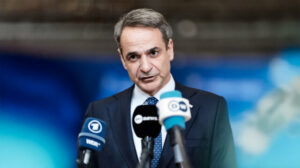
The press conference after the Summit
Asked after the conclusion of the Summit whether there was unity among European leaders and how Europe would proceed from here in its relations with the United States, Mr. Mitsotakis acknowledged that transatlantic relations have been strained.
“It is no secret that over the past year, Euro-Atlantic relations have gone through periods of turbulence,” he said, stressing, however, that there is a shared understanding that they must be kept at a functional level.
As he noted, the goal is to pursue relations of cooperation in good faith, “without behaviors that could lead to developments that cannot later be reversed.”
Improved climate after Trump’s clarifications
The Prime Minister noted that the atmosphere during the Summit was clearly improved following the American President’s latest statements.
“Things are slightly better, insofar as President Trump clarified that he does not intend to impose additional tariffs on countries that openly supported Greenland,” he said.
At the same time, Mr. Mitsotakis underlined that Donald Trump made it clear he “does not intend to use military force to seize territory belonging to the Kingdom of Denmark.”
Reservations about the Peace Council
Referring to the Peace Council, Mr. Mitsotakis emphasized that, as it is currently formulated, “not only Greece, but almost all European countries find it difficult to participate.”
He recalled, however, that Greece played a leading role in Resolution 2803, which legitimized the U.S. Peace Council exclusively as a temporary administration for Gaza, in order to implement the next stages of the peace plan as agreed.
Europe’s presence in the Middle East
The Prime Minister stressed that Greece has a direct interest in developments in the Middle East. “We want to be present. We want Europe to be present,” he said.
He noted that both the EU’s High Representative for Foreign Affairs, Kaja Kallas, and several member states find it interesting to explore the possibility of European initiatives, even if full participation in the Peace Council is legally difficult.
As he explained, the original purpose of the Council was to bring peace to Gaza and establish a transitional administration, followed by a reconstruction phase and the first substantive step toward resolving the Palestinian issue.
Arctic: A matter of global security
With regard to the protection of the Arctic, Kyriakos Mitsotakis pointed out that, although geographically distant from Greece, it is a critical priority for NATO and for the security of Europe and the United States.
He argued that close cooperation with the United States within NATO is necessary to prevent the expansion of Chinese or Russian influence in the region.
“Clear red lines” on Greenland
Specifically on Greenland, the Prime Minister was unequivocal: “The red lines are very clear. There can be no question of challenging Greenland’s territorial integrity and sovereignty.”
He stressed that only Greenland itself and the Kingdom of Denmark can decide the future of the region, while acknowledging that the United States has legitimate concerns regarding Arctic security.
As he noted, there are ways to address these concerns both through NATO and through the bilateral U.S.–Denmark agreement of 1951, while respecting the independence and territorial integrity of Denmark and Greenland.
No organized European coordination
Responding to a question about whether there had been coordination between NATO Secretary General Mark Rutte and European leaders prior to his meeting with the American President in Davos, Mr. Mitsotakis said he did not have that impression.
According to him, there was no organized framework of coordination at either the European or NATO level; the relevant discussions primarily concern Denmark and the United States, with the EU fully supporting Copenhagen’s choices.
Strategic autonomy and European strength
In closing, the Prime Minister emphasized the need for Europe to invest substantially in its strategic autonomy, recalling that Greece was among the first countries to support this approach.
“Significant steps have been taken since the Versailles Conference. Greece was always at the forefront of this logic,” he said, adding that strategic autonomy is directly linked to strengthening European competitiveness.
“We must move from the power of our values to the value of our power. This concerns both Greece and the European Union as a whole,” he concluded.
Ask me anything
Explore related questions




