





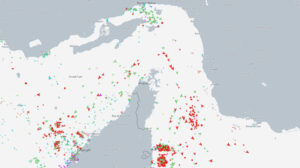
Iran has announced the closure of the Strait of Hormuz, triggering immediate disruption in international shipping and raising intense concern in energy markets. The decision comes amid heightened geopolitical tensions in the Middle East, with vessels navigating the area closely monitoring official instructions.
Iran’s Revolutionary Guards Navy Issues Warning
The Navy of Iran’s Revolutionary Guards broadcast a message to all ships, stating that “all vessels passing through the Strait of Hormuz are prohibited” and “no ship, under any circumstances, is allowed to pass.” The announcement sparked reactions in the shipping industry and beyond.
According to MarineTraffic, a large number of tankers have anchored safely to the northwest and south of the Strait, while a limited number continue to transit. This cautious approach highlights the importance of the passage as a critical artery for global oil trade.
Strait of Hormuz: A Critical Energy Chokepoint
The Strait of Hormuz, only 21 miles wide, serves as a major “bottleneck” for roughly 20 million barrels of crude oil daily—about one-fifth of global production. Nearly all oil exports from Persian Gulf countries pass through this narrow waterway.
Analysts warn that a prolonged disruption could push Brent crude prices above $100 per barrel, although a total, long-term blockade is considered difficult. Iran would need to maintain full control of the area, risking substantial revenue losses, as nearly half of the country’s state income comes from crude exports.
According to OPEC, Iran produces an average of 3.2 million barrels per day—around 4% of global output—making it the sixth-largest oil producer worldwide, despite international sanctions. To bypass restrictions, Iran uses a “shadow fleet” of tankers, offering oil at significant discounts.
Greek Shipping and Coast Guard Actions
The Greek Coast Guard has contacted all Greek-flagged vessels in the Persian Gulf and the Strait of Hormuz to confirm they face no immediate issues and provide detailed guidance.
Safety recommendations to the shipping community include:
- Increased surveillance and strengthened security measures
- Limiting non-essential personnel on upper decks
- Inspecting and ensuring watertight integrity
- Maintaining continuous communication with authorities
The Operations Room is monitoring developments 24/7 and maintains an open line with all Greek-flagged ships.
Ask me anything
Explore related questions




