





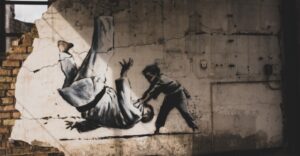
The biggest mystery in the art world appears to have been solved: Banksy. According to reports, he is a middle-aged man from Bristol, England, named Robin Gunningham.
The revelation of the most enigmatic street artist’s identity followed a months-long investigation by Reuters, which combined testimonies, court documents, photographs, and corporate records. However, many note that his name had been an “open secret” for years, having already been published by the Mail on Sunday as early as 2008.
Banksy himself has neither confirmed nor denied the claims and continues to maintain a low profile.
According to Reuters, the artist has managed to combine anonymity with a well-organized and profitable structure. He has even created a paradox: a creator who challenges the art market while simultaneously operating within it under strict control and generating significant financial gains.
The importance of anonymity
A report by CNN highlights that Banksy is not the only artist who prefers to remain anonymous. Among them is Jerkface, a New York-based street artist known for reinterpretations of popular cartoon characters.
In an email to CNN, Jerkface—who refused to reveal his identity—said anonymity has long held value in the art world:
“Across creative fields, visual art is one of the few where someone can express themselves without revealing their identity. Actors and musicians may change their names, but they can’t hide their faces. Writers, however, have hidden their identities for centuries.”
He added that audiences enjoy the honesty of an “obviously constructed persona,” and many fans don’t actually want to know the artist’s real identity. “The mystery is destroyed,” he said, noting there is disappointment surrounding Banksy’s alleged unmasking.
“The superhero myth is over”
Art advisor Nico Epstein, based in Lisbon, told CNN that there had long been “whispers” about Gunningham, but he is disappointed the mystery may be confirmed.
“I wanted the legacy of the anonymous artist—and the mystery around it—to remain alive. For many, Banksy is a superhero. People want to believe in that fairy tale, and now it’s over,” he said.
According to Epstein, the anonymity added neutrality—no one knew if Banksy was male or female. “Now that he’s definitively linked to a middle-aged white man from Bristol, it doesn’t interest me the same way,” he added.
The cost of revealing identity
Banksy has made great efforts to maintain anonymity, likely both as part of his artistic persona and to avoid legal trouble.
Epstein believes that revealing his identity could also affect the value of his works, which currently sell for enormous sums. In 2021, Love is in the Bin—the piece that partially self-destructed during an auction—sold for $25.4 million.
The key question now is whether he can continue producing compelling work like his pieces in Ukraine and the West Bank. “I think it will be harder,” Epstein said, predicting a slight decline in both output and market value.
“Anonymity is both protection and freedom”
Why do artists choose anonymity?
The creator behind Hey Reilly, a popular Instagram account satirizing celebrities with AI-generated images, told CNN:
“For a street artist, anonymity is often a shield against prosecution; for me, it’s a tool of creative freedom.”
“By removing personal identity, the work gains a more universal appeal,” he added.
Beyond visual art
Anonymity is also common in other creative fields. Artists like Sia and Daft Punk remained anonymous for years.
In literature, the Brontë sisters used male pseudonyms to overcome gender bias, while George Eliot concealed the identity of Mary Ann Evans.
More recently, Elena Ferrante has published her bestselling Neapolitan novels under a pseudonym, with her true identity still unconfirmed—despite ongoing speculation.
A notable case of a revealed identity was J.K. Rowling, who was uncovered as the author behind the pseudonym Robert Galbraith. She later said anonymity was “liberating,” allowing her to publish without expectations or hype.
The allure of anonymity
Friendred Peng, senior lecturer at the University of the Arts London, told CNN there is “something deeply fascinating about anonymity.”
“In a culture where identity shapes interpretation, its absence allows the work to be experienced without bias related to background, gender, or fame—shifting focus from the creator to the idea itself.”
However, he notes that when anonymity collapses, this dynamic changes. The work may become tied to personal context, potentially reducing its universality and reintroducing bias.
“For this reason, anonymity should not be seen as absence, but as an active and meaningful artistic choice,” he concluded.
Ask me anything
Explore related questions




