





The platform for the new Fuel Pass is expected to open within the coming week, with the aim that the first payments will be made by Easter, activating a support package that reaches €50 for mainland Greece and €60 for the islands for the two-month period April–May.
The measure, with increased income thresholds and expanded coverage, concerns approximately 78% of vehicle owners and allows use not only for fuel but also for public transport and taxis.
The key point beneficiaries must pay attention to is that the subsidy is linked to the vehicle and not to the household.
In simple terms, one vehicle corresponds to one subsidy. Each individual can declare only one vehicle, while in cases of co-ownership the same vehicle does not grant double support, as it is declared by only one beneficiary. On the contrary, in families with two cars belonging to different individuals, two subsidies can be granted, reaching up to €100 in total for the two-month period.
In practice, this means that the distribution of support depends exclusively on how the vehicles are registered. One car with two co-owners yields one subsidy, while two cars with different owners “unlock” double support.
The “key” is who declares the vehicle on the platform, as that person is also the final beneficiary of the subsidy.
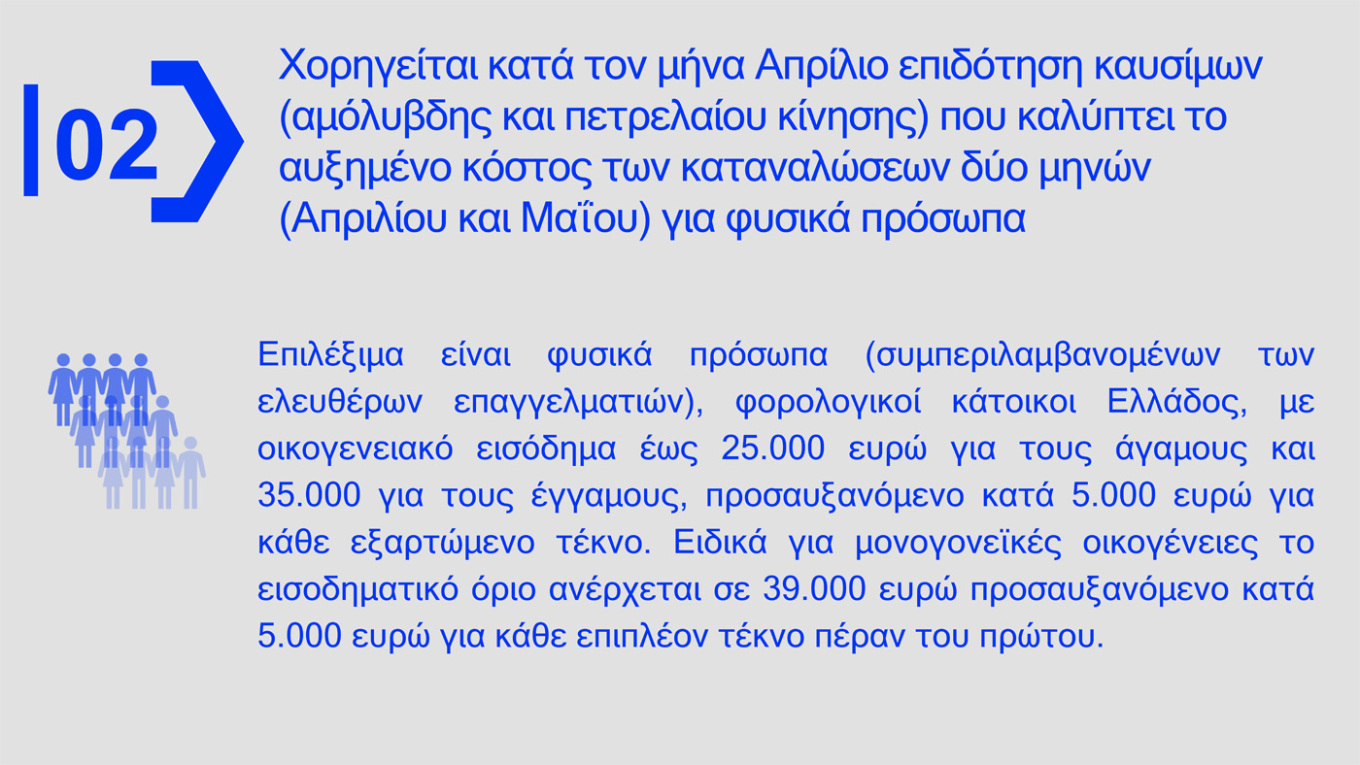
Eligible beneficiaries are individuals, including self-employed professionals, who are tax residents of Greece and have a family income of up to €25,000 for singles and up to €35,000 for married couples, increased by €5,000 for each dependent child. For single-parent families, the limit reaches €39,000, also increased by €5,000 for each additional child beyond the first.
The process is fully digital and is carried out through a platform on gov.gr, where the beneficiary declares the vehicle for which they apply for support and in which they must have full or partial ownership or a long-term lease agreement. A requirement is that the vehicle is in circulation, insured, and without outstanding road tax debts.
The support is provided via a digital card on the mobile phone, which functions like a debit card and can be used at fuel stations, public transport, and taxis. The amounts can even be spent in one go, for example on a full tank. For those who choose a bank deposit instead of the card, the amount is reduced by €10, which acts as an incentive for using the digital format.
The support is paid as a lump sum for the entire two-month period, with a single payment credited to the digital card and usable immediately. The amounts can be used within a specific period, estimated at around 3 to 4 months.
Specifically, the support amounts to €50 with a digital card and €40 via IBAN for mainland Greece, while for the islands it reaches €60 with the card and €50 without. For motorcycles, the amounts are €30 with a card and €25 without in mainland Greece, and €35 with a card and €30 without on the islands.
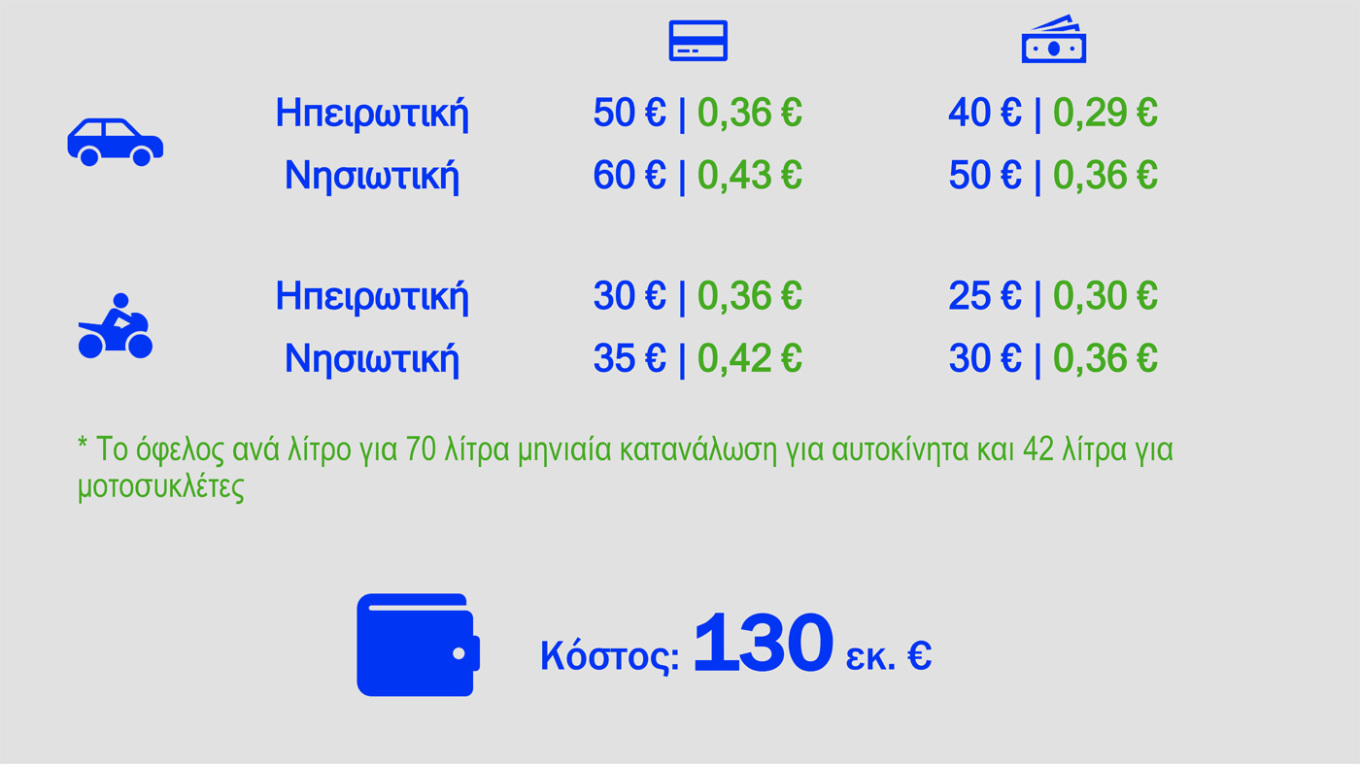
Based on an average consumption of 70 liters per month, the subsidy corresponds to approximately 36 cents per liter and essentially covers most of the increase recorded recently. Indicatively, when the price of unleaded rises from €1.75 to €2.10 per liter, the additional cost for a driver is about €25 per month, an amount that is essentially returned through the subsidy.
Why “Pass” and not tax reduction
Within the same framework, the government defends the choice of subsidies instead of a horizontal tax reduction. For diesel, it is noted that the discount at the pump has the same effect as a tax cut but is more flexible, as it can be adjusted depending on international prices.
In addition, the excise duty on diesel is already close to the minimum European limit, limiting the margin for further reduction, while under the current model the discount reaches about 20 cents per liter.
For gasoline, the economic team notes that a horizontal tax cut would be more costly and less targeted, as it would also benefit high-income individuals or tourists, whereas the Fuel Pass is directed at specific categories of citizens at a cost of about €130 million for the two-month period.
Responding to comparisons with other countries, such as Spain, it is argued that the relief per liter in Greece is similar or even higher, while also taking into account the size of the economy and fiscal margins.
Overall, the chosen direction is targeted and temporary interventions, so that support is provided without jeopardizing fiscal balance.
How the measures are allocated across transport, food, and tickets
The package of interventions is not limited only to direct support for households through the Fuel Pass but extends to key sectors of the economy, aiming to limit the spread of fuel price increases across the entire market.
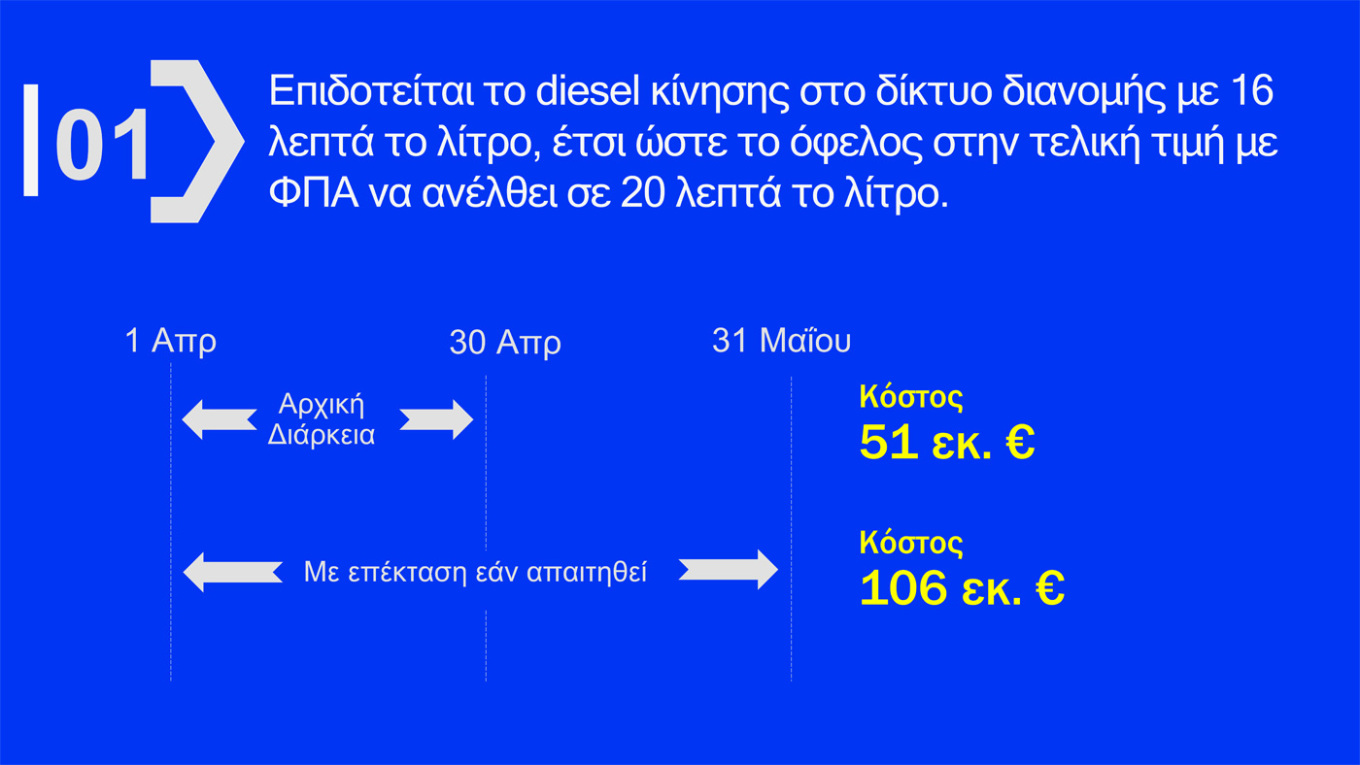
Second measure – Subsidy on diesel fuel: It directly targets the containment of costs in the supply chain and transport. Diesel is used in trucks, logistics, and agricultural machinery, thus affecting the cost of almost all products. The subsidy amounts to 16 cents per liter at the distribution network, corresponding to about a 20-cent final reduction at the pump including VAT. The goal is to limit the pass-through of increases to basic goods.
The discount is applied horizontally at the pump, without application and without income criteria, for all consumers.
The cost of the measure is estimated at €51 million for April and may reach €106 million if extended into May.
Continuation or adjustment of the measure will be reviewed at the end of April, depending on developments in international prices.
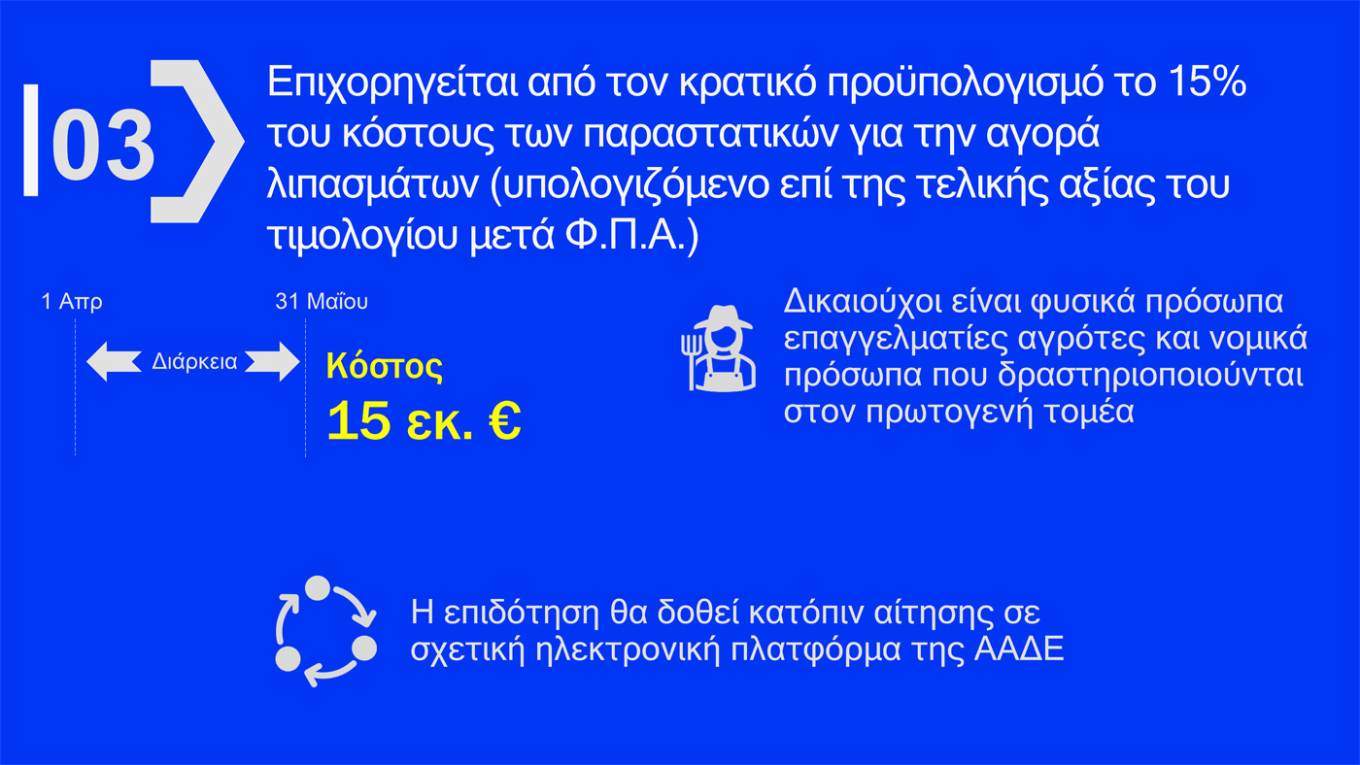
Third measure – Support for the primary sector: It provides a subsidy of 15% of the value of fertilizer purchase receipts for April and May.
The intervention aims to limit increased production costs in agriculture so that they are not passed on to food prices. The support will be granted upon application through an AADE platform and concerns both professional farmers and primary sector businesses. The total cost is estimated at €15 million.
Fourth measure – Intervention in ferry transport: It concerns compensation to ferry companies for mandatory discounts they already provide to passenger categories such as students, families, and people with disabilities.
This intervention aims to keep ticket prices stable for all passengers, especially ahead of the Easter period and increased demand. The fiscal cost is estimated at approximately €56 million annually.
How the measures are financed: “Surcharge” on online casinos
To finance the support package, the government turns to taxing online casino-type gambling (slots, online poker), increasing tax rates on players’ winnings.
Specifically, for winnings from €100 to €500, the tax rises to 20% from the current 15%, while for winnings above €500 it increases to 30% from 20%. For amounts up to €100, the tax-free regime remains.
The intervention concerns exclusively online casino-type games and not traditional games or betting shops, and is part of a broader effort to increase revenues from a sector with high profitability and strong growth in recent years.
According to estimates by the economic team, this change will generate about €100 million in additional annual revenue, strengthening fiscal space to support households and businesses.
The implementation of the measure starts on July 1, with revenues for 2026 estimated at around €50 million and reaching €100 million annually from 2027.
Currently, revenues from taxing players’ winnings are estimated at around €270 million, with a target of reaching €370 million after the rate increases.
The measure is permanent in nature, unlike fuel subsidies which are temporary, and acts as a key mechanism for boosting public revenues without directly burdening the entire body of taxpayers.
Ask me anything
Explore related questions




