





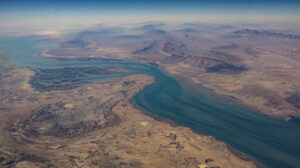
Iran and control over the Strait of Hormuz are once again at the center of the geopolitical and shipping equation, as the fragile ceasefire in the region is far from guaranteeing a return to normality. Tehran is not only maintaining control over vessel transit, but is also using it as leverage, directly linking it to developments on the Lebanese front and Israeli operations against Hezbollah.
According to the Financial Times, citing Iran’s Fars News Agency—which maintains close ties with the Revolutionary Guards—Tehran has reportedly once again halted the passage of tankers through the Strait of Hormuz in response to Israeli strikes in Lebanon. Although earlier the same day passage permits had been granted to two tankers, the agency noted that “simultaneously with Israeli attacks on Lebanon, transit through the Strait of Hormuz stopped.”
This development came just hours after the announcement of an agreement for a two-month ceasefire between the United States and Iran, which provided for a halt to U.S. strikes in exchange for the reopening of the Strait. However, a joint statement by the naval and air forces of the Revolutionary Guards made it clear that Iran intends to keep “its finger on the trigger” during negotiations.
At the same time, Israel is intensifying its operations in Lebanon, carrying out—according to the same sources—the strongest strikes since the start of the conflict with Hezbollah last month. More than 100 targets, including command centers, are said to have been hit in Beirut and southern Lebanon, further reinforcing the climate of uncertainty.
Within this environment, the reopening of the Strait does not amount to a full restoration of freedom of navigation, but rather a controlled and conditional process. As analysts point out, the ceasefire creates a limited “window” for movement without removing the underlying uncertainties.
Dimitris Roumeliotis, an analyst at Xclusiv Shipbrokers, estimates that the issue is not merely temporal but deeply political. Tehran has made it clear that transits will take place “in coordination with the Armed Forces,” effectively maintaining control. The pre-crisis regime of free passage has not been restored.
“The Strait of Hormuz is not just a maritime route for Iran, but one of its key negotiating tools,” Roumeliotis explains. “A full reopening without conditions would amount to relinquishing its strongest lever of pressure.” As a result, even if the ceasefire holds, a return to normality will be gradual and conditional.
At the same time, the shipping market remains on high alert. Ambrey Analytics estimates that the risk to navigation is reduced until April 22, but could change immediately, warning of ongoing risks for unauthorized transits or vessels linked to the U.S. and Israel. A similar stance is taken by international shipping bodies. The head of the Norwegian Shipowners’ Association, Knut Arild Hareide, stresses that “the situation remains unpredictable and it is not clear under what conditions safe passage can be ensured.” As he notes, companies will not resume routes without real security.
In the same vein, BIMCO points out that even the withdrawal of vessels from the Persian Gulf is not a simple matter, as it requires coordination with both the U.S. and Iran—otherwise, the risk increases significantly.
Meanwhile, analysts at Xeneta estimate that shipping companies will continue to act cautiously, maintaining alternative routes and carrying out only limited trial transits. The crisis has already displaced 250,000 TEU of weekly capacity, while congestion at ports in the Middle East and Asia remains severe. The cost of this instability is already visible: freight rates have surged, while uncertainty is spreading across the entire global supply chain. Overall, the picture that emerges is clear: the ceasefire is not a solution, but a temporary pause in a crisis where Iran retains control of the world’s most critical maritime chokepoint—and with it, a powerful geopolitical card it is unlikely to give up without substantial concessions.
Today, the situation remains extremely tight. Around 120 tankers carrying 130 million barrels of crude and 46 million barrels of refined products are stranded, while 1.3 million tonnes of LNG remain tied up. In total, more than 800 vessels of various types have been affected.
The critical question is whether the ceasefire window is sufficient. “The answer is mixed,” Roumeliotis notes. For vessels already inside or near the Gulf, the 15-day period may be enough for unloading or departure. However, for new charters, the timeframe is insufficient, as greater stability is required.
Ask me anything
Explore related questions




