





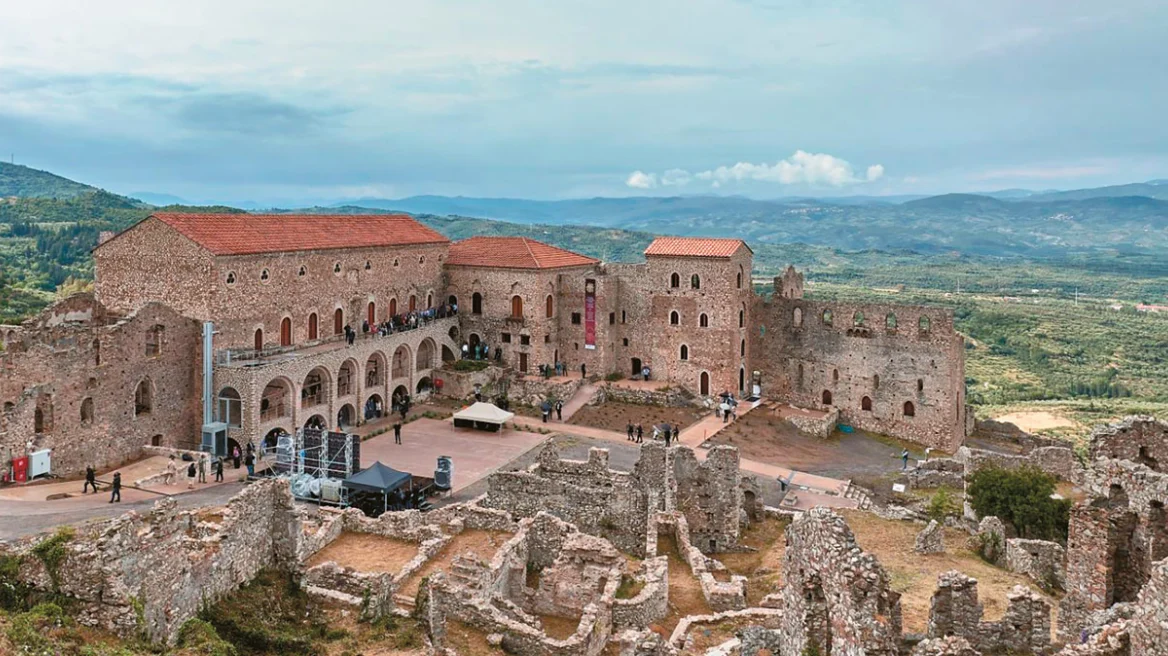
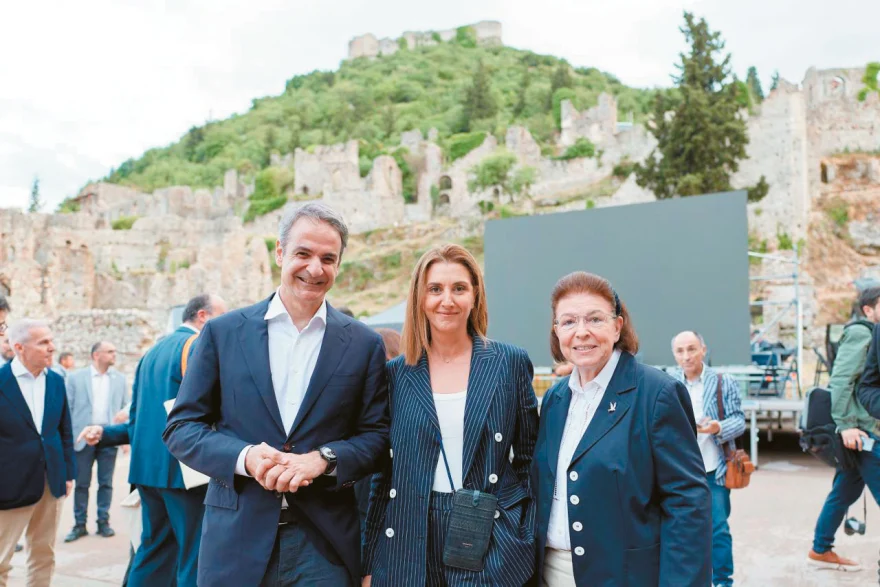
Minister of Culture Lina Mendoni highlighted Mystras’s reputation as “the miracle of the Morea” and its invaluable significance not only for the historical wealth of Greece but also for the roots of Western civilization during her celebratory speech inaugurating the now-restored, almost mythical town as a visitor-accessible monument and museum.
The observation that Mystras constitutes one of the most important and best-preserved examples of a Byzantine fortified settlement in Greece merely describes its present condition. Emphasizing the point while symbolically accepting, on behalf of the Greek people, the spectacularly restored settlement perched on the foothills of Mount Taygetus and struggling against decay for 777 years, Prime Minister Kyriakos Mitsotakis stressed that:
“Mystras is not only a World Heritage monument, but also the place where the twilight of Byzantium met the dawn of modern Greek identity. Here, in the 13th century, a dialogue opened between the past and the future. A dialogue that, in reality, never ceased. And we are here to ensure that it never will.”
As Ms. Mendoni recalled, in 1989 UNESCO recognized the Castle Town of Mystras as a World Heritage Site, further underscoring its significance as a Byzantine archaeological site—a material, built reminder that this corner of the Peloponnese once served as a major intellectual center, home to leading scholars such as the Neoplatonist George Gemistos Plethon, Bessarion, and others.
In this way, Mystras served as a source of cultural influence for centuries, contributing decisively to the transmission of Greek learning to the West and to the formation of the European Renaissance. In particular, the churches and monasteries of Mystras—religious buildings, many of them integrated into the town’s fortifications—are adorned with remarkable frescoes from the Palaiologan period, the final trial of Byzantium, spanning from 1261 until the final Fall of Constantinople in 1453.
The Donors and the Guardian Angel
Not coincidentally, Ms. Mendoni, owing to her long tenure as Secretary General of the Ministry of Culture, has followed every step of the highly complex, exceptionally delicate restoration project of Mystras, which lasted more than three decades. For this reason, it was particularly meaningful that the minister personally thanked a wide circle of people who contributed to the revival of the Castle Town, from archaeologists to local government officials who supported the project during its most difficult periods.
Among them, she expressed her gratitude to the monastic sisterhood of the Monastery of Pantanassa, whose nuns, with boundless patience and attention to detail, sewed and embroidered the garments of the emperor and the Byzantine nobility.
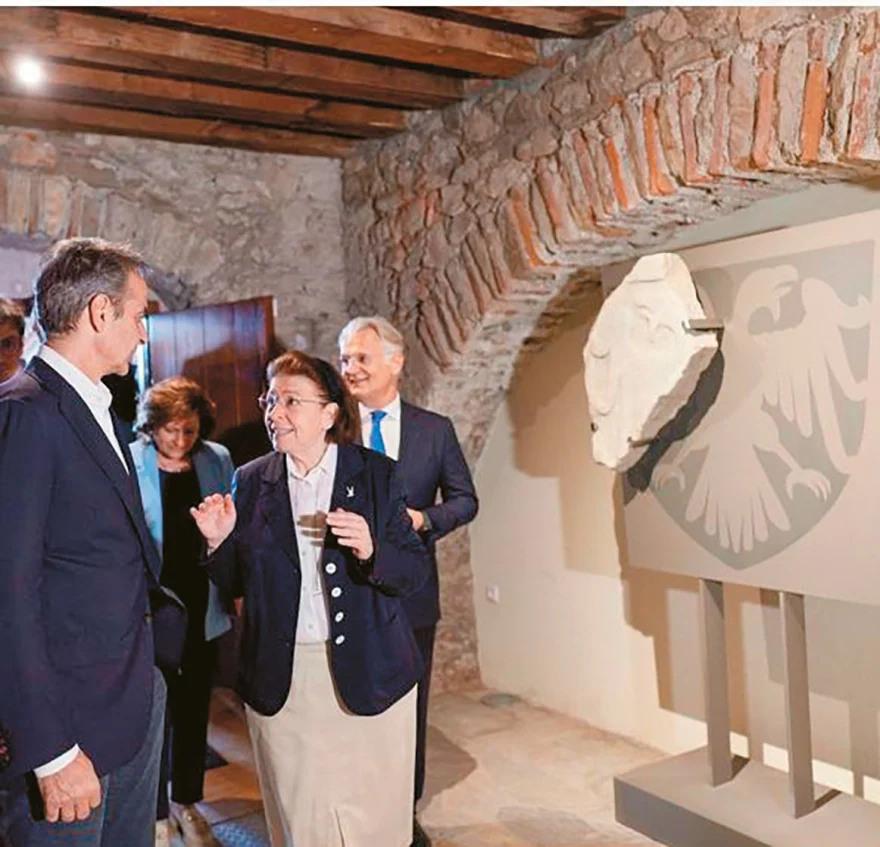
“The exhibition in the Throne Hall would not have been realized without the generous donation of Thanasis and Marina Martinos, who always support the work of the Ministry of Culture,” the minister stated, emphasizing that “the area surrounding the Castle Town of Mystras was cared for by the Athanasios C. Laskaridis Charitable Foundation through the ‘Kyklon’ program, which removed large quantities of useless materials. I thank Thanasis and Effie Laskaridis for their consistently positive response to every request.”
Although absent from the inauguration ceremony, Professor Stefanos Sinos, Professor of Architecture at the National Technical University of Athens and Chairman of the Committee for the Restoration of the Monuments of Mystras, was present in spirit. For 31 years, he was the driving force behind the restoration effort together with a team of collaborators.
Speaking to Proto Thema, Mr. Sinos attempted to condense his experience from the 31 years he spent at Mystras, from 1984 to 2015, studying, touching, and restoring literally every stone and fragment of the ruins of the once-glorious Castle Town, especially its famous Palace.
“In 1984 our committee found only two craftsmen at Mystras, both of advanced age,” Professor Sinos recalls.
“Until 1990 funding for the project was limited, and the permanent staff consisted of no more than ten skilled workers and three scientists. Systematic funding began in 1990, with resources coming from the European Union through programs administered by the Region of Peloponnese. As a result, our service expanded to twenty-five skilled workers and five scientists. From then on, the project progressed at a satisfactory pace.
“However, many of the residential buildings, as well as the Palace, were in a ruinous condition. I would say that the overall appearance of the Palace in 1984 was essentially nothing more than a few walls and some rubble. Yet the entire complex retained its fundamental characteristics, and that was extremely important.
“We proceeded with extensive excavation and clearing of the site, a study of the complex and its individual elements, detailed survey drawings, and a restoration plan.”
Regarding the support he received from the Greek state, the professor notes that Constantine Karamanlis, as President of the Republic, showed strong interest in the project.
“Karamanlis conveyed his views on Mystras to the then Minister of Culture Melina Mercouri, and he personally supported the project with 6 million drachmas from the Presidency’s remaining budget for 1984. Another 10 million were provided the following year from the same source. The funds were transferred from the Presidency to the Archaeological Society of Athens, which in turn financed the fieldwork.
“But Mercouri, thanks to her directness and dynamism, solved many of our problems. Melina told us that, for her, ‘Mystras is the Acropolis of Byzantine Greece.’ If Melina Mercouri had not believed in the project, we would not have been able to continue.”
Like a Magnet
The story of the restoration of the Palace at Mystras is presented in full detail in Professor Sinos’s substantial volume The Late Byzantine Palace of Mistras and Its Restoration (published in English by Kapon Editions).
The lavishly illustrated work presents the history of the Byzantine Palace of Mystras, a 13th-century palace building that was later expanded to serve as the seat of the Byzantine governors of the region. From the mid-14th century onward, the Palace became the residence of the Despots of Mystras, around which trade and scholarship flourished dramatically.
Unfortunately, however, this was destined to be the final flowering of Byzantine civilization.
The Palace reached its final form in the early 15th century through large-scale interventions, before being abandoned to its fate from the 18th century onward, essentially until the first decades of the 20th century. It was then that the ruins of Mystras attracted the attention of Anastasios Orlandos, a pioneer of modern Greek archaeology.
His work was taken up by Professor Sinos and his collaborators from 1984 onward. Consequently, the professor’s book includes extensive supplementary material on the history and political and cultural origins of Mystras, while also testifying that those involved in the restoration project fell under the spell of the Castle Town’s magical allure, binding all who approached it to a lifelong relationship of exclusive devotion.
Highlighting some of the curiosities among the countless details of the restoration effort, Professor Sinos notes, for example, that during the Byzantine era the palace complex possessed a primitive earthquake-protection system consisting of wooden tie beams embedded in the middle of each wall regardless of orientation.
Another unusual aspect was that restoration crews had to wait years before locating suitable tree trunks for reconstructing the palace roof.
“The material and dimensions—especially the cross-sections of the timber—had to match those originally used,” the professor explains. “In the end, we found the trunks we needed on Mount Athos.”
The story of Mystras begins in 1249, forty-five years after the armies of the Fourth Crusade captured Constantinople. At that time, William II of Villehardouin, the third Frankish ruler of Achaea, built a fortress on a hill of Mount Taygetus to protect the Eurotas Valley, which was under constant threat from Slavic tribes such as the Melingoi who raided from the mountains.
As the Chronicle of the Morea records, the hill was called “Myzithras,” a place-name that, according to one theory, eventually evolved through linguistic changes into “Mystras.”
There is, however, an alternative theory regarding the origin of the name. Some kind of settlement may already have existed in the area of the future Palace during the Roman period, and it is possible—indeed more likely—that Mystras derived its name from the Latin mistrum (“trowel”), indicating a place associated with quarries and builders.
In 1262, following his defeat and capture at the Battle of Pelagonia in Macedonia, Villehardouin was compelled to surrender Mystras to the Byzantine Emperor Michael VIII Palaiologos.
Over the next two centuries, Mystras developed into a major Byzantine city, dominating politically and economically all Byzantine territories in the Peloponnese and becoming the capital of the Despotate of Mystras. Until Ibrahim Pasha swept through the Peloponnese, Mystras lived its own largely prosperous life as the seat of supreme authority in the region.
The Exhibitions
Undoubtedly, the jewel in the stone crown of Mystras is the Palace of the Despots, and above all its mesmerizing Throne Hall.
According to the Minister of Culture at the inauguration ceremony:
“The Kantakouzenos and Palaiologos wings, the administrative, residential, and ceremonial spaces, together with the imposing Throne Hall, form an exceptional architectural ensemble that reflects both the functional hierarchy of power and the daily life of the late Byzantine aristocracy.
“Within this framework are presented the permanent physical exhibition Princely Narratives and the digital exhibition In the Princess’s Palaces, the latter illuminating through archival material the evolving perception of Mystras by European intellectuals. There is also another exhibition entitled In the Light of the Court: An Image of Glorious Attire, installed in the Throne Hall, showcasing handmade garments inspired by Byzantine iconography.”
In practical terms, a unique monument, rich in symbolism and historical significance, has just been added to the list of completed projects of the Ministry of Culture.
And certainly, Mystras now rightfully takes its place among the most compelling destinations for Greek and international visitors alike in the immediate future—with a mark of the highest priority.
Ask me anything
Explore related questions




