






A series of major road projects and interventions is set to put an end to the hardship of millions of drivers and other citizens who spend endless hours stuck in traffic jams in Athens. The government has decided to immediately push forward—starting in the coming days—the projects that will decongest Attica’s major road axes, aiming for some of the roads to be delivered even within the current year, offering relief to the city’s traffic problem.
“The traffic problem in Attica cannot be solved with just one project,” says Minister of Infrastructure and Transport Christos Dimas, who announced a series of projects such as Metro Line 4, as well as the reconstruction of the Metamorfosi interchange on the Attiki Odos motorway.
The interchange project is not only set to start in the very near future, but is also scheduled to be completed within the current year. It is expected to be a project of limited disruption and high effectiveness, becoming a model for years to come.
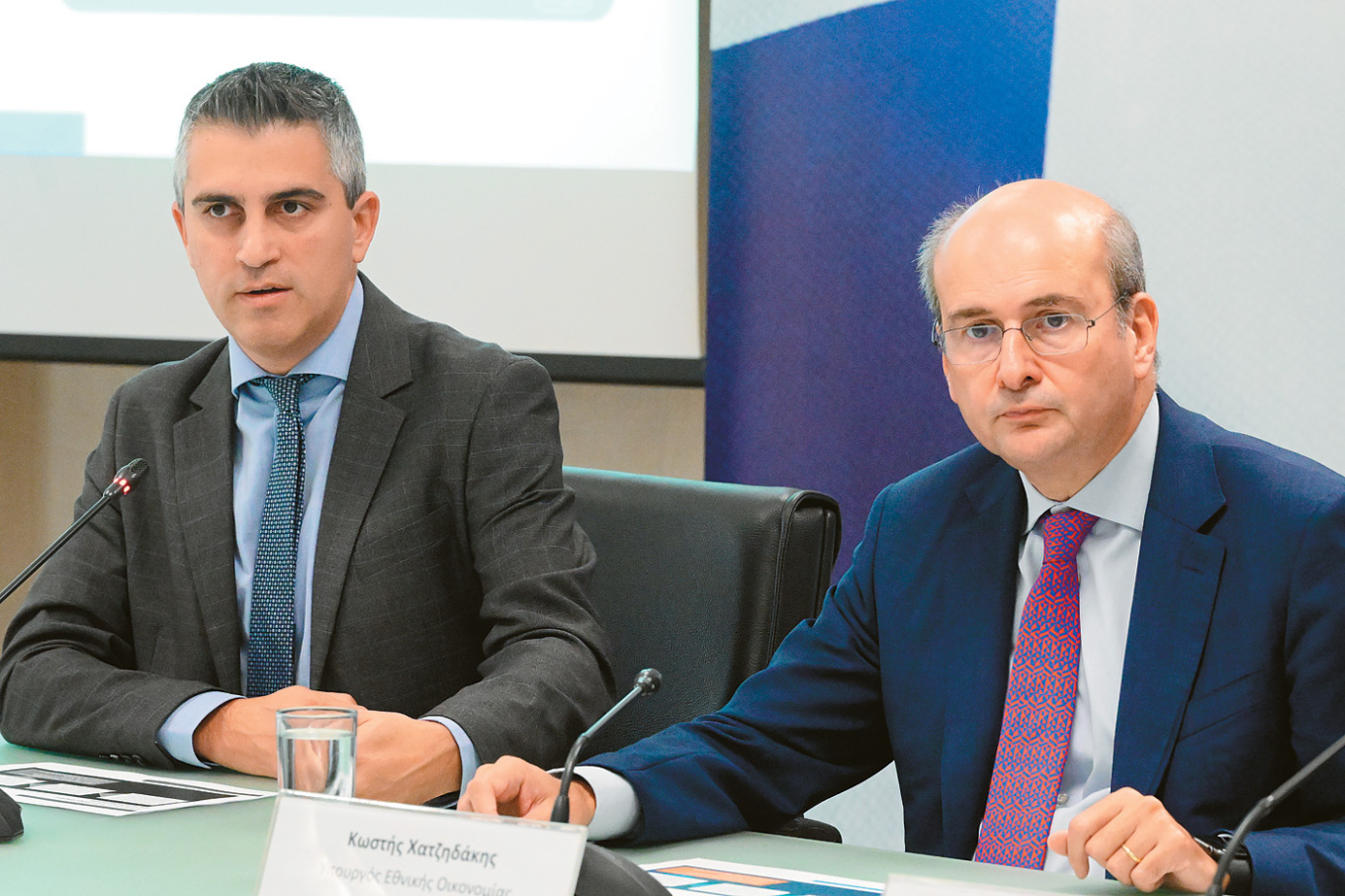
The Deputy Prime Minister Kostis Hatzidakis and Minister of Infrastructure and Transport Christos Dimas are driving the interventions to improve the capital’s traffic problem
In general, construction machinery is set to start working to provide relief and solutions to Attica’s traffic congestion and to facilitate drivers’ daily lives. Thus, by the end of the current month, the major Skaramagkas interchange project is expected to begin, while in the immediately following period the Oinofyta–Elefsina road interchange project will also start, which will absorb heavy vehicle traffic, along with the extensions of Attiki Odos in southern Attica, which is expected to come under increased pressure due to the Ellinikon project.
Bypass of Kifisos
Further arrangements are also expected regarding the coordination of ship arrival schedules, heavy vehicle movements, and logistics timing so they do not coincide with peak traffic in the capital. By the end of June, the government plans to finalize the contract for the Skaramagkas triple interchange. It will then pass through the Court of Audit and construction will begin, with a completion horizon of three years.
The triple interchange includes the construction of the Schistos, shipyards, and Skaramagkas interchanges, as well as the simultaneous completion of the Western Egaleo Peripheral Road. The latter, which connects with Athinon Avenue and Schistos Avenue, is almost complete, with only a segment of less than 1.5 km remaining.
But why is this so important? Because it answers… the prayers of drivers stuck in traffic who wish there were an alternative route to avoid congestion on Kifisos—or at least to magically shift heavy vehicles that worsen the situation.
The project is considered of utmost importance for decongesting Attica, as it concerns the country’s largest road axis, Kifisos, which is congested daily and rapidly transmits traffic problems across the entire road network of Attica. A typical example is Attiki Odos, where drivers try to escape congestion, creating unexpected delays that spread further across the network.
At the junction of Athinon–Korinthos national road with Schistos Avenue, where the triple interchange will be built, more than 130,000 vehicles pass daily, many of them trucks. The plan proposed by experts and implemented by the government aims for the triple interchange to channel heavy traffic through Skaramagkas, significantly reducing truck passage through Kifisos and surrounding areas.
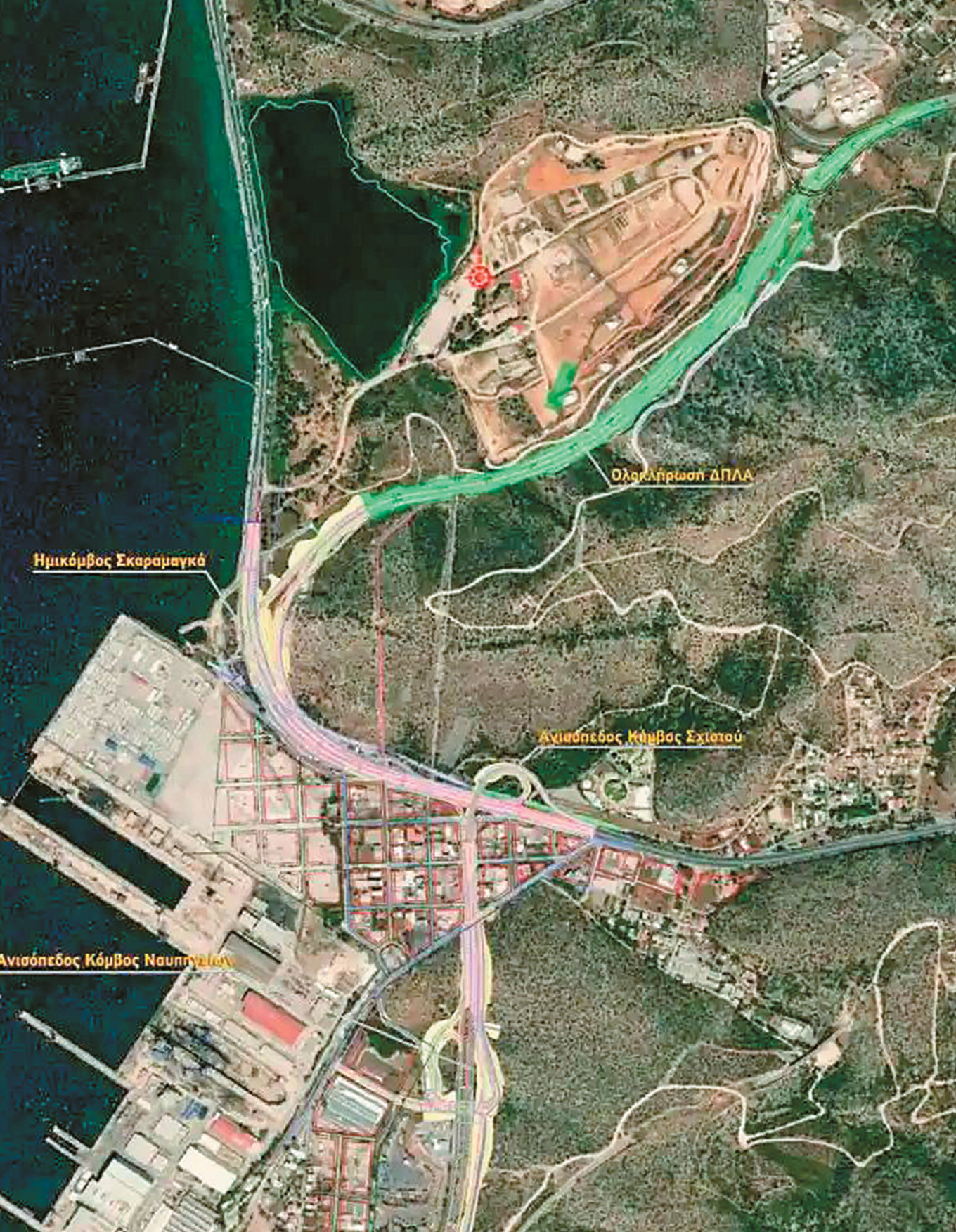
Map of the three interchanges in Skaramagkas
The project, with a budget of €70 million and a provisional contractor consortium METKA–Domiki Kriti, is expected to be contracted by the end of the month and completed in about three years. Once finished, it will create a new “anti-Kifisos”—a parallel alternative corridor connecting Schistos Avenue with the Western Egaleo Peripheral Road, redirecting most traffic, especially heavy vehicles, to and from Piraeus.
It also foresees the removal of one of the most hated traffic lights in western Attica at Skaramagkas, and the addition of a new lane on the Schistos bridge, eliminating delays. Broader interventions are also planned on the Athens–Korinthos national road (from Haidari to Skaramagkas).
The project includes:
■ Skaramagkas grade-separated interchange: a mini-interchange directly linking the Western Egaleo Peripheral Road with the Athens–Korinthos national road and Schistos Avenue.
■ New upgraded Schistos interchange: reconstruction of the existing bridge and construction of a second overpass for traffic from Athens towards Schistos.
■ New shipyards interchange: a completely new grade-separated interchange at the Schistos–Palaska junction, replacing one of the most problematic signalized intersections in the country.
Additional optional works include a new interchange in Aspropyrgos connecting the Egaleo ring road with the national highway. The ministry expects the project to form a continuous corridor relieving Kifisos and reducing heavy vehicle load.
Logistics are also a key issue: experts note that more than 20,000 daily truck movements linked to ports and industrial zones contribute heavily to congestion. Trucks serving Piraeus and industrial areas (Elefsina, Thriasio, Aspropyrgos) account for a disproportionate share of traffic on Kifisos.
According to the Association of Greek Transport Engineers, congestion on Kifisos causes an estimated €90 million annual economic loss, with drivers losing over 14–15 million hours annually in traffic.
Relief for Attiki Odos
The Metamorfosi interchange project—where Attiki Odos meets the Athens–Lamia national road—is also being upgraded. The current merge of two major traffic streams without separation causes severe bottlenecks, with delays reaching up to one hour during peak times.
The project will create a double exit system, separating flows from the airport and Elefsina, aiming to cut delays by up to 50% during peak hours. The new exit will improve traffic flow not only on Attiki Odos but also on the national highway.
New freight corridor
A major long-term project is the Elefsina–Oinofyta road axis, a new motorway designed to bypass Kifisos entirely, redirecting freight traffic away from Athens. With an estimated cost of around €1 billion and 40 km in length, it is proposed as a full “bypass” of the capital’s congested corridor.
Extensions of Attiki Odos towards Vouliagmeni, Rafina, and Lavrio are also planned, along with tunnels and new connections aimed at redistributing traffic flows across the wider Attica basin.
Proposals and PPPs
To accelerate implementation, the government is using “standard proposals” and public–private partnerships (PPPs). These mechanisms allow private consortia to propose and finance major infrastructure projects, helping overcome funding limitations as EU resources increasingly focus on less developed regions.
If approved, such projects can unlock major infrastructure investments and gradually reshape the road network of Attica, easing congestion on Kifisos and across the wider metropolitan area.
Ask me anything
Explore related questions




